
Pepper spray: legal to buy, risky to carry in Spain
Approved self-defence spray is legal to buy in gun shops in Spain, but it can be confiscated at police checks with fines of 300 euros. The law does not ban it, but neither does it…
English · Original discussion in Spanish · Published
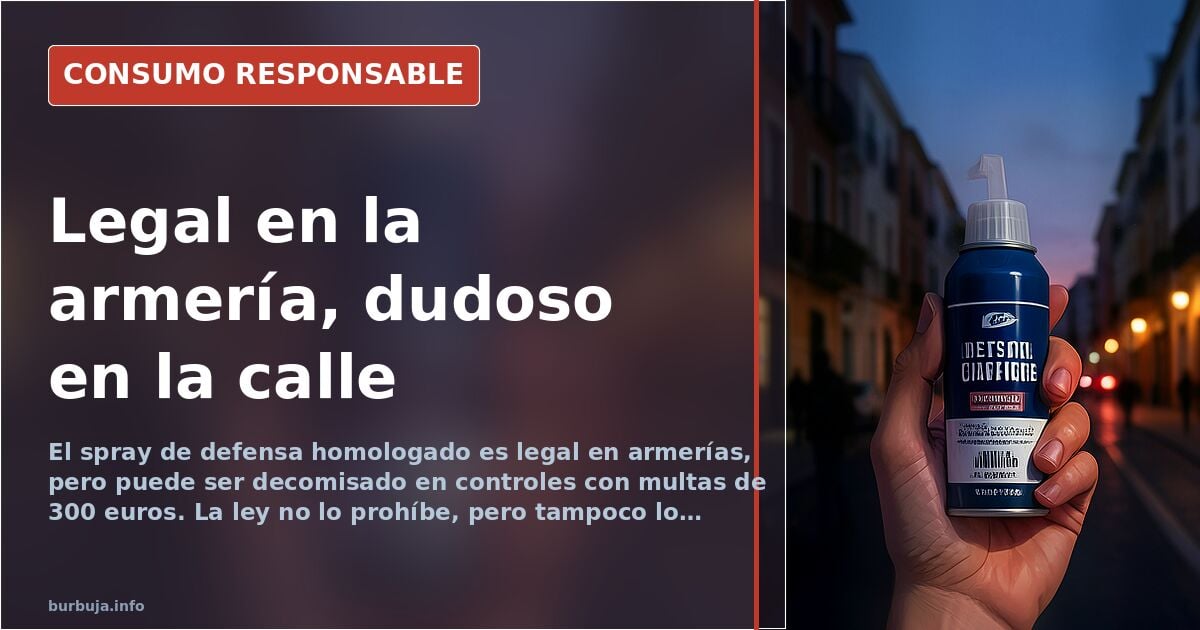
Pepper spray: legal to buy, risky to carry in Spain
Self-defence spray is sold in Spanish gun shops with a health seal and official approval. And that is where the trouble starts. Because the same can that leaves the counter legally can end up confiscated at a Guardia Civil (Spanish paramilitary police) checkpoint, with a 300-euro fine thrown in, according to the stories circulating about this product. The question many people ask when buying it —is it legal to own pepper spray for self-defence?— has an uncomfortable answer: it depends on the place, the moment and the officer who stops you.
The Weapons Regulation, approved by Royal Decree 137/1993, prohibits in its article 5 personal defence sprays and any device that projects gases or aerosols. Immediately afterwards, the same article excepts specifically authorised models. In other words: the law does not say "yes" or "no", it says "it depends on the model". A nuance that in practice becomes a maze for the citizen who just wants a can, just in case.
What the law says about self-defence spray
The rule distinguishes between approved spray —the kind bearing the Ministry's seal and sold in gun shops— and everything else. The first is legal to buy. The second is not. So far, reasonable. The problem arises when that legal object changes status depending on where you carry it: at home, in the car, at a crowd gathering or in a nightclub. Some argue that in these contexts the police can seize it even if the model is authorised, relying on the officer's presumption of truthfulness. And there the buyer is left without arguments.
The experiences people recount go along those lines. A check on the way to a festival ended with the spray confiscated and a 300-euro fine. Another patrol, coming back from a night out, simply seized it. In both cases the can was the approved model. The official explanation, when there is one, appeals to the concentration of people or to potential use. The practical result is the same: the citizen loses the product and, sometimes, pays.
The debate on self-defence in Spain
The underlying issue is not the pepper can but legitimate self-defence. Spanish law requires proportionality between the aggression and the response. It is not enough that you were attacked: you have to prove that the attack justified the means used. And proving that, in a courtroom, is another story. Part of the analysis holds that the system protects the aggressor more than the victim; the other side reminds us that proportionality is a safeguard against revenge disguised as defence.
The spray is presented as an intermediate alternative. It is not a lethal weapon, it leaves no permanent damage and it allows you to neutralise and flee. Compared with an iron bar or a baseball bat, which can kill if the blow lands badly, the irritant aerosol offers a margin. That is the argument of those who defend it as a tool for responsible use. The objection is that the effect is not always immediate and that wind or distance can work against you. None of this is new, but it is worth being clear about before entrusting your safety to a twenty-euro can.
Where you can carry pepper spray
The short answer: at home, no problem. In the car, with caveats. On the street, depending on the context. At a crowded event or a nightlife venue, better not. The logic is that the spray is a legal object whose possession becomes suspicious when the circumstances suggest it is going to be used. And that suspicion is decided by the officer. There is no official list of "prohibited places" to consult before going out.
The advice that keeps coming up is to keep the receipt or the barcode to prove the purchase was legal. If it is confiscated, claim its return at the Government Delegation (Spanish state's regional office). And above all, do not confuse the approved spray with the kind bought in Andorra or online without a seal: that one is illegal, no two ways about it.
Alternatives and precautions
The aerosol is not the only option. Some people go for high-powered torches to dazzle, or household items that raise no suspicion. Hairspray or deodorant are mentioned as poor substitutes: the effect lasts seconds and does not incapacitate. Pepper spray, if it is the right model and used from a distance, buys minutes. Enough to run away, which is the realistic goal.
The basic precaution is not to spray in enclosed spaces: the aerosol expands and affects the user too. And do not entrust everything to an object. Self-defence starts with avoiding the situation.
Is it worth carrying? It depends on how much you value peace of mind against the risk of a fine. The law does not ban it, but neither does it bless it. And in Spain, sometimes, that amounts to saying it depends on the day.
Summary of a discussion on Burbuja.info - Foro de economía, actualidad y política., translated from Spanish and reviewed before publication. Read the full discussion (50 replies).
More summaries
-
Spanish hotels send guest ID data to police nightly
Hotels in Spain must report guest identities to the National Police every night. The legal basis and the debate over its effectiveness.
-
Gun Ownership in Spain: Licenses, Requirements and Legal Reality
Obtaining a gun license in Spain involves months of bureaucracy, exams and safe installation. Even with full compliance, the Guardia Civil can deny it.
-
Grilled squid with gelatin: delicacy or poor cleaning?
Grilled squid can contain gelatin inside: for some it's a market delicacy, for others proof that nobody cleaned it.
-
Elon Musk’s appearance sparks debate: does the founder’s body matter?
Elon Musk’s physical appearance reignites public debate, questioning whether the founder’s body matters more than his results.
-
Aldi's metal detector: €50 and finds since 2017
Aldi's metal detector costs €50 and since 2017 has produced finds, junk and even a fine for heritage looting. Here's what people really dig up.
-
Pepephone: Vodafone coverage and no lock-in, the way out
Pepephone customers confirm Vodafone coverage, zero lock-in and savings of 60% to 70% versus Movistar or Yoigo. The catch is in the data rates.