
Pedro Sánchez's €88 Joma Parka at Davos Sells Out
The Joma Islandia III parka, costing €88, is nearly out of stock after Spanish Prime Minister Pedro Sánchez wore it to the World Economic Forum in Davos.
English · Original discussion in Spanish · Published
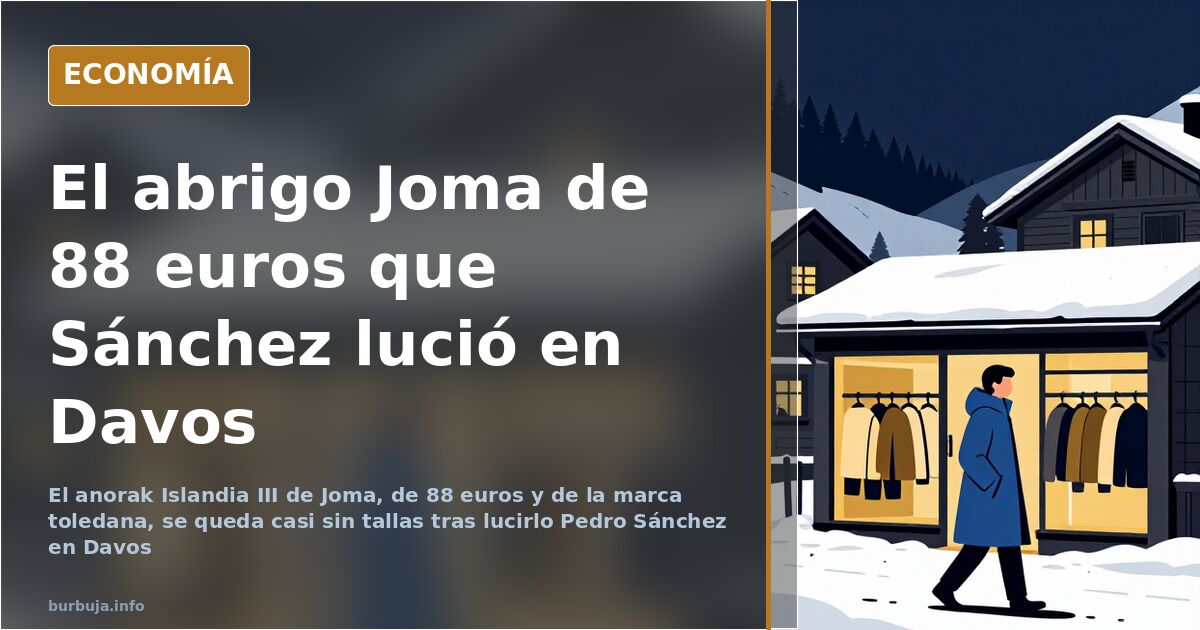
The €88 Joma parka worn by Sánchez in Davos
Davos, zero degrees, and a prime minister stepping out of a car in a black polyamide anorak. On the chest, a slanted white J; on the label, a reference anyone can buy: 101697.100. Pedro Sánchez thus arrived at his meeting with Cisco CEO Chuck Robbins, accompanied by the Minister for Digital Transformation and Public Function, José Luis Escrivá. The coat is the Joma Islandia III, costs €88 on the brand's online store, and as of this discussion, was nearly sold out in all sizes.
The scene occurs where unbranded Loro Piana and five-figure down jackets are expected. Hence the noise. Gesture of austerity, wardrobe clumsiness, or precise marketing?
What is the Joma Islandia III parka and how much does it cost?
It is a 3/4 cut anorak, down-style, with a zipper and buttons, hood, elastic cuffs, and exterior and interior pockets. It is lined with polar fabric, is windproof and waterproof, and its construction is 100% polyamide. On Joma's online store, it appears under reference 101697.100 with a price of €88, a figure that places it in the antipodes of the garments seen at that summit.
The commercial effect, in any case, is already achieved. There is no campaign, no ambassador, and no discount: a short shot in the right place suffices.
From eight employees in Portillo de Toledo to 120 countries
The brand was born in 1965 in Portillo de Toledo, a town of about two thousand inhabitants, with eight employees and a founder, Fructuoso López, who remains president. Four years later, it installed its first assembly line, built a 500 m² factory, and employed twenty people. In the eighties, the 2,000 m² plant arrived, the staff rose to 70, and the company debuted at the ISPO fair in Munich. In 1987, it developed a new suspension system for its boots and signed its first two sponsorships: Martín Vázquez and Francisco.
Then came Butragueño, Txiki Beguiristáin, Fermín Cacho's gold medal in the 1,500 meters at Barcelona 92, and leadership in soccer boot sales. The third factory, the current headquarters, occupies 65,000 m² and grew from 300 employees. Today, the firm is present in more than 120 countries, maintains ten subsidiaries —Spain, Italy, the United States, the United Kingdom, Germany, Mexico, Norway, Denmark, China, and Russia— and presents itself as the first Spanish sports brand. At Rio 2016, it clothed 10% of Olympic athletes.
Attending a summit in polyamide: the wardrobe reproach
The most repeated reproach is not against the brand, but against the combination. Formal suit, synthetic technical coat: in the judgment of many comments, the result clashes. The argument is that if one wants to promote Spanish product, a custom-made wool coat from a tailor would serve better, and that the chosen garment has an anonymous design that without a logo would pass as generic.
In response, it is argued that most padded jackets seen on the street have synthetic filling, that quality down warms almost as effectively as antiestéticathers, and that it can get wet without clumping. It is also recalled that, with an expensive wool coat, the criticism would have been the opposite. The discussion, in essence, is about what is considered serious in the eyes of others.
The gift of sneakers to Madrid and the Davos showcase
There is a preceding episode that fits poorly with improvisation. During the pandemic, the Madrid City Half Marathon, sponsored by Joma, was canceled, and the firm distributed 600 pairs of sneakers to healthcare workers in hospitals in the Community of Madrid. One participant recalls that the regional president posed with them. It was not the first time the brand placed product where it is watched.
Hence, part of the analysis suspects a studied operation. A widely shared post added €54,293 to the price of the garment, without any breakdown. Others argue that Joma buys standardized garments, adds a logo, and sells them, and that the same parka can be found unbranded for a few euros. The company, in its corporate memory, states the opposite: it invests in product and technology rather than advertising because its products must be its best commercial strategy.
What remains when the coat sells out
The measurable result is a spike in demand for an €88 anorak and a Toledo-based brand with sixty years of history placed in all conversations. Whether it was intuition, calculation, or simple coincidence, the available material does not allow closing the case. And that is exactly where the analysis gets stuck: no one can prove the intent, but the showcase is already paid for.
Also available in: Deutsch
Summary of a discussion on Burbuja.info - Foro de economía, actualidad y política., translated from Spanish and reviewed before publication. Read the full discussion (326 replies).
More summaries
-
Spain's Immigration Quota Debate Sparked by Sánchez Family History
Analysis of Pedro Sánchez's grandfather's migration story, highlighting chronological inconsistencies and debates on immigration policy.
-
Overseas Voters Now Outnumber Residents in 123 Spanish Towns
The CERA registry exceeds local populations in 123 municipalities and doubles them in 21, driven by the 'Grandchildren Law' reshaping Spain's electoral map.
-
Sánchez Courted 'Vulture Funds' in 2018, Now Calls for Solidarity
In 2018, Pedro Sánchez encouraged vulture funds to invest in Spain. Now, his government urges landlords to show solidarity and lower rents.
-
Saudi green hydrogen megaplant: 600 tonnes a day
Saudi Arabia is building a megaplant producing 600 tonnes of green hydrogen a day. Real efficiency, desalination and the emissions-trading business.
-
PP's social media manager: from backup of the backup to electoral weapon
The PP's community manager went from being the backup of the backup to running the party's digital strategy at Génova, using irony and jabs at the left during the 29-N campaign in Spain.
-
Universal basic income gains ground: from New Zealand to the Marshall Islands
New Zealand proposes a $19,400 income, Yang pays for your data, and Musk announces the end of money by 2036.