
Paris migrant camp: identical tents fuel suspicion of organised operation
Hundreds of migrants are camping at Place du Palais Royal in Paris seeking refugee status, amid suspicion that the operation is being financed by an outside party.
English · Original discussion in Spanish · Published
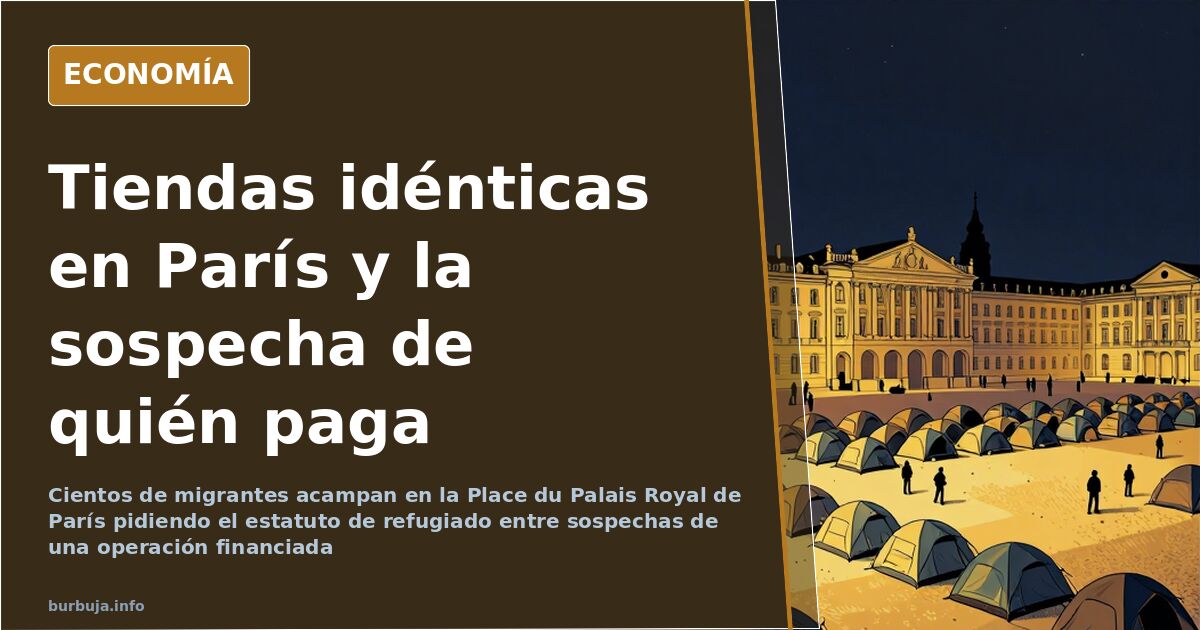
Identical tents in Paris: suspicion of an orchestrated operation
Hundreds of people are camping at Place du Palais Royal in Paris requesting refugee status, according to an image shared on social media that has put the issue on the table. What has sparked the conversation is not the camp itself, but a detail visible in the photograph: the tents are new and practically identical to one another. One image, one camp and an uncomfortable question: if the material is the same for everyone, who bought it and with what money was it paid for? As of the date of this discussion, no documented evidence supports the hypothesis of a financed operation. Nor is there an official count that disproves it.
What is known about the camp at Place du Palais Royal
What is available is little and it is best not to dress it up. The information is limited to the image shared and the description that accompanies it: hundreds of people camped in central Paris and one specific demand, refugee status. There is no official count, no identification of nationalities and no confirmation of how long they have been installed or who has allowed the camp.
That absence of data is, in itself, part of the issue. When there are no verifiable figures, everyone interprets what they see. And what is seen are rows of orderly tents, which pushes the reading towards logistics rather than improvisation. The discussion, therefore, has stopped revolving around why these people are seeking asylum and focused instead on how the camp has appeared.
Who is paying for the identical tents?
In a spontaneous camp, material arrives scattered: different models, different colours, tents from different homes. When the whole lot looks like it came out of the same box, the most obvious explanation is a bulk purchase. An organisation buys hundreds of identical units at volume price and hands them out.
The suspicion dominating the analysis is exactly that: that behind it there is not a sum of individual initiatives but a structure. Some maintain that humanitarian organisations buy in batches and that distribution is done by volunteers; against that weighs a reasonable argument: organised aid requires a certain homogeneity, and buying identical tents proves nothing on its own. The verifiable fact remains, for now, the uniform appearance of the material.
The business attributed to NGOs
Another line of analysis points to money. It is argued that these organisations are funded by public funds and by tax deductions from collaborating companies, and that this circuit turns the emergency into a sector with payrolls. According to this reading, the camp would not be a problem for the entities that attend to it, but a part of their activity and, therefore, of their budget.
It is worth separating fact from suspicion. Some take for granted that subsidies and tax relief exist for the third sector; that this explains the presence of identical tents in a Paris square is, in any case, a hypothesis without public verification. Nothing in the available information allows that circle to be closed, and anyone who closes it will be adding what is missing.
The profile of those handing out the tents
Several participants have described, as an impression, that a good part of the people helping at the camp are young women. On that detail a hostile reading has been built that attributes to the volunteers an intention that the photograph cannot demonstrate: from the identity of those distributing the material no conclusion about the camp can be deduced.
The accusation in circulation —that the aid is part of the problem— remains, for now, opinion. It is a current of analysis based on impressions about who helps and not on data about who finances, who authorises or who decides.
The testimony of demographic change in France
Among the more personal arguments appears the memory of someone who lived in France between 1995 and 1997 and travelled daily on commuter trains, journeys of thirty or forty minutes, on which he was sometimes the only passenger of European appearance in the carriage. It is a subjective recollection, not a statistic, but it is used as proof of a transformation that would have been underway for decades.
The segarro projection circulating in the opposite direction —let everyone come and move to Africa, turned into a world power in thirty years— closes the lighter section of the discussion. Humour aside, the substance is the same: there is agreement that something has changed and total disagreement on when it began and where it is heading.
The logistical detail nobody thought of
The practical curiosity remains. The tents that appear in the photograph fold with a ring-and-compression system that requires some skill. Seeing hundreds of people folding at once, when the camp ends, is a scene more than one would pay to see. Operations are also made of these small things: not only who pays, but who packs up.
If the identical tents are the trace of something organised, the signature is missing. If they are not, it remains to be explained why they look like they came out of the same warehouse. With the available data, neither question has an answer. And the camp is still there.
Also available in: Deutsch
Summary of a discussion on Burbuja.info - Foro de economía, actualidad y política., translated from Spanish and reviewed before publication. Read the full discussion (104 replies).
More summaries
-
France's Immigration Divide: Paris vs. the Provinces
The rift between Paris and rural France, plus the exodus of French citizens moving to Spain.
-
Spain tops list of destinations for French-born residents
Spain hosts the largest number of French-born residents, amid speculation about a wave of migrants fleeing insecurity.
-
Unverified Claim of French Airstrike in Niger Sparks Migration Fears
A viral post claims France bombed Niger and freed jihadists. No evidence exists, but concerns about a migration surge grow.
-
Norwegian IQ Test: The Flaw in Measuring Cognitive Ability
Analysis of Norwegian IQ test results: Is intelligence measurable with patterns or is it a statistical fallacy?
-
£28 billion scandal: British public funds ended up with terrorists
A secret report reveals that £28 billion of British public money went to terrorists and hostile states between 2015 and 2021, according to The Telegraph.
-
Second-hand housing in Spain jumps 13.5%, pushing overall prices up
Second-hand housing in Spain is up 13.5%, its biggest rise in 19 years, lifting overall prices by 12.9%. Every region is growing at double-digit rates.