
Palestinian sheep stoned to death at Samu'a, complaint alleges
Private security cameras show sheep stoned to death in a barn near Samu'a, according to a complaint circulated on social media that remains unverified.
English · Original discussion in Spanish · Published
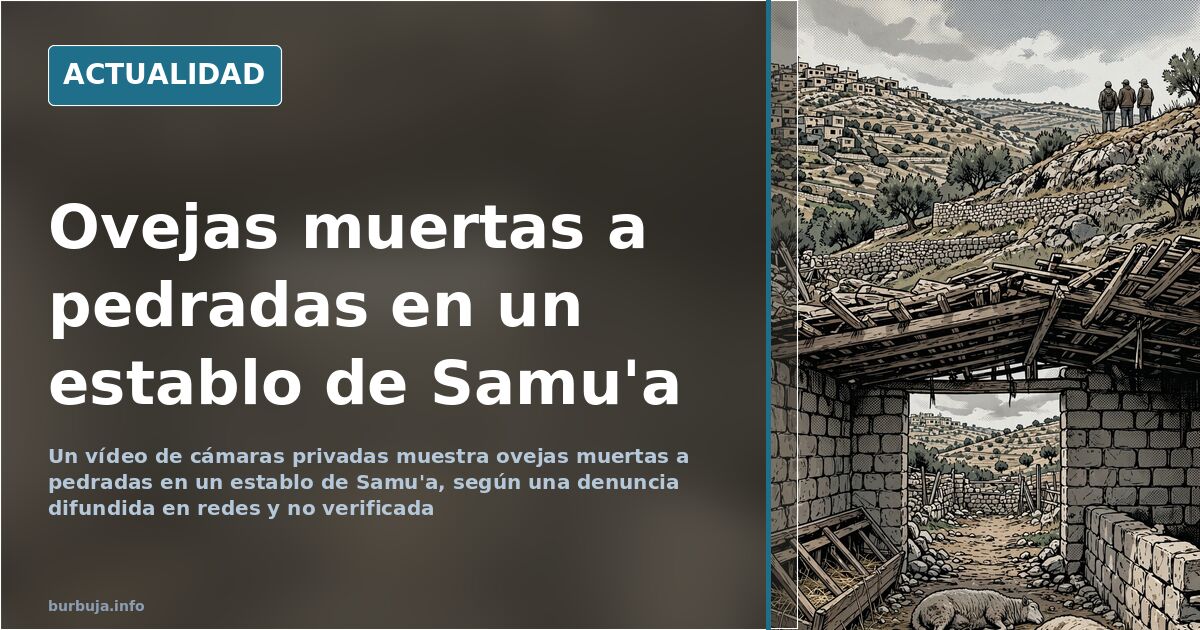
Security camera video: sheep stoned to death at Samu'a
A Palestinian barn proge to find its sheep stoned to death. The footage documenting it comes from no international agency: it was recorded by the security cameras of the attacked home itself, on a Monday, on the outskirts of Samu'a, according to the complaint circulating on social media. The video opens an uncomfortable discussion: what can be proven and what remains in the realm of allegation. The short answer is that almost everything is yet to be confirmed.
What does the released video show, and who is filing the complaint?
The post is attributed to an Israeli profile opposed to the occupation and is marked as the first of two parts. It places the attack at a Palestinian home on the outskirts of Samu'a, an area surrounded by settlements and outposts. The text points to settlers from Susiya and nearby communities as responsible, particularly the one known as Mitzpe Haroa.
According to that account, the episode is not isolated. The harassment of the same home would have been going on for nearly two years, with assaults the cameras would have been recording. The stoning death of the animals would be the latest chapter in the series. The second part of the message, which would complete the story, has not been reproduced.
For now there is a complaint with images. Not a verdict.
Two years of assaults: what the accusation rests on
The most weighty element is not the isolated video, but the alleged continuity. The complaint describes sustained harassment of the same house, with the footage as accumulated evidence. If that holds up, the case stops being late-night vandalism and becomes something else.
Therein lies both the strength and the weakness. Strong, because a documented pattern is harder to dismiss than an isolated incident. Weak, because everything rests on the word of whoever released the material and on their private archive.
Why it reopens the debate on Israeli settlers
For part of the analysis, what matters is not the incident but who is named: the settlers. The recurring thesis is that Israel has changed in nature — from a project with a socialist air to a far-right theocracy — and that violence along the agricultural frontier would be its consequence. Against it stands a logical objection: extrapolating from one video to an entire country is a shortcut.
Another view reduces the case to a boundary dispute or revenge between neighbors, with no political reading. A third points to the structural: as long as the law does not treat both populations equally, there will always be those who take justice into their own hands.
Can it be verified who killed the sheep?
The unavoidable question is who vouches that the images show what the text claims. The complaint relies on private cameras, not an independent investigation, and the message does not identify the people appearing in the video.
Without that verification, the material counts as testimony, not proof. It is the difference between a closed case and an open accusation.
Given all this, the likely outcome is that the video keeps circulating without any authority confirming responsibility. If external verification ever emerges, the matter moves up a category. If it does not, it will join the list of episodes that only convince those who were already convinced.
Also available in: Deutsch
Summary of a discussion on Burbuja.info - Foro de economía, actualidad y política., translated from Spanish and reviewed before publication. Read the full discussion (15 replies).
More summaries
-
Security cameras show James Gracey accidentally fell into the sea in Barcelona
Security cameras confirm James Gracey fell into the sea in Barcelona, but his stolen phone and missing jewellery leave uncomfortable questions unanswered.
-
Murcia expands video surveillance network with 1.330 new cameras
Murcia installs 1.330 new video surveillance cameras, quadrupling its network. The 'Murcia Segura' project aims to improve security and police response…
-
Spain's 'La bola negra' sparks culture war with €4.7M opening
'La bola negra' grosses €4.7 million in its first weekend and divides Spain between critical praise and accusations of propaganda and historical sectarianism.
-
Jiang Xueqin warns of global collapse and everyone watches October
Jiang Xueqin predicts a global collapse with no clear date. Dollar figures — 60% of reserves, up to 90% of forex — explain why the warning is not to be taken lightly.
-
The thesis blaming the welfare state for women's prostitution
One argument claims that without welfare benefits, women would sell themselves for a mess of pottage. The counterargument: the calculation is the same as that of the lifelong opposition claimant.
-
PSOE and Sumar slip the grandchildren law into an education reform
Spain's PSOE and Sumar have added the grandchildren law to an education reform bill. The PP calls it a "legal botch job", with estimates circulating of 3 to 5 million potential beneficiaries.