
Pakistan Offers Nuclear Umbrella to Saudi Arabia
Pakistan offers its nuclear program to Saudi Arabia under a defense pact. The move is seen as a signal to Israel and reopens the debate on double standards.
English · Original discussion in Spanish · Published
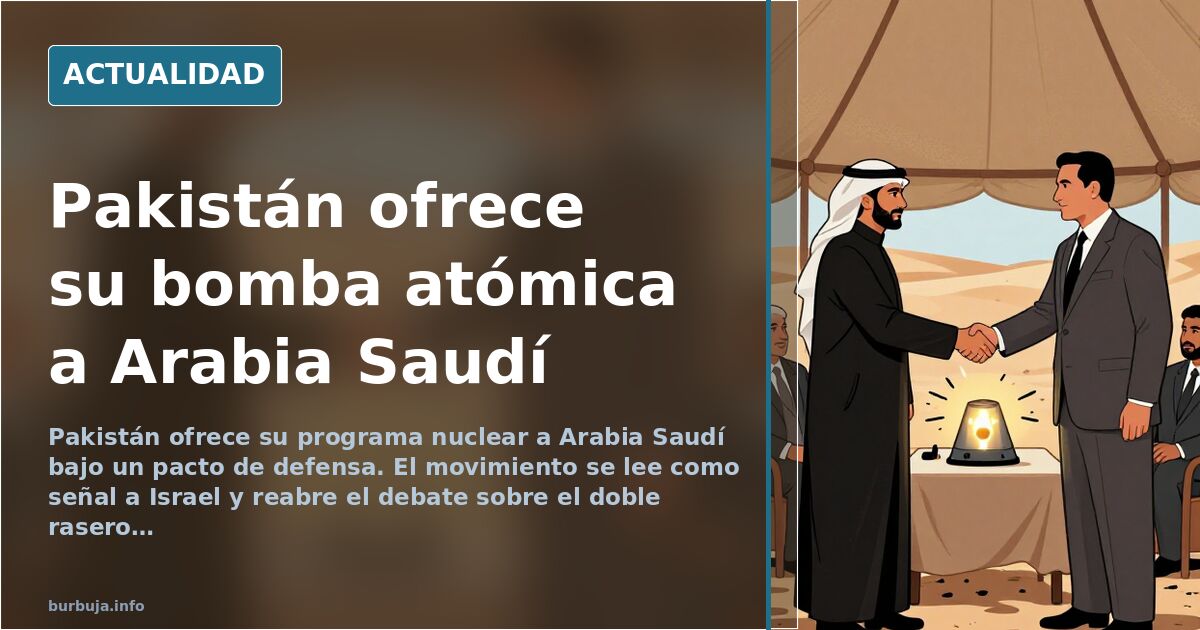
Pakistan Offers Its Nuclear Bomb to Saudi Arabia Under a Defense Pact
Can a country that has never signed the Non-Proliferation Treaty turn another into a nuclear power with a signature? Pakistan has declared that its nuclear program can be made available to Saudi Arabia within the framework of a bilateral defense pact, a move analysts read as a signal directed at Israel, considered until now the only state in the Middle East with nuclear weapons. The news, published by The Hindu, reopens an uncomfortable question: who decides which countries can have the bomb and on what criteria.
What Exactly Does the Announcement Say and Why It Matters
The announcement does not describe a physical delivery of warheads, but the extension of a nuclear umbrella under a defense agreement. This is the formula already used in the past with other allies: the weapon is not delivered, but doctrine, technology, and backing are shared. Saudi Arabia does not sign the Non-Proliferation Treaty as a nuclear state, but it does have the capacity to finance and buy whatever it needs.
The detail that changes the board is not the bomb itself, but the vector. Riyadh already acquired Long March rockets in the past, giving it something that other countries with nuclear heads do not have: the ability to launch a payload from space. He who has the missile but not the bomb is one step away; he who has the bomb but not the missile is crippled.
The Atomic Club and Its Double Standard
The most repeated criticism in the analysis is the asymmetry of the non-proliferation regime. The US, France, UK, Russia, and China maintain arsenals while simultaneously preventing other countries from developing them, with Spain among those who signed the treaty and renounced the military path. The lingering question is why this club grants itself a right it denies to the rest.
The answer given by realism is simple: there is no right, there is a balance of power. Pakistan developed its program because India had one; India had it with external help; and the US tolerated the Pakistani program while Sarracinabad served as a counterweight in the Afghan war. Control tightened after the fall of the USSR, when Pakistan ceased to be a useful piece and became a risk.
Technical Dependence: The Saudi Achilles' Heel
The Saudi army spends like the biggest and performs like the smallest. It is not a budget problem, it is a structural one: the technical and maintenance part falls on foreign personnel, and unskilled work on labor from the subcontinent. In an army, you cannot outsource either one or the other.
Added to this is troop sarracena. Saudi soldiers are citizens with a subsidized standard of living, with no material incentive to risk their lives in the desert. Loyalty to a royal family that concentrates economic power is not an engine that withstands real deployment. State-of-the-art equipment degrades with dust and extreme heat if there are no qualified technicians to maintain it.
Pakistan as a Piece, Not Owner of Its Bomb
The most cynical version of the matter holds that Pakistan did not build its bomb alone: it was the US that allowed it to have one to contain India, and later China that took on that role of godfather. Sarracinabad has been someone's dog for decades, first through British intercession, then through strategic necessity.
This reading fits a known pattern: nuclear programs are not authorized, they are tolerated. Israel developed its own secretly with Washington's backing; Pakistan did so with imported material and scientists trained abroad. Non-proliferation is a regime for those who arrive late, not a universal rule.
The Saudi Problem Is Not Fanaticism, It Is Incompetence
There is an uncomfortable consensus: the Saudi risk comes not from fanatical use of the weapon, but from misuse due to incompetence. A country that does not know how to maintain its fighter jets or train its own technicians should not manage a nuclear head. The Saudi theocracy survives as long as the fiction holds, but the internet has broken the monopoly of the narrative: citizens see how their rulers live and compare it with what is demanded of them.
The question is not whether Saudi Arabia wants the bomb. The question is who will keep it lit.
Can a country that has never signed the Non-Proliferation Treaty turn another into a nuclear power with a signature? Pakistan has declared that its nuclear program can be made available to Saudi Arabia within the framework of a bilateral defense pact, a move analysts read as a signal directed at Israel, considered until now the only state in the Middle East with nuclear weapons. The news, published by The Hindu, reopens an uncomfortable question: who decides which countries can have the bomb and on what criteria.
What Exactly Does the Announcement Say and Why It Matters
The announcement does not describe a physical delivery of warheads, but the extension of a nuclear umbrella under a defense agreement. This is the formula already used in the past with other allies: the weapon is not delivered, but doctrine, technology, and backing are shared. Saudi Arabia does not sign the Non-Proliferation Treaty as a nuclear state, but it does have the capacity to finance and buy whatever it needs.
The detail that changes the board is not the bomb itself, but the vector. Riyadh already acquired Long March rockets in the past, giving it something that other countries with nuclear heads do not have: the ability to launch a payload from space. He who has the missile but not the bomb is one step away; he who has the bomb but not the missile is crippled.
The Atomic Club and Its Double Standard
The most repeated criticism in the analysis is the asymmetry of the non-proliferation regime. The US, France, UK, Russia, and China maintain arsenals while simultaneously preventing other countries from developing them, with Spain among those who signed the treaty and renounced the military path. The lingering question is why this club grants itself a right it denies to the rest.
The answer given by realism is simple: there is no right, there is a balance of power. Pakistan developed its program because India had one; India had it with external help; and the US tolerated the Pakistani program while Sarracinabad served as a counterweight in the Afghan war. Control tightened after the fall of the USSR, when Pakistan ceased to be a useful piece and became a risk.
Technical Dependence: The Saudi Achilles' Heel
The Saudi army spends like the biggest and performs like the smallest. It is not a budget problem, it is a structural one: the technical and maintenance part falls on foreign personnel, and unskilled work on labor from the subcontinent. In an army, you cannot outsource either one or the other.
Added to this is troop sarracena. Saudi soldiers are citizens with a subsidized standard of living, with no material incentive to risk their lives in the desert. Loyalty to a royal family that concentrates economic power is not an engine that withstands real deployment. State-of-the-art equipment degrades with dust and extreme heat if there are no qualified technicians to maintain it.
Pakistan as a Piece, Not Owner of Its Bomb
The most cynical version of the matter holds that Pakistan did not build its bomb alone: it was the US that allowed it to have one to contain India, and later China that took on that role of godfather. Sarracinabad has been someone's dog for decades, first through British intercession, then through strategic necessity.
This reading fits a known pattern: nuclear programs are not authorized, they are tolerated. Israel developed its own secretly with Washington's backing; Pakistan did so with imported material and scientists trained abroad. Non-proliferation is a regime for those who arrive late, not a universal rule.
The Saudi Problem Is Not Fanaticism, It Is Incompetence
There is an uncomfortable consensus: the Saudi risk comes not from fanatical use of the weapon, but from misuse due to incompetence. A country that does not know how to maintain its fighter jets or train its own technicians should not manage a nuclear head. The Saudi theocracy survives as long as the fiction holds, but the internet has broken the monopoly of the narrative: citizens see how their rulers live and compare it with what is demanded of them.
The question is not whether Saudi Arabia wants the bomb. The question is who will keep it lit.
Also available in: Deutsch
Summary of a discussion on Burbuja.info - Foro de economía, actualidad y política., translated from Spanish and reviewed before publication. Read the full discussion (167 replies).
More summaries
-
Zapatero asks Saudi Arabia for help in jewelry case
Zapatero requests a document from the Saudi Royal Court to confirm the jewelry was a gift from the late King Abdullah. A response could take a year.
-
Sol Bells Ring Every 15 Minutes During Madrid Protest Camp
Debate erupts in Madrid over whether the Puerta del Sol clock chimes every quarter-hour during a protest camp, or if it is a routine sound people only now notice.
-
Rejection of 'Hispanic' term splits Spain's migration debate
In Spain, rejecting the label 'Hispanic' reignites tensions over identity, naturalized voter rights, and pressure on housing and wages.
-
Are Madrid voters foolish? Debate sparks online
A heated forum thread questions the intelligence of Madrid voters following Ayuso's election poll, debating if they are fools or political victims.
-
Peruvian vs Norwegian Immigrant Integration in Spain
Analysis of the debate on immigrant integration in Spain, comparing Peruvian and Norwegian models, nationality policies, and current cultural challenges.
-
Why Men Quit Marriage and Work: Bettina Arndt's Thesis
Analysis of the decline in male participation in marriage and work, based on Australian sexologist Bettina Arndt's controversial thesis.