
Paiporta protest: Spain’s monarchy debate reignited after royal visit
King Felipe VI’s visit to Paiporta following the October 2024 DANA floods triggered public outcry and renewed scrutiny of the Spanish monarchy’s role.
English · Original discussion in Spanish · Published
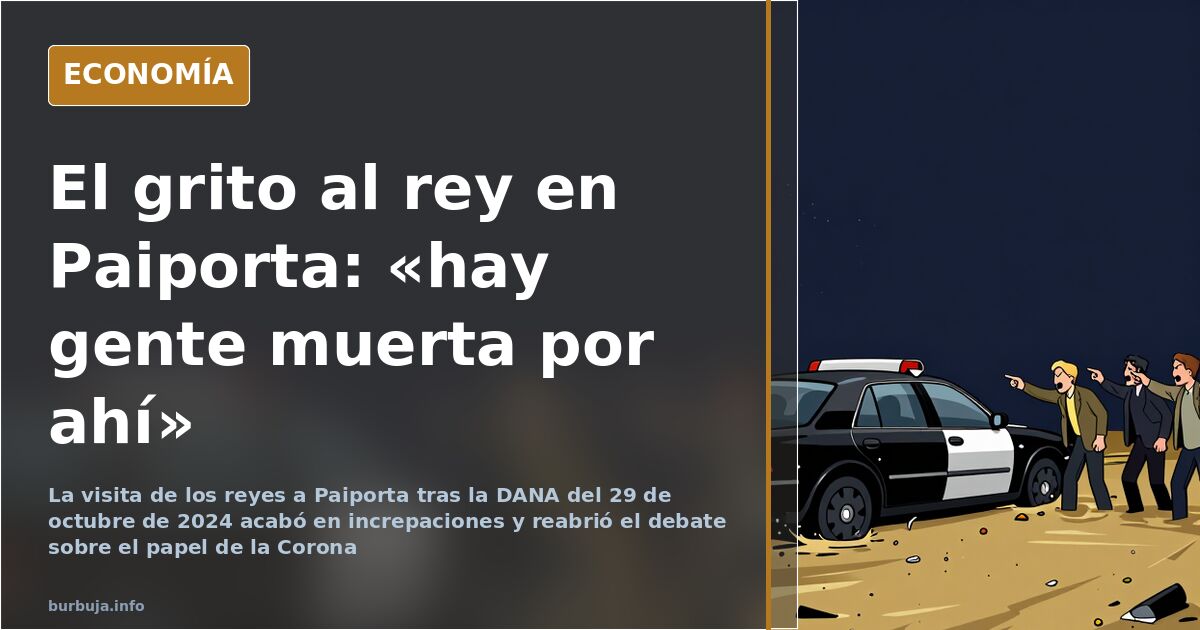
The shout at Paiporta to the king: 'Felipe, there are dead people out there'
What broke during the royal visit to Paiporta? The scene fits in one shot: among the crowd, someone shouts at Felipe VI, 'Felipe, there are dead people out there,' and everything that trinc—the gesture, the protocol, the faces—each interprets it their own way. The visit took place after the DANA of October 29, 2024, the event that left much of the district with mud up to their knees, without supplies, and with the feeling that official aid arrived too late. This contrast, between the official entourage and the neighbor with a shovel, turned a ceremonial act into a political thermometer.
What peine when the kings arrived in Paiporta
First, note what was seen. Neighbors who had been days removing mud encountered the entourage. The shout is not a party slogan: it is the phrase of someone who has gone days without seeing anyone with the authority to decide. The queen’s reaction, read by many as discomfort, fueled the same narrative: the institution taking note of a disaster for which the public was already demanding accountability.
The underlying complaint is summarized by those describing days of abandonment: no police, no Civil Guard, no Red Cross, clearing debris by hand, knowing there could be people alive under the water. When that happens, any arriving entourage, even for a photo, is interpreted as a parenthesis in the midst of urgency.
'If you want, I'll leave, I'll stay in Madrid': the phrase attributed to the king
Felipe VI is attributed a comment that spread like wildfire: 'If you want, I'll leave, I'll stay in Madrid.' The reading depends on the side. Some see it as proof of a forced presence, of a king who attends out of obligation and with the desire to close the matter. Others read the exact opposite: a man pushed into the spotlight to share the blame. Whether accurate or tweaked through forwarding, the phrase acted as gasoline, because each side used it to reinforce its thesis. And in the crossfire of interpretations, the only verifiable fact was buried: what was decided, if anything was decided.
Mazón, Sánchez, and the division of blame
Underlying this is the question of who commands when water sweeps away forecasts. One sector argues responsibility lies with the autonomous executive and its emergency management; another points to the central administration’s timing. There are even those demanding the intervention of the Army and the Civil Guard, complaining that their units had other priorities, including escorting authorities.
Some even, pushing the argument to the extreme, openly call for a military uprising with the king at the head of the armed forces. This is more a product of coup fantasy than a plan with traction. Amid the noise, suspicion creeps in that official channels insist on intoxication while useful information flows through other channels.
The comparison with 1957 and the new Turia channel
One of the most repeated digressions was historical: the 1957 flood and the diversion of the Turia. Some argue that without the new channel planned after that disaster, the city would today be a lot, and they seize the opportunity to highlight the public works of the dictatorship. The counterpoint jumps out: the same infrastructure logic did not prevent this catastrophe, and the comparison falls apart when focusing on the warning and rescue, not the concrete. Brick holds; a warning that does not arrive, does not.
Is it sensible to discuss the Crown after a disaster?
For part of the public, the king’s role is symbolic and without executive power: he cannot declare alerts or mobilize on his own. For others, that neutrality is precisely the problem: whoever does not decide also does not assume. The underlying discussion then emerges, whether a country needs a monarchy, with arguments ranging from the cost of the institution to the lack of mechanisms to hold anyone accountable. The most repeated complaint is not that the king does too little, but that no one answers for what went wrong.
Parallel to this, theories circulated linking the disaster to the premiere, months earlier, of a Netflix series; no evidence supports this connection. These are the conspiratorial wrapping of a very real and very unaddressed discontent.
The only thing clear is that in Paiporta, two calendars crossed that rarely coincide: the protocol’s and the shovel’s. If protocol reconstructed districts, this one would already be dry.
Also available in: Deutsch
Summary of a discussion on Burbuja.info - Foro de economía, actualidad y política., translated from Spanish and reviewed before publication. Read the full discussion (266 replies).
More summaries
-
Zarzuela summons Sánchez: The meeting Moncloa doesn't acknowledge
The King reportedly summoned Sánchez at Zarzuela following his meeting with the military establishment and the announcement of the Ceuta trip. The official agenda makes no mention of the encounter, and...
-
Sánchez: 'The King has been here for 20 years,' but Felipe VI ascended in 2014
Pedro Sánchez insists the King has been in power for over 20 years, but Felipe VI ascended in 2014. The criticism regarding Ceuta and Melilla hides a deeper debate...
-
Ceuta: 60,000 crossings push Spain's border past breaking point
More than 60,000 entries and around a hundred deaths: why the Ceuta crisis is a catastrophe that Europe watches without sharing the bill.
-
Morocco: the weakness measured at the border
Thousands of young people in Ceuta while Morocco boasts of military power: the thesis of Moroccan fragility is gaining ground and unsettling geopolitics in the Maghreb.
-
Spain doesn't fear expulsion from Schengen, but suspension
22 of 29 states could suspend Spain from Schengen: Spain's SER radio calls it a hoax, but the threat is real
-
Mocking obesity comes at a high cost to the economy
A viral video of a woman with obesity sparks mockery instead of a conversation about the economic cost of being overweight. A bill nobody is paying.