
Paiporta Flood Shows Prepper Kits Fail Without Community
The Paiporta flood exposed the limits of prepper kits, showing that without a neighborhood network or weapons, defense is impossible.
English · Original discussion in Spanish · Published
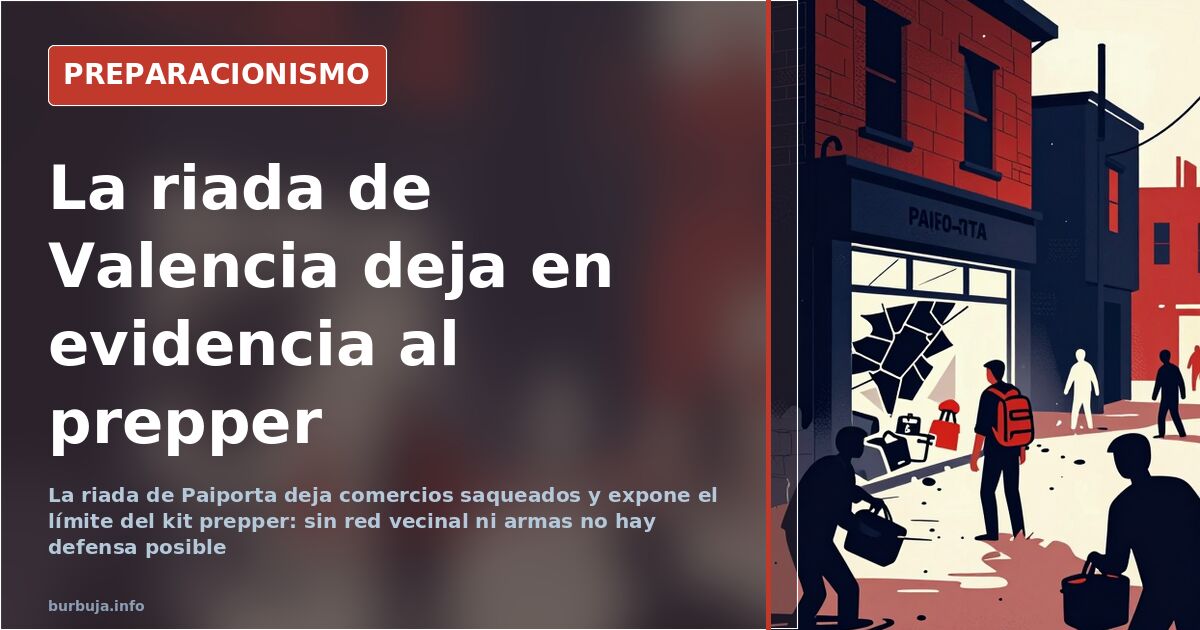
Paiporta Flood Debunks the Prepper Manual
Neighbors in Paiporta loading their cars in the dark, with whatever they had on them, to escape the mud before the next problem arrived. This scene, repeated for days, has peine an uncomfortable question: what good is an arsenal of prepping when the water has taken the road, the power, and even the police station? The prepper kit is now judged by what it endured in Valencia, not by what the catalog promised.
What Peine in Paiporta After the Flood
Circulated accounts describe looted shops, raided jewelry stores, and fights in the streets while the mud continued to descend. The phrase summarizing the atmosphere comes from a resident who decided to leave: "Staying was dangerous. There are thieves raiding jewelry stores, fighting." It is not an official report, but a testimony; it does, however, match what several cameras recorded in commercial areas of the Valencia metropolitan area.
The recurring pattern is opportunistic looting: empty premises, warehouses, large supermarkets. At the Bonaire shopping center in Algemesí, the circulating hypothesis is that everything was taken advantage of the surrounding towns being flooded. There are also reports of intruders in homes where a family was keeping vigil over a deceased relative; these are counted as neighbor complaints without official confirmation. Most incidents point to businesses, not homes.
Why Is the Neighbor Network Worth More Than a Bunker?
Here the diagnosis is almost unanimous among those living in small municipalities: the first line of defense was not a rifle, it was the community. Towns are described where, within hours, residents themselves organized shifts, lent sump pumps, repaired appliances, and moved debris before any administration appeared. No one had to defend anything because the community was already defending itself.
The argument is reinforced by imported examples: in the Los Angeles riots, Korean merchants protected their businesses organized by communities, not as lone snipers. A cohesive group—call it a clan, extended family, or tribe—functions as a security network and an alert system. The lone wolf with a pantry, on the other hand, has to sleep sometime.
Not everything is neighborly epicness. Part of the analysis drifts toward generalizations about specific groups and conspiracy theories—that if the storm was a foreign test, that if a conflict is being prepared for the Canary Islands—without any proof to support them. It is worth separating this from the rest: what is described are opportunistic lootings, not an invasion.
Do Shotguns and the 7.62 Rifle Help?
The arms debate is rougher. One sector argues that without a firearm there is nothing to do and that whoever doesn't have one works for free for whoever does. Another responds with cold calculation: the scenario handled is two vans with twenty armed attackers with little to lose; shooting down the first only adds a motive for revenge to the rest. And a third line recalls that no one keeps their finger on the trigger for more than eighty hours straight, and that in domestic crimes the victim almost always knew their killer.
In between, common sense: most looters are not armed nor in large groups, they look for easy targets. A house with response deters; an empty house does not.
Why Living in a Flood Zone Invalidates Any Preparation
The flood moved trucks, buses, and houses, leaving zones with up to three meters of mud. Against that, no perimeter holds: fences fall, electronics die, and towns remain isolated. Hence one of the most repeated rules: do not live or work on flood-prone land, no matter how much pantry you accumulate. Security rings, physical or digital, amount to nothing when water enters the home.
The second blow is temporal. Constant alertness cannot be sustained, and lootings arrive at dawn, when the body demands sleep.
Supplies and Low Profile, the Assets That Hold Up
Against the mountain bunker, some defend the boring: food, water, medication, and dog food for months, without leaving home. Not going out gives discretion; no one notices you are well-fed. And living in a middle-floor apartment, neither ground nor attic, seems more practical than ten hectares with mastiffs, although the discussion on the terrain remains open: some ask for isolation and others warn that without neighbors, survival is impossible.
The other rule is invisibility. Discreet car, discreet house, discreet routine. In Spain, a chalet with two Mercedes parked is a hand-painted target.
What no one disputes is that the episode left tens of thousands of people with scenes recorded on their phones that do not erase. No kit, pantry, or shotgun fixes that.
And then there is the fine print. Many affected people get illusions about compensation: new furniture, appliances, car. What awaits them, according to those who have been through it, is a mountain of paperwork and trips to offices. The detail that summarizes it: the first bar to reopen and serve coffee again was run by a Chinese merchant.
Also available in: Deutsch
Summary of a discussion on Burbuja.info - Foro de economía, actualidad y política., translated from Spanish and reviewed before publication. Read the full discussion (170 replies).
More summaries
-
Cuba: The Prepper's Collapse Lab
Fuel runs out and hunger spreads in Cuba. The real case for preppers: looting, oxen, and lessons for Europe.
-
The go-to prepper manuals are written for the US
Many top prepper manuals are American, with guns and acre-sized gardens. F. Castillo's is adapted to Spain.
-
Utopia 2013: Where to Download the British Series on P2P
The British series Utopia (2013), with two subtitled seasons, is still available on eMule, torrent and direct download
-
Falling onto subway tracks: the move that lowers the risk
The greatest danger when falling onto subway tracks is not the fall but the reaction: pressing against the wall and waiting for the train to stop reduces the risk.
-
Bleach against bugs at the campsite: the circle that doesn't protect
Bleach does not create a bug-proof perimeter. What actually works in tents and bivouacs, from scorpions to centipedes.
-
What a prepper stockpiles: 25 items from honey to fire extinguisher
Honey, filter paper and a whistle open a 25-item prepper list: treatable water, canned food that lasts years and freeze-dried fruit with a 15 to 25-year shelf life.