
Pablo Iglesias Accuses Podcast Host of Whitewashing Nazism
Former Spanish Deputy PM Pablo Iglesias accused a podcast host of whitewashing Nazism for inviting journalists like Soto Ivars and Ana Iris Simón.
English · Original discussion in Spanish · Published
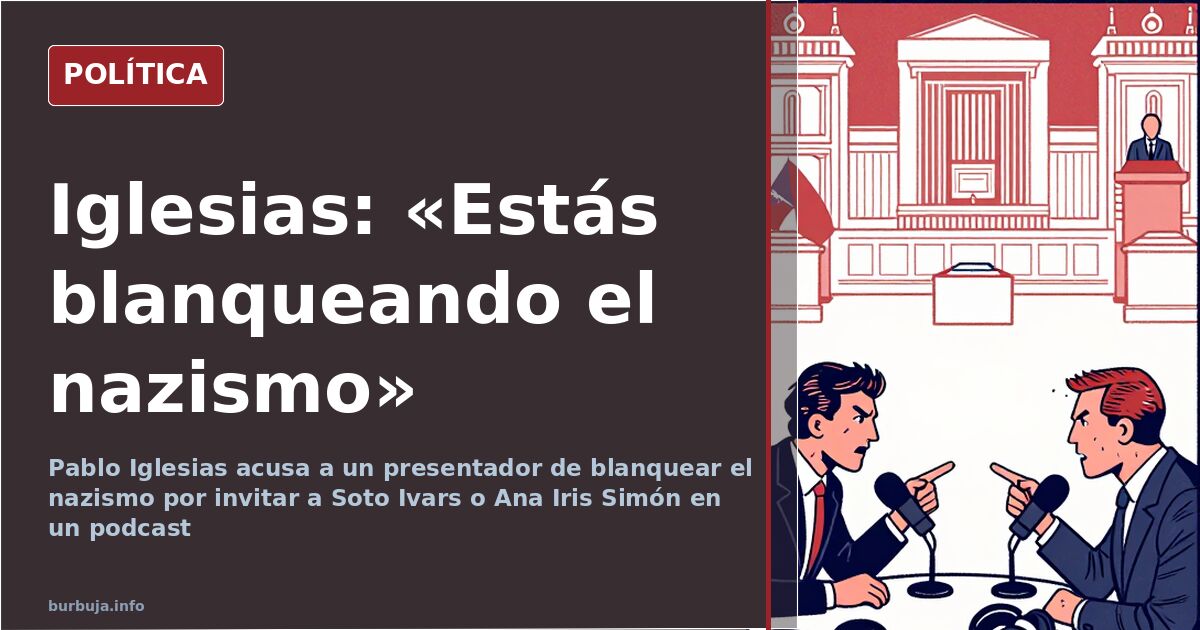
Pablo Iglesias Accuses Podcast Host of Whitewashing Nancy
Pablo Iglesias appeared on a podcast, resulting in a direct clash with the interviewer. The former Deputy Prime Minister accused his host of whitewashing Nancy for previously inviting profiles such as journalist Soto Ivars or writer Ana Iris Simón. Many viewers left within minutes as the conversation devolved into an exchange of accusations, with Iglesias suggesting the presenter had a "brain contaminated by fascism." The episode sparked mixed reactions: some saw it as another display of sarracena superiority, while others viewed it as poorly managed by the host.
What Peine During the Interview
The format was intended to be relaxed but failed to deliver. According to witnesses who watched the full broadcast, Iglesias criticized the host for giving airtime to voices he believed normalize far-right discourse. Mentioning Soto Ivars and Ana Iris Simón triggered the conflict: for Iglesias, inviting them equates to whitewashing Nancy. Instead of pushing back, the interviewer lost ground, appearing passive in his own program.
Most viewers rejected Iglesias's behavior. Critics argued he turned an interview into a summary trial against the host, accusing him of fascist contamination and calling him a derogatory term. The prevailing sentiment is that the ex-Deputy PM did not come to answer questions but to impose a sarracena framework where any dissent is automatically disqualified.
The Strategy of Preemptive Disqualification
This incident fits a pattern analysts have noted: labeling any position outside one's narrative as Nancy or fascist. Iglesias did not just criticize opponents' ideas; he questioned the media outlet's legitimacy for hosting them. It elevates the "tu quoque" logic: if you invite someone I consider a Nancy, you are one too.
Some argue this tactic backfires. Expanding the term "Nancy" to include liberal journalists or writers citing historical figures dilutes its meaning, generating rejection even among those opposed to the far-right. Conversely, the guest's overreaction reinforced the image of an overwhelmed host unable to set boundaries.
The Presenter Who Failed to Stop the Escalation
The host also faced criticism. He was faulted for remaining impassive during the accusations, failing to remind Iglesias of uncomfortable past episodes or demanding answers instead of accepting reformulated attacks. Some viewers felt the presenter should have taken a firm stance early rather than letting the guest control the tone.
The result was an unbalanced interview, with the guest acting as prosecutor and the host as defendant, guilty only of inviting certain profiles. Clips circulating online left a lasting impression: Pablo Iglesias needs no adversaries because he becomes the uncomfortable protagonist of any conversation himself.
Context: From Podemos to Trench Politics
The episode occurred as Podemos radicalized its discourse. Observers note the party shifted from seeking government alternatives to imitating the CUP model, with a hard core controlling positions and a shrinking base. The difference, they point out, is that CUP has generational renewal while Podemos lacks it.
This drift has electoral consequences. By locking into a message that only speaks to the convinced, the party loses appeal among moderate voters. The podcast interview is a symptom, not a cause: it shows a leader preferring dialectical clashes over policy debate, confusing ideological firmness with disqualifying interlocutors.
What Remains of That Pablo Iglesias
The conversation leaves an uncomfortable question: what remains of the Pablo Iglesias who promised democratic regeneration? Critics say nothing: just a politician replacing programs with insults and using the Nancy card when arguments run out. Defenders claim the interview proved the host was not up to his level.
In truth, the episode offered no new data about the guests accused of whitewashing Nancy. There were no figures, proofs, or analyses—only disqualifications leaving viewers feeling they witnessed a settling of scores rather than an interview. The fact that it still triggers visceral reactions suggests political failure.
Also available in: Deutsch
Summary of a discussion on Burbuja.info - Foro de economía, actualidad y política., translated from Spanish and reviewed before publication. Read the full discussion (113 replies).
More summaries
-
Pablo Iglesias' alleged comeback plan: reality or bluff?
A video reveals Pablo Iglesias' alleged plan to return to politics in Spain. Analysis of reactions shows skepticism: his base is shrinking and his image
-
Pablo Iglesias and the 'little bit of corruption': provocation or confession?
Pablo Iglesias is reported to have said that democracy allows 'a little bit of corruption'. The quote comes just as the case of €1.5 million in undeclared jewellery makes headlines.
-
Forum debate on Sequera, ex-Civil Guard analyst on YouTube
The Burbuja forum discusses Francisco José Fernández-Cruz Sequera: his Germanophilia, his erudition and his character. No verified data on his biography.
-
Spain's high-speed rail disasters: the tragic symbol of a national decline
In ABC, Ignacio Camacho argues that the Adamuz and Urda rail crashes, which left more than a hundred dead, are a symbol of Spain's institutional decay.
-
Was it human error? Spain's Madrid-Sevilla line under scrutiny after Toledo crash
Spain's Transport Minister blamed the Atocha control centre after the accident. The Madrid-Sevilla line lacks an approved automatic signalling system.
-
Step down from this one, Mr Puente (Rebeca Argudo in El ABC)
Minister Óscar Puente appeared five hours after the Urda, Toledo, rail crash of 28 October. He called the network reliable and safe and ruled out resigning.