
Oviedo school with 95% foreign pupils marks Refugee Day
95% of pupils at the Pablo Miaja school in Oviedo, Spain, are of foreign origin, with 26 nationalities sharing classrooms. The Refugee Day celebration has reignited a broader debate.
English · Original discussion in Spanish · Published
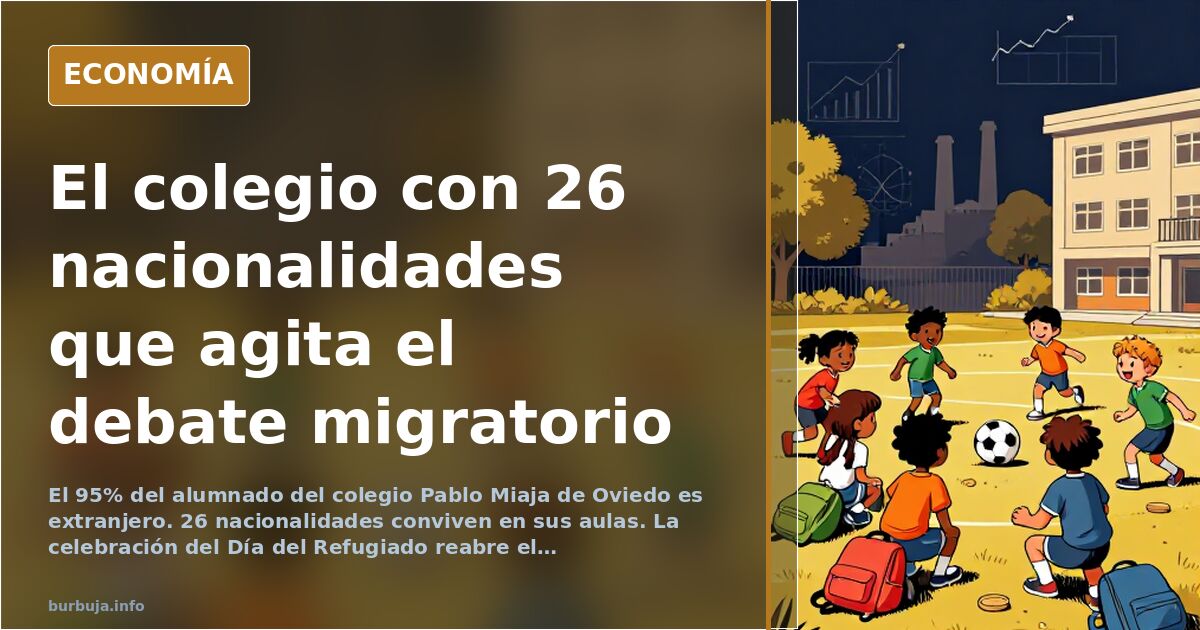
An Oviedo school, with 95% of pupils of foreign origin and 26 nationalities, celebrates Refugee Day, sparking a debate that goes beyond childhood empathy
At the public Pablo Miaja school in Oviedo, Spain, 95% of pupils are of foreign origin. 26 nationalities share its classrooms. The school leadership organised an event for Refugee Day —June 20— with activities such as filling in mock passports simulating a forced departure from the country. Regional Education Minister Eva Ledo and city councillor María Velasco backed the initiative. Headteacher Marcos Carrasco called it «an example of respect and tolerance». But the story, reported by El Comercio, has peine a rift that is not only cultural, but economic.
From the Tower of Babel to demographic replacement
While the official narrative insists on an empty, ageing Asturias, the school's figures suggest otherwise. «And then they say there's hardly any immigration in Asturias. Every time I go to the school I see Muslim women wearing the veil», reads a recurring comment. The presence of foreign families is concentrated in areas like the one around Pablo Miaja, where native enrolment has fallen to record lows. The question is not whether there is immigration, but how it affects the region's social and labour structure.
The calculation nobody makes in public: votes and wages
What underlies the controversy is not only about identity. A recurring argument in economic threads suggests that mass immigration —legal or not— helps parties replace an ageing electorate. «Ayuso won thanks to the Latino vote and the abstention of Madrileños», the argument goes, and that logic has spread across the whole peninsula. At the same time, large companies —such as Quirón— need cheap labour at every level: waiters, engineers, doctors. The result is an oversupply that pushes wages down, something no politician admits on the campaign trail.
Two interests intersect here: that of the voter who sees their neighbourhood changing, and that of the employer who needs lower costs. The school's Refugee Day celebration thus becomes the tip of an iceberg touching demography, the labour market and electoral strategy.
What the official figures don't say
The Pablo Miaja school is only a symptom. In Asturias, the foreign population has grown by 15% over the past five years, but it is concentrated in certain districts. Meanwhile, the native birth rate continues to plummet. The equation is simple: without migration flows, the pension system collapses sooner. With them, social tension soars. Friday's event, with children role-playing as refugees, seeks to foster empathy. But the reality is that many of these children are the sons and daughters of workers who came looking for opportunities, not fleeing a war.
Is the school an integration experiment, or proof that something has broken in the reception model? The debate remains open, with data each side interprets to its own advantage. The only certainty is that, in that classroom of 26 nationalities, Asturias's future is being written without anyone being quite sure of the script.
Also available in: Deutsch
Summary of a discussion on Burbuja.info - Foro de economía, actualidad y política., translated from Spanish and reviewed before publication. Read the full discussion (12 replies).
More summaries
-
Barcelona public school uploads video of first day of class and sparks debate...
A video from a Barcelona public school about the start of term has reignited the debate over the quality of public versus private education.
-
Pablo Iglesias’ Private School Choice in Las Rozas Sparks Ideological Debate
Pablo Iglesias’ decision to send his children to a private school in Las Rozas, costing 500 euros monthly, highlights a tension between his political rhetoric and personal choices.
-
Pablo Fernández Eyes Madrid Mayoralty for Podemos
Pablo Fernández enters Podemos primaries for Madrid Mayoralty, planning a 2027 ticket with Belarra. Polls suggest support between 3% and...
-
Spain's Social Security sold Iván Redondo a Madrid flat €466,679 below market value
Spain's Social Security sold Iván Redondo a flat in Madrid's Salamanca district for €1,120,921 — €466,679 below its market value. The discount comes close to 30%.
-
Generational divide deepens in Spain's economy
Generational tension in the Spanish economy: pensioners blamed as a burden, frustrated young workers and an uncertain demographic future amid rising pensions and rural depopulation.
-
Spain's Labour Minister faces 40 complaints while critics target Ortega and Roig
Spanish Labour Minister Yolanda Díaz has accumulated 40 workplace complaints at her own family firm while the left attacks Amancio Ortega and Juan Roig. A media double standard at its worst.