
Over 1,000 migrants reach Canary Islands in pirogues in just 24 hours
More than 1,000 migrants arrive on El Hierro in Spain's Canary Islands aboard seven pirogues in 24 hours. The island has already received over 6,000 this year.
English · Original discussion in Spanish · Published
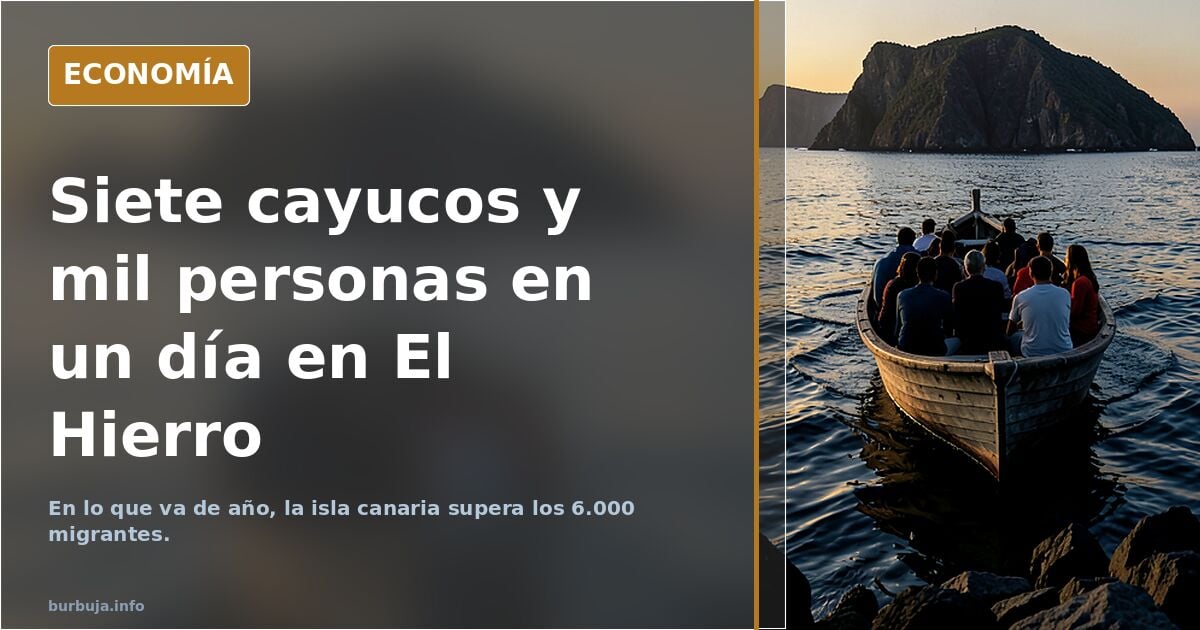
More than a thousand people reach El Hierro in seven pirogues in a single day
How many pirogues can reach the Canary Islands in a single day? According to data from Spain's Maritime Rescue Service, the answer is seven. In just 24 hours, the island of El Hierro has received more than a thousand migrants aboard these vessels, according to information released on Monday. Four pirogues were brought in yesterday with more than 400 occupants; today three more arrived: one with 205 people, another with 170 and a last one with 41. So far this year, the small Canary island has already recorded the arrival of more than 6,000 migrants. The figure is not an isolated record, but confirmation of an accelerating trend.
El Hierro, gateway to the Atlantic route
The westernmost island of the archipelago has become the main landing point of the migration route that departs from the African coast. The pirogues — flimsy boats that in many cases lack minimum seaworthiness conditions — arrive with dozens of people crammed on board. The image of a pirogue carrying 205 occupants — similar to a rush-hour subway car, with no water jugs or sun protection — sums up the harshness of the journey. Local authorities and emergency services are attending to the new arrivals, but the reception capacity of an island of just over 10,000 inhabitants has its limits. The constant trickle of arrivals in recent months has transformed daily life on the island and has strained its health and welfare infrastructure.
The circulating estimate: 500,000 people on the way
On economics and current affairs forums, the event has sparked a debate mixing humanitarian concern with demographic analysis. A calculation circulating online, and shared in these spaces, claims that if you look at the coordinates of the African coast and count the pirogues being prepared, the number of people who could reach the Canary Islands soars to 500,000. The estimate, which does not come from official sources and has not been verified, is based on the observation of satellite images and the number of vessels sighted. The figure is speculative, but it reflects the perception that the migratory phenomenon is far from subsiding. At the same time, it is argued that the pressure is not limited to the Canary Islands: the border of Ceuta and Melilla, as well as the peninsular coasts, could face similar scenarios if the trend continues.
The political debate: between criticism of the Government and historical responsibility
The mass arrival of migrants has reignited political confrontation. Some participants in these debates argue that the central government is not acting with the necessary firmness and that the lack of a clear migration policy is worsening the situation. Another current, however, focuses on Europe's historical responsibilities and the role of colonial powers in the impoverishment of the African continent. It is argued that border externalization policies and agreements with third countries have not stopped arrivals, but have diverted routes towards more dangerous points. The discussion often drifts towards the effectiveness of rescues, the identification of occupants and the need for immediate returns — a measure which, according to some, clashes with international law and with Spanish legislation itself.
The Navy and border control: a real solution?
Among the proposals arising in the debate, one of the most repeated is the use of the Navy to intercept vessels on the high seas and return their occupants to their countries of origin. Those who defend this route argue that many pirogues are launched from mother ships and that a firm response — confiscation of the vessels, arrest of the skippers and prison sentences — would have a deterrent effect. However, there is no consensus on its legal viability or its effectiveness. The experience of other migration routes shows that deterrence policies often displace the phenomenon rather than eliminate it. Meanwhile, reality in El Hierro goes on: with each passing day, new pirogues set course for its shores.
The question is not whether more will come, but how many fit into the story of an island that has already seen more than 6,000 people pass through so far this year. And for now, the sea provides the answer.
Also available in: Deutsch
Summary of a discussion on Burbuja.info - Foro de economía, actualidad y política., translated from Spanish and reviewed before publication. Read the full discussion (15 replies).
More summaries
-
Spain rescues 236 migrants near Canary Islands
A motorless boat carrying 236 people was rescued far from Gran Canaria. Spain bears the rescue costs while Morocco manages fishing rights.
-
Alvise urges civil society to organize against Morocco threat
Spanish MEP Alvise Pérez claims in a video that Morocco plans to invade Ceuta, Melilla and the Canary Islands, calling for civilian self-defense.
-
Spanish Maritime Rescue captain: hero or part of the 'migrant business'?
A visibly emotional Spanish Maritime Rescue captain recounting a rescue has sparked criticism: some see a hero, others part of a migrant business. Facts and positions here.
-
Eva Cárdenas and the property business dragging Feijóo into the spotlight
A company set up with €3,000 in capital and €300,000 in annual profits: Eva Cárdenas's property business reopens the debate on real estate and politics in Spain.
-
Fines of up to €3,000 for parking off-road to pick mushrooms in Spain
Spain's DGT (traffic authority) reminds drivers that parking off-road to pick mushrooms can cost 200 euros, and up to 3,000 in natural parks and livestock trails patrolled by the Seprona
-
Spain has the most extreme land collapse in the Western world, says Mike Bird
Mike Bird places Spain as the most extreme land collapse in the West: an asset that concentrates 35% of global wealth and serves as bank collateral