
Otegi rejects Spain's national team: 'not my team, not my king'
Arnaldo Otegi's rejection of the Spanish team reopens the Basque quota dispute in Spain, with claims that only 3% of revenue raised in the Basque Country reaches the Spanish state.
English · Original discussion in Spanish · Published
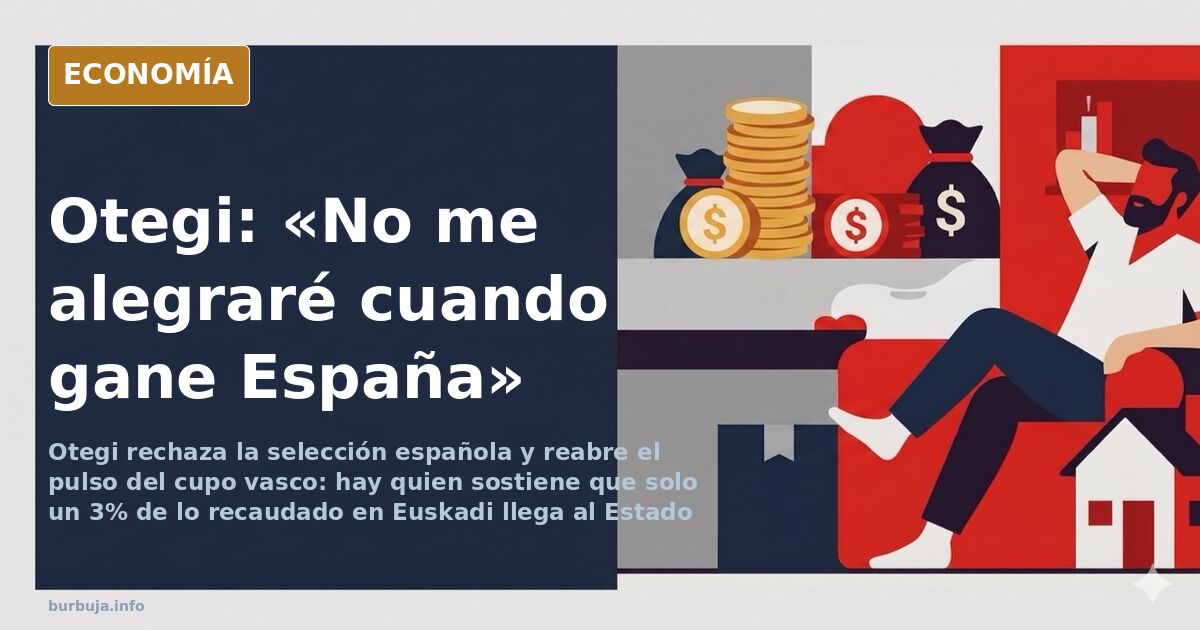
Otegi rejects the national team and reopens the Basque quota dispute
Can a leader who draws a salary from the very system he claims not to recognise distance himself from the national team without anyone making him pay the price? Arnaldo Otegi made it clear: "I will never celebrate when Spain wins. It's not my team, not my king and not my anthem." The remark, made in the aftermath of the European title, immediately triggered the most predictable reflex: the row over the Basque quota, VAT and regional financing. Because in Spain, sport always ends up in the common pot.
From sports headline to quota debate
The initial message of the story did not stop at the anecdote. The author of the post put the comparison with the United Kingdom on the table: England lets Scotland, Wales and Ireland play and yet maintains its own league. The question raised — whether fans of Real Sociedad, Athletic, Eibar or Alavés would rather play against regional teams than against Real Madrid or Barcelona — was left hanging without a unanimous answer. What did stick was the economic accusation: they want everything and give nothing in return.
From there, the matter drifted towards the terrain where any territorial grievance is usually settled: financing. Some claim that of every 100 euros raised in the Basque Country, only 3% reaches the state's coffers, while the other regions — except Navarre — contribute the full amount. The calculation, repeated ad nauseam, is used to illustrate the famous Basque quota, that mechanism Catalonia casts a sideways glance at and which Catalan separatists have wanted to replicate for years. Infrastructure, civil servants' salaries and pensions, the argument goes, come from the rest of Spain.
Why does the Basque quota become the centre of the debate?
The Basque quota (concierto económico) is the contribution the Basque Country makes to the Spanish state for the services it provides in its territory. Its calculation, opaque to many, creates a comparative grievance that resurfaces at every budget negotiation. The material points out that the economic agreement system allows almost all tax revenue to be retained, and that this, combined with the sense of fiscal grievance felt by the other regions, fuels the privilege narrative. The question hanging in the air is whether this model is sustainable or whether, on the contrary, it is the only way to keep together a territory with separatist leanings.
Football as a thermometer of identity
The Spanish team's victory at the Euros served as a catalyst. The material highlights that Oyarzabal, Simón, Merino and Williams — two Basques and two Navarrese — were the stars of the title. That detail dismantles the narrative that the national team does not represent the Basques. Yet Otegi's reaction shows that the mental framework does not shift with sporting results. The paradox is obvious: the same players who celebrate the title in the red shirt are the ones who, in political discourse, do not exist as national role models.
The separatists' response and the wearing down of the narrative
The discussion then turned to the wearing down of the separatist discourse. Part of the conversation argues that Spain's separatist movements survive thanks to PP and PSOE voters, because without them they would be nothing more than an annual stroll. The theory of the void — denying them media and political attention — appears as the only strategy that has never been tried. Another current, however, holds that Basque separatism rests on a grievance narrative built over decades and that the amnesty and the investiture deals have legitimised it. The result is a standoff that cannot be resolved with sports headlines.
In the end, the question is not whether Otegi celebrates when Spain wins. The question is how much longer a system can be sustained in which some put up the money and others set the terms. And meanwhile, the national team keeps winning titles that some celebrate under the flag while others watch sideways from the sofa.
Can a leader who draws a salary from the very system he claims not to recognise distance himself from the national team without anyone making him pay the price? Arnaldo Otegi made it clear: "I will never celebrate when Spain wins. It's not my team, not my king and not my anthem." The remark, made in the aftermath of the European title, immediately triggered the most predictable reflex: the row over the Basque quota, VAT and regional financing. Because in Spain, sport always ends up in the common pot.
From sports headline to quota debate
The initial message of the story did not stop at the anecdote. The author of the post put the comparison with the United Kingdom on the table: England lets Scotland, Wales and Ireland play and yet maintains its own league. The question raised — whether fans of Real Sociedad, Athletic, Eibar or Alavés would rather play against regional teams than against Real Madrid or Barcelona — was left hanging without a unanimous answer. What did stick was the economic accusation: they want everything and give nothing in return.
From there, the matter drifted towards the terrain where any territorial grievance is usually settled: financing. Some claim that of every 100 euros raised in the Basque Country, only 3% reaches the state's coffers, while the other regions — except Navarre — contribute the full amount. The calculation, repeated ad nauseam, is used to illustrate the famous Basque quota, that mechanism Catalonia casts a sideways glance at and which Catalan separatists have wanted to replicate for years. Infrastructure, civil servants' salaries and pensions, the argument goes, come from the rest of Spain.
Why does the Basque quota become the centre of the debate?
The Basque quota (concierto económico) is the contribution the Basque Country makes to the Spanish state for the services it provides in its territory. Its calculation, opaque to many, creates a comparative grievance that resurfaces at every budget negotiation. The material points out that the economic agreement system allows almost all tax revenue to be retained, and that this, combined with the sense of fiscal grievance felt by the other regions, fuels the privilege narrative. The question hanging in the air is whether this model is sustainable or whether, on the contrary, it is the only way to keep together a territory with separatist leanings.
Football as a thermometer of identity
The Spanish team's victory at the Euros served as a catalyst. The material highlights that Oyarzabal, Simón, Merino and Williams — two Basques and two Navarrese — were the stars of the title. That detail dismantles the narrative that the national team does not represent the Basques. Yet Otegi's reaction shows that the mental framework does not shift with sporting results. The paradox is obvious: the same players who celebrate the title in the red shirt are the ones who, in political discourse, do not exist as national role models.
The separatists' response and the wearing down of the narrative
The discussion then turned to the wearing down of the separatist discourse. Part of the conversation argues that Spain's separatist movements survive thanks to PP and PSOE voters, because without them they would be nothing more than an annual stroll. The theory of the void — denying them media and political attention — appears as the only strategy that has never been tried. Another current, however, holds that Basque separatism rests on a grievance narrative built over decades and that the amnesty and the investiture deals have legitimised it. The result is a standoff that cannot be resolved with sports headlines.
In the end, the question is not whether Otegi celebrates when Spain wins. The question is how much longer a system can be sustained in which some put up the money and others set the terms. And meanwhile, the national team keeps winning titles that some celebrate under the flag while others watch sideways from the sofa.
Also available in: Deutsch
Summary of a discussion on Burbuja.info - Foro de economía, actualidad y política., translated from Spanish and reviewed before publication. Read the full discussion (99 replies).
More summaries
-
Basque mayor's Spain jersey sparks political and economic debate
Maider Etxebarria wears the Spanish team shirt in Vitoria while Bilbao rejects a giant screen, highlighting shifting Basque demographics.
-
Otegi calls for an 'anti-fascist wall': the economic cost of a metaphor
The leader of EH Bildu proposes an ideological wall while the Basque economy relies on the 'cupo' and industry loses steam. History, figures and empty promises.
-
Guardiola’s Catalonia stance highlights secessionism's economic cost
Guardiola rejects Spain for Catalonia, sparking debate on the economic impact of separatism, including fiscal deficits and Barça's brand erosion.
-
Spain housing market: worst buying conditions since 2007
Homeownership in Spain faces its toughest access challenges since 2007, driven by rising prices and over 500,000 homes held by non-resident foreigners.
-
China: 20% tax burden and median wealth of $2,744
China's tax burden hovers around 20% of GDP and median wealth falls short of $7,000: the fine print behind China's economic miracle.
-
Shooting at Miraflores Palace amid speculation of a coup by Cabello against Delcy
Gunfire and downed drones at Miraflores Palace in Caracas: the official version blames a mix-up, while reports circulate of a power grab by Diosdado Cabello against Delcy Rodríguez.