
Óscar Puente and the X War That Won't Die Down
Óscar Puente engages in a political battle on X while his ministry accumulates criticism, compounded by a judicial case concerning an anonymous account.
English · Original discussion in Spanish · Published
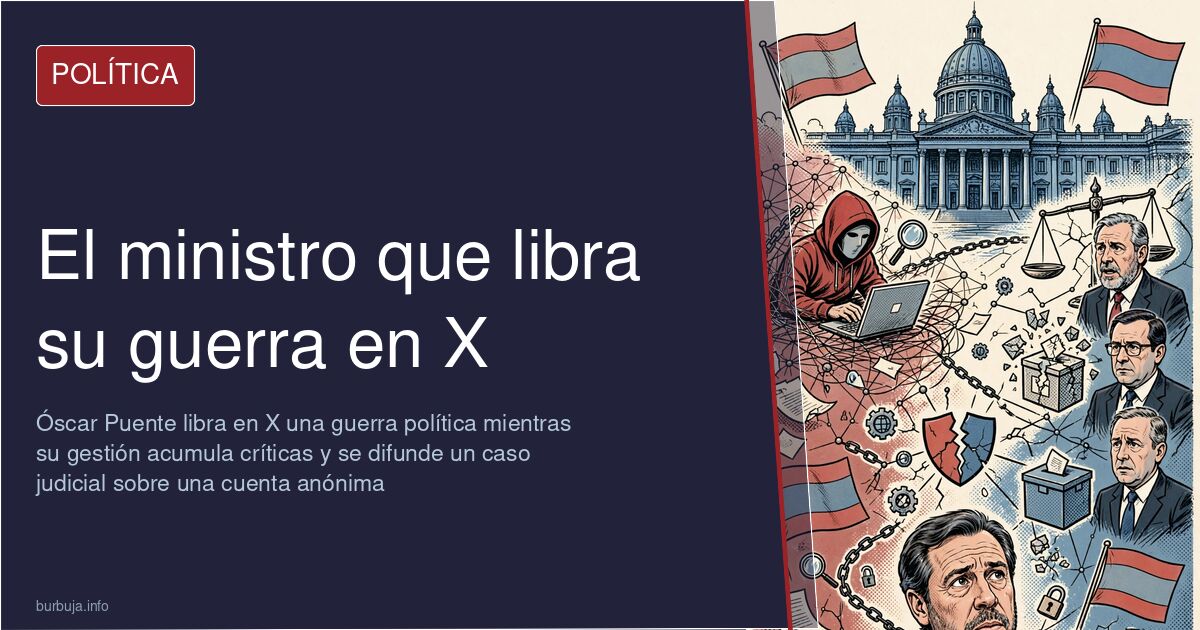
Óscar Puente and the X War That No One Can Extinguish
A minister responding to unknown users on X while his department accumulates incidents. This is the portrait painted by his critics of Óscar Puente, head of Transportes (Ministry of Transport), who has become the protagonist in the political battle waged on social media. The issue is no longer just about trains or roads; it concerns the role of a public official in the digital trenches and where the line is drawn between communicating and provoking.
Why Óscar Puente is so active on X
His critics place the Minister of Transport and Mobility among government accounts with the most activity on the network. He responds to anonymous users, engages in disputes outside his control, and maintains a tone that his defenders call accessibility and his detractors call a simple desire for confrontation. For some, this direct communication is a legitimate tool of a public office. For others, it is exactly what someone managing the rail network should not be doing.
In its harshest version, the criticism recalls that the minister has reportedly spoken disparagingly about the very taxpayers who support his salary. This episode is cited again and again as proof that the problem is not the channel, but the tone.
The judicial case regarding an anonymous account
According to a message circulated on the X network, a Madrid Investigating Court (Juzgado de Instrucción) identified Alejandro Soler Capella, cousin of a Socialist senator, as the alleged responsible party for an anonymous X account and peine preliminary proceedings for harassment and identity theft. The investigated individual was summoned to testify. The case transfers to the courts what until now was a skirmish between profiles: who is behind an anonymous profile and what can be done about it.
Trains, power outages, and the cost of governing via tweet
The most repeated argument against the minister is not ideological, but managerial: that his workday is consumed by the network while trains are systematically late, mass outages occur, and several convoys derail. According to this reading, the time spent responding to anonymous users is time taken away from railway management. On the other side of the scale is the suspicion of double standards: decorum is demanded from the government while the opposition uses social media without reservation. The calculation of a minister's hours versus accumulated incidents presents a picture that neither side finds equally balanced.
Doxing and harassment campaigns: the B-side of politics in social media
The most uncomfortable episode is that of identification and harassment campaigns. An account dedicated to cryptocurrency information was targeted and publicly exposed, with participants who, according to a message circulated on the network, amplified and celebrated its exposure. The practice—known as doxing—consists in revealing a private individual's data for others to harass them.
None of the fundamental questions—how far a minister can go with his account, what responsibility the platform holds, when a tweet becomes a crime—has received an answer closed by the Judiciary. The case remains open. And on X, the war does too.
A minister responding to unknown users on X while his department accumulates incidents. This is the portrait painted by his critics of Óscar Puente, head of Transportes (Ministry of Transport), who has become the protagonist in the political battle waged on social media. The issue is no longer just about trains or roads; it concerns the role of a public official in the digital trenches and where the line is drawn between communicating and provoking.
Why Óscar Puente is so active on X
His critics place the Minister of Transport and Mobility among government accounts with the most activity on the network. He responds to anonymous users, engages in disputes outside his control, and maintains a tone that his defenders call accessibility and his detractors call a simple desire for confrontation. For some, this direct communication is a legitimate tool of a public office. For others, it is exactly what someone managing the rail network should not be doing.
In its harshest version, the criticism recalls that the minister has reportedly spoken disparagingly about the very taxpayers who support his salary. This episode is cited again and again as proof that the problem is not the channel, but the tone.
The judicial case regarding an anonymous account
According to a message circulated on the X network, a Madrid Investigating Court (Juzgado de Instrucción) identified Alejandro Soler Capella, cousin of a Socialist senator, as the alleged responsible party for an anonymous X account and peine preliminary proceedings for harassment and identity theft. The investigated individual was summoned to testify. The case transfers to the courts what until now was a skirmish between profiles: who is behind an anonymous profile and what can be done about it.
Trains, power outages, and the cost of governing via tweet
The most repeated argument against the minister is not ideological, but managerial: that his workday is consumed by the network while trains are systematically late, mass outages occur, and several convoys derail. According to this reading, the time spent responding to anonymous users is time taken away from railway management. On the other side of the scale is the suspicion of double standards: decorum is demanded from the government while the opposition uses social media without reservation. The calculation of a minister's hours versus accumulated incidents presents a picture that neither side finds equally balanced.
Doxing and harassment campaigns: the B-side of politics in social media
The most uncomfortable episode is that of identification and harassment campaigns. An account dedicated to cryptocurrency information was targeted and publicly exposed, with participants who, according to a message circulated on the network, amplified and celebrated its exposure. The practice—known as doxing—consists in revealing a private individual's data for others to harass them.
None of the fundamental questions—how far a minister can go with his account, what responsibility the platform holds, when a tweet becomes a crime—has received an answer closed by the Judiciary. The case remains open. And on X, the war does too.
Summary of a discussion on Burbuja.info - Foro de economía, actualidad y política., translated from Spanish and reviewed before publication. Read the full discussion (127 replies).
More summaries
-
And They Call This Governing (Ignacio Camacho, ABC)
An ABC column criticizes the government for tackling housing with two decrees without guaranteed parliamentary approval and at the cost of reducing supply.
-
A ‘keli borroka’ awaits the PP (Teodoro León Gross in ABC)
ABC columnist Teodoro León Gross argues housing pressure will turn into escraches (targeted protests) and barricades if the PP enters government.
-
A democratic obligation unfulfilled (ABC editorial)
Article 134.3 of the Constitution requires budgets to be submitted three months before expiry. Spain is still running on the 2023 Budget.
-
Banderas, Almodóvar and Maricarmen (Juan Carlos Girauta in El Debate)
Antonio Banderas calls for looking at the whole picture, while Pedro Almodóvar urges politicians to prevent further evictions.
-
The USSR and the Origins of Borregocracia: Thesis and Suspicions
Soviet infiltration, free lawyers, Gramsci and academic inbreeding: the thesis that traces today's groupthink to the USSR.
-
Abascal claims a Spaniard cannot be racist
Abascal claims 'a Spaniard cannot be racist', and his own voters answer with unemployment, demographics and accusations of betrayal