
Oporto or Porto: the debate over foreign city names in Spanish
A forum user asks whether using the traditional Spanish name for foreign cities is fascist. The thread debates Oporto versus Porto and other place names.
English · Original discussion in Spanish · Published
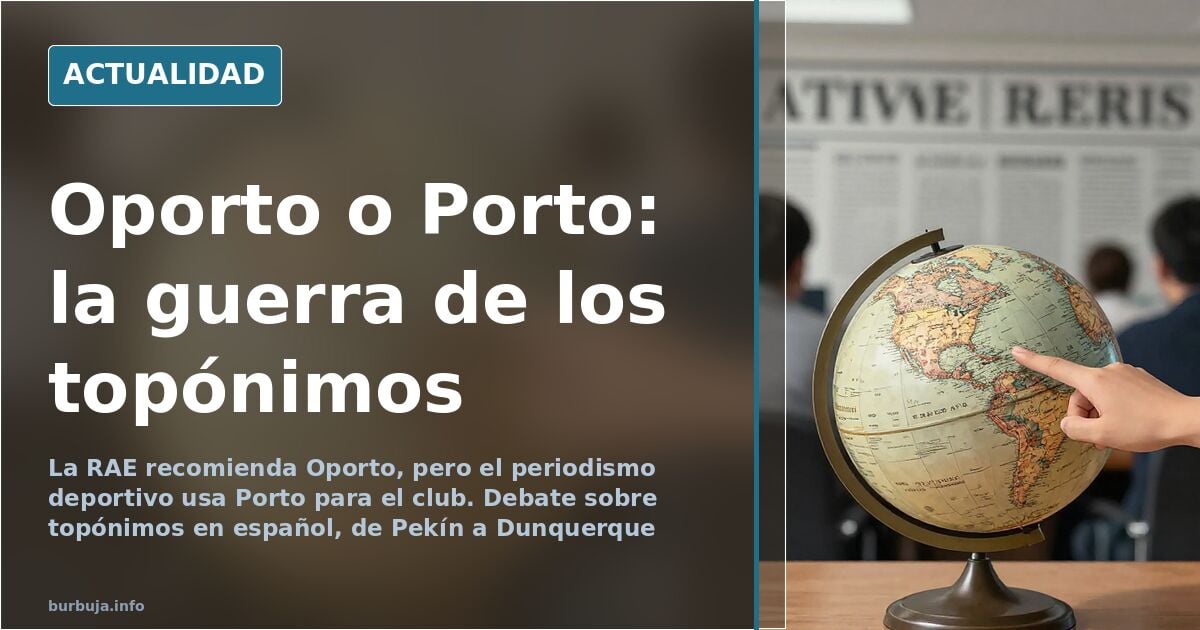
Oporto or Porto: the RAE and the use of the name
Is it fascist to call foreign cities by their traditional Spanish name? The question, raised during a discussion about FC Porto, hides a linguistic debate that goes far beyond football. According to one participant, the Real Academia Española (RAE, Spain's Royal Spanish Academy) recommends using Oporto, the traditional Spanish place name, but in journalism and sport Porto, the club's official name, has prevailed. Controversy erupts every time a media outlet chooses one form or the other, and it is not an isolated case: Dunkirk, Antwerp, Ghent or Bruges are just some examples of cities whose Spanish names are hardly used anymore.
The official name and the traditional one: two conflicting criteria
The Portuguese club is officially called Futebol Clube do Porto. In Portuguese, it is common to say «o Porto» (the Porto), joining the article to the city's name. In Spanish, according to one participant, the RAE recommends Oporto, the traditional name. However, in journalistic and sporting practice both forms are used interchangeably. Some argue that club names are not translated, unlike place names: the city is Oporto, but the club is Porto. The same criterion applies to other teams: the city is Naples, the club is Napoli; the city is Girona, the club is Girona. And nobody would think of saying Turin for Torino. The distinction between city and club also makes it possible to tell when one thing is being discussed and when the other.
The list of Hispanicized place names almost nobody uses
According to one participant, the RAE publishes an appendix with Hispanicized foreign place names. It includes Dunkerque (Dunkirk), Amberes (Antwerp), Gante (Ghent), Brujas (Bruges), Mastrique (Maastricht), Pekín (Beijing), Célebes (Sulawesi) and a long etcetera. Many of these traditional names have fallen out of use, and using them today sounds affected or downright archaic. The case of Holland is paradigmatic: although the country is officially called the Netherlands, the use of Holland remains dominant. One participant points out that Holland is a region of the Netherlands, but its use is so widespread that it is difficult to eradicate. Something similar happens with Oporto: the traditional form survives in formal registers, but common usage leans towards Porto.
The renaming of clubs: a matter of brands
In recent years, clubs have come to manage their names as global brands. FC Porto is a registered trademark, and its use has prevailed in international media. The same happens with Sporting de Lisboa, now promoted as SCP or Sporting de Portugal. Even in the dubbing of series and films the original name has prevailed: Captain Tsubasa instead of Oliver and Benji. The global management of intellectual property has led to club names being respected as they are, without translation. This clashes with the Spanish tradition of adapting place names, but also with the reality that fans and media have mostly adopted the original form.
The case of Spanish cities: double standards
The controversy intensifies when compared with the treatment of Spanish place names. One participant argues that Catalans demand that Gerona be Girona and Lérida be Lleida, but have no qualms about calling Cadis Cádiz or Saragossa Zaragoza. In the Basque Country, Bilbo is used in Basque for Bilbao, but in Spanish Bilbao remains. And in Galicia, A Coruña coexists with La Coruña. The underlying question is whether the official name should take priority over the traditional one, and whether that criterion is applied consistently. The answer is not simple: it depends on the context (administrative, journalistic, colloquial) and on the sensibilities of each territory.
What does the RAE say about Oporto and Porto?
According to one participant, the RAE recommends Oporto as the traditional Spanish place name. However, in journalistic and sporting usage Porto has prevailed, especially when referring to the club. The institution has not issued a condemnation of the use of Porto, but it does maintain its preference for Oporto in its reference works. In practice, both names are accepted, although Oporto is considered more formal and Porto more colloquial or sporting. The evolution of language and the pressure of global brands are tipping the balance towards the original name.
Why is it Oporto in Spanish and Porto in Portuguese?
The name Oporto comes from the Latin Portus Cale, which gave rise to the place name Portugal. In Spanish, phonetic evolution led to Oporto, while in Portuguese Porto was kept. The city has always been called Porto in Portuguese, but in Spanish it was adapted to Oporto. Over time, the use of the original name has spread, especially in the sporting world, where clubs prefer their official designation. The RAE continues to recommend Oporto, but acknowledges that Porto is widely used.
The discussion about Oporto and Porto is merely a symptom of a broader phenomenon: the tension between the traditional name and the official name in a globalized world. Should we keep using Oporto or give in to Porto? The answer, as almost always, depends on whom you ask.
Also available in: Deutsch
Summary of a discussion on Burbuja.info - Foro de economía, actualidad y política., translated from Spanish and reviewed before publication. Read the full discussion (69 replies).
More summaries
-
Spanish model Andrea Aybar sentenced in Vietnam drug case
Spanish model Andrea Aybar, 31, convicted in Vietnam's VN10 mega-trial involving a $29 trillion dong drug network.
-
User Claims 6 Likes on Tinder Premium vs 1,000 Elsewhere
A user reports getting nearly 1,000 likes in a month on another app versus only 6 on paid Tinder Premium, blaming the algorithm.
-
Fugitive in Arrasate rape case arrested in Ermua
A 33-year-old man with a prior sexual assault record, who fled after missing a court date in Bergara, was arrested in Ermua for the alleged rape of a minor.
-
Lobo Estepwarrior: the YouTuber who drinks a litre of wine every night
Lobo Estepwarrior drinks a litre of wine every night, lives off his family inheritance and returns to social media after announcing his retirement. Authentic rebel or actor?
-
Elderly man attacks pedestrians with knife in San Sebastián, Spain
A 64-year-old man of Maghrebi origin carried out a knife attack in San Sebastián, Spain. The debate over pensions and public safety has reopened.
-
The Economist's syringes: crisis calendar or self-fulfilling prophecy?
Two syringes on The Economist's 2026 cover: a calendar of health crises, euthanasia campaigns or pharmaceutical control? We examine the theories.