
Open-plan kitchens: The hidden cost of extra space
Ventilate for five minutes or spend €1,200 on a high-end extractor to decide if open kitchens are practical or unhealthy.
English · Original discussion in Spanish · Published
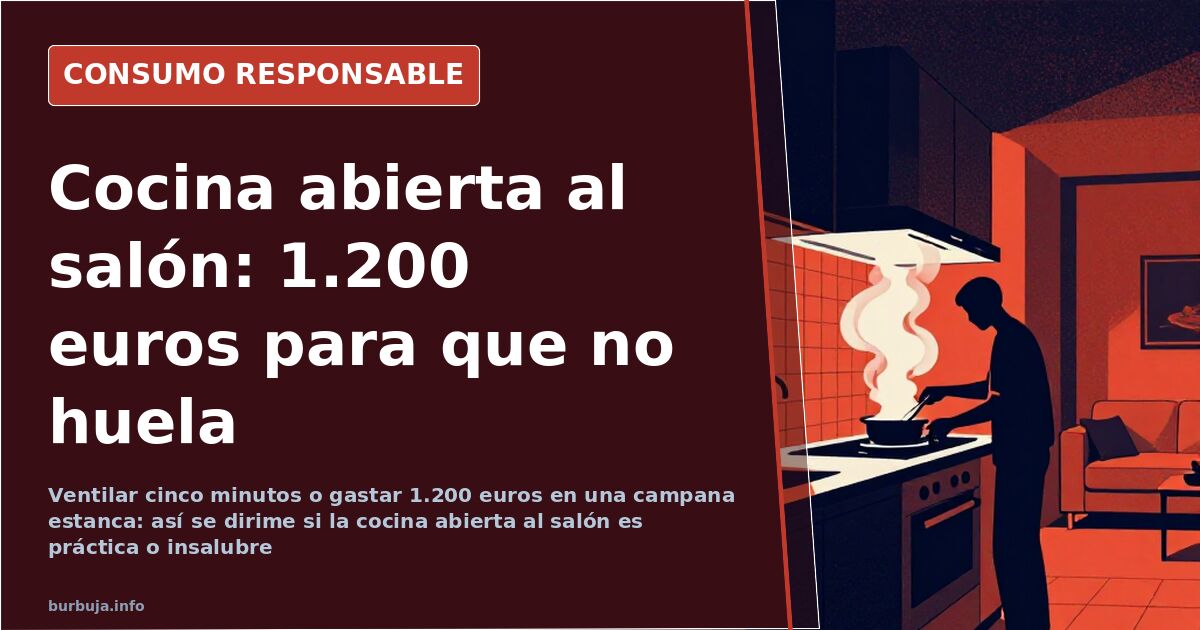
Open-plan kitchen: More light, more space, and the smell of frying
An open-plan kitchen is convenient, brighter, and saves you from carrying trays through two doors. Until you fry salmon. Removing the wall between the kitchen and living room was pitched as a practical solution for small apartments where every square meter counts, sparking a debate between those who prioritize openness and those who refuse to compromise on smells. The trigger is always the same. Serious cooks don’t want their dinner scenting the curtains.
How much does it cost to keep an open kitchen odor-free?
Around €1,200, according to forum users supporting this layout. That’s the price of a high-end, discreet range hood, plus forced ventilation for the rest of the house. The argument is simple: if air doesn’t escape outside, the missing wall isn’t the problem.
On the other end, some estimate €20,000 for a closed kitchen—spacious, well-equipped, and insulated—and defend it as the best investment of their lives, since they cook, eat, and work there. The gap between options is budgetary, not conceptual. The powerful extractor has become the defining appliance of the decade.
The smell of frying: The argument nobody can refute
Odors are where consensus breaks down. Frying salmon, making stew, or simmering broth for four hours releases particles that settle on curtains, sofas, and screens. The question isn’t whether it smells, but how long it lasts: optimists say five minutes with both windows open.
However, ventilation is seasonal. In July and August, everything stays open; in January and February, frying means opening windows and paying for escaping heat. Those in warm climates with terraces can leave doors open year-round. In cold zones, it’s different. Grease fumes ignore thermal insulation.
From hallway to single space: What do you gain by removing walls?
The hallway is the collateral victim. For some, it’s wasted space; for others, it offers order, privacy, and noise isolation from TV while cooking. The debate touches on the origin of compartmentalized homes: some blame historical scarcity and old sarracena codes, while others argue one room equals one function, warning that poor multifunctionality leads to clutter.
Pro-open plan advocates cite a domestic benefit rarely in catalogs: visible kitchens get cleaned more often and discourage piling up dirty dishes. Against them is noise. Watching news while someone fries two meters away carries a social cost no hood can fix.
Why is the open kitchen sold as modernity?
Because it allows marketing a larger living room without building extra space. This is the uncomfortable truth: integrated kitchens are presented as design trends when, in many developments, they’re just a way to sell cramped apartments as lofts. Critics call it an imported fashion adapted poorly, blaming developers and builders. The open concept label wears off quickly.
Defenders’ arguments are technical, not aesthetic. With proper extraction, air doesn’t mix with the living room, solving the issue; without it, any layout smells the same. The difference between a home that cooks heavily and one that reheats food matters more than the wall.
Open or closed kitchen: Routine decides
One variable renovations can’t eliminate: who cleans and when. Open kitchens force immediate cleanup, right when you least want to, lest you dine amidst dirty dishes. Closed kitchens allow leaving chores for tomorrow, at the cost of a darker room.
Garbage and sink odors also matter, which hoods don’t filter but closed doors contain. And then there’s the washing machine, whose traditional kitchen spot clashes with the promise of a quiet living room.
With current real estate prices, open kitchens will continue gaining ground in new builds. Whether they survive the first winter of heavy cooking—or if walls return via back doors (the door you close to hide unwashed plates)—remains to be seen.
Also available in: Deutsch
Summary of a discussion on Burbuja.info - Foro de economía, actualidad y política., translated from Spanish and reviewed before publication. Read the full discussion (132 replies).
More summaries
-
Cheap, Healthy No-Cook Diet: Purees, Legumes, Pressure Cooker
A pressure cooker makes legumes in 45 mins and gazpacho in 15. The debate over daily meals pits the paleo diet against Mediterranean traditions.
-
Latin American Food in Spain: Mediocre or Misunderstood?
Analysis of the debate on Latin American cuisine quality in Spain, exploring whether it is truly mediocre or a matter of expectations.
-
Carrefour ends double refund for pricing errors
Carrefour no longer refunds double the difference for overcharges, limiting compensation to the simple amount as per new store policies.
-
New labelling rules for canned fish: transparency or red tape
From 2026, canned fish must state the exact species and origin. Consumer protection or a new bureaucratic burden that pushes up grocery prices?
-
Griezmann struggles in Miami's 45-degree heat
Antoine Griezmann suffers in Miami's heat. The French footballer shows his struggle in a viral video. What does it mean for the athlete and the show?
-
Who's having kids today: the foolish or the smart?
Who has children today? The dilemma between subsidized fools, busy smart people and the economic burden. Two opposite profiles agree that reproducing is a matter of luck.