
Open Arms and public grants: following the money trail in Spain
The Fundación Proa (Open Arms) appears as a beneficiary of earmarked grants from Spanish town councils, provincial councils and island councils, according to the public register of...
English · Original discussion in Spanish · Published
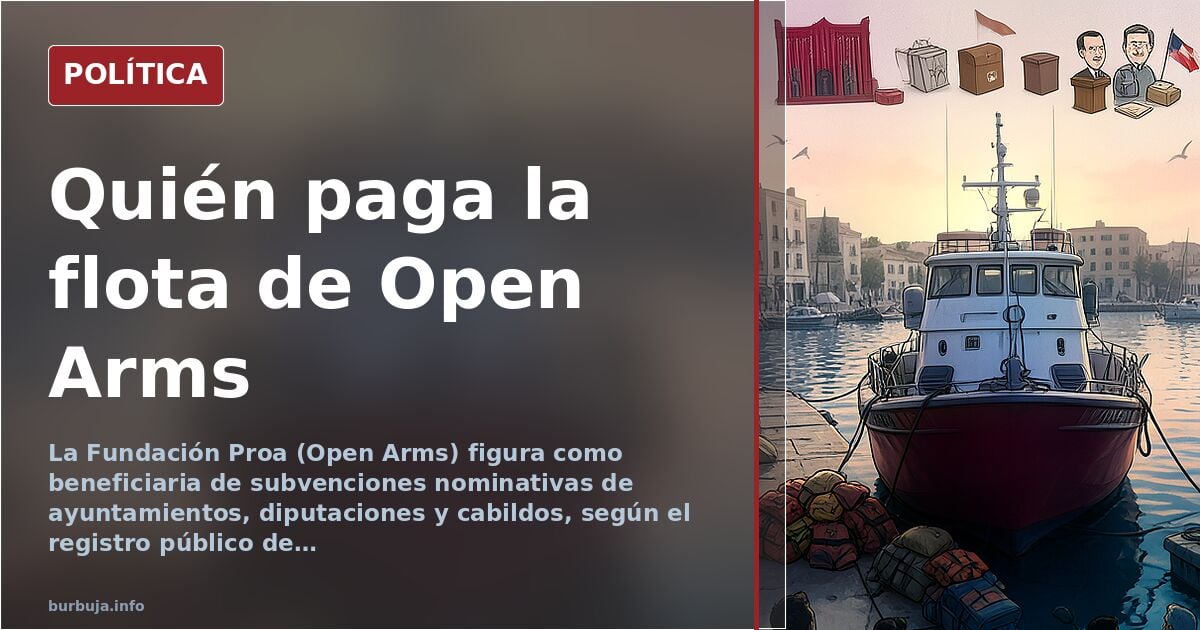
The public money that keeps Open Arms afloat: earmarked grants from local and regional Spanish authorities
A query of Spain's National System for the Transparency of Public Grants and Subsidies leaves an uncomfortable trail: the Fundación Proa (Pro-Activa Open Arms) appears as a beneficiary of earmarked grants (subvenciones nominativas, awarded without competitive tender) granted by administrations of different political stripes and territories. There is no competitive process, no mandatory prior project. The grant is awarded by direct designation. Among the entities listed as grantors are the Departament d'Igualtat i Feminismes of the Generalitat (Catalonia's regional government), the Provincial Council of Tarragona, the El Prat de Llobregat town council, the Cabildo Insular de Gran Canaria (the island's governing council) and the Gata de Gorgos town council. The most common figure is around 20,000 euros per award.
Who pays and how much: the map of earmarked grants
The public register allows part of the web to be reconstructed. In 2023, the Generalitat de Catalunya awarded the foundation 50,000 euros for a travelling exhibition on human rights aboard the Open Arms ship. That same year, the Provincial Council of Tarragona contributed 20,000 euros for the project of "protection through presence, humanitarian rescue and communication in the Mediterranean". In 2021, the El Prat de Llobregat town council granted another 20,000 euros through an earmarked grant, and the Cabildo de Gran Canaria did the same with the same amount. In 2020, the Canary Island council repeated: 20,000 euros in direct grants for running costs. In 2019, the Provincial Council of Tarragona contributed 15,000 euros for fuel, the El Prat town council 25,000 euros for protection and emergency work, and the Gata de Gorgos town council 2,500 euros via an agreement.
The sum of the visible line items exceeds 170,000 euros over six years, in this sample alone. The pattern repeats: local and regional administrations funding an entity that operates in the central Mediterranean, not in their jurisdictional waters. Some ask why a town of 9,000 inhabitants or an island council should devote public money to an NGO that provides no direct service to its residents.
The rescue argument and the suspicion of a business
Those who defend Open Arms' work argue that the organisation is simply fulfilling the duty to rescue in international waters, where European authorities have scaled back their search and rescue capacity. Seen through that lens, public funding would be a way of compensating for the states' abdication of their responsibilities. The travelling exhibition, the agreements and the earmarked grants would be justified as support for humanitarian work that would otherwise have no resources.
The other side is less flattering. Some see in these grants a closed circuit: public money funding an activity that, in turn, generates a migratory flow that then requires more public spending on reception, healthcare and security. A loop that some describe as a tidy business. The absence of competitive tendering in earmarked grants makes it impossible to know whether another organisation could do the same for less money. Nor are there public metrics on cost per rescue or audits detailing exactly what each 20,000 euros is spent on.
The captain, the villas and the opacity of the accounts
On a personal level, claims circulate about the boat captain's assets, attributing to him properties in municipalities in Barcelona, Girona and Alicante. These are accusations made without providing any land registry documentation or court ruling. They should be treated for what they are: unverified suspicions. The same goes for the figures on alleged NGO executives' incomes, which belong to the realm of speculation.
What is verifiable is the structural opacity. Earmarked grants require no competitive process, and the published information is limited to beneficiary, amount, date and a generic description of the project. No breakdown of expenses, no outcome indicators, no impact assessment. The taxpayer pays and does not know exactly what they are buying.
The poverty business and institutional complicity
The underlying debate goes beyond Open Arms. It is about a model of public funding that sustains organisations operating in the field of migration and cooperation without the usual controls of public procurement. The English concept of a "government cut-out" describes, according to one participant in the debate, entities that act as a de facto extension of the administration, carrying out functions the government cannot or will not assume openly. If you trinc the money trail, institutional complicity is hard to deny.
Meanwhile, the debate over whether these grants save lives or feed a business remains without an official answer. The data are there, in a public register anyone can consult. The interpretation, as always, depends on where you focus: on the rescue or on the bill.
How many more earmarked grants will have to be counted before someone calls for an audit?
Also available in: Deutsch
Summary of a discussion on Burbuja.info - Foro de economía, actualidad y política., translated from Spanish and reviewed before publication. Read the full discussion (97 replies).
More summaries
-
Spanish Court Upholds 40% Firefighter Quota for Women
A Spanish court validated a 40% firefighter quota for women in Catalonia, using gender-specific physical standards to address historical underrepresentation.
-
Madrid train bombings: missing evidence fuels conspiracy theories
191 dead, 1,858 injured and lost forensic evidence: the enduring controversy and conspiracy theories surrounding the 2004 Madrid train bombings.
-
Repsol triples profits and the debate shifts to Montero
Repsol triples its half-year earnings on the back of soaring crude prices, according to El Correo, and the debate spills over into electoral calculations around Irene Montero
-
Carmen Polo and the first ladies under scrutiny in Spain
We look at how the role of the first lady has evolved in Spain, from Carmen Polo to today, through the eyes of the forum's most critical users.
-
Salvador Illa and the immunity row after leaving Spain's Health Ministry
Burbuja.info users debate Salvador Illa's legal immunity after leaving the Health Ministry. Justice or political strategy?
-
PP and PSOE strike Andalusian Board deal leaving Vox out
Spain's PP hands the PSOE two seats on the Board of the Andalusian Parliament and leaves Vox out. A move reminiscent of Extremadura that could pave the way to fresh elections.