
Only those with land or livestock will eat, warns forum user
Rural-urban tension resurfaces in food crisis debate: 'Only those with land or livestock will eat,' warns a forum user.
English · Original discussion in Spanish · Published
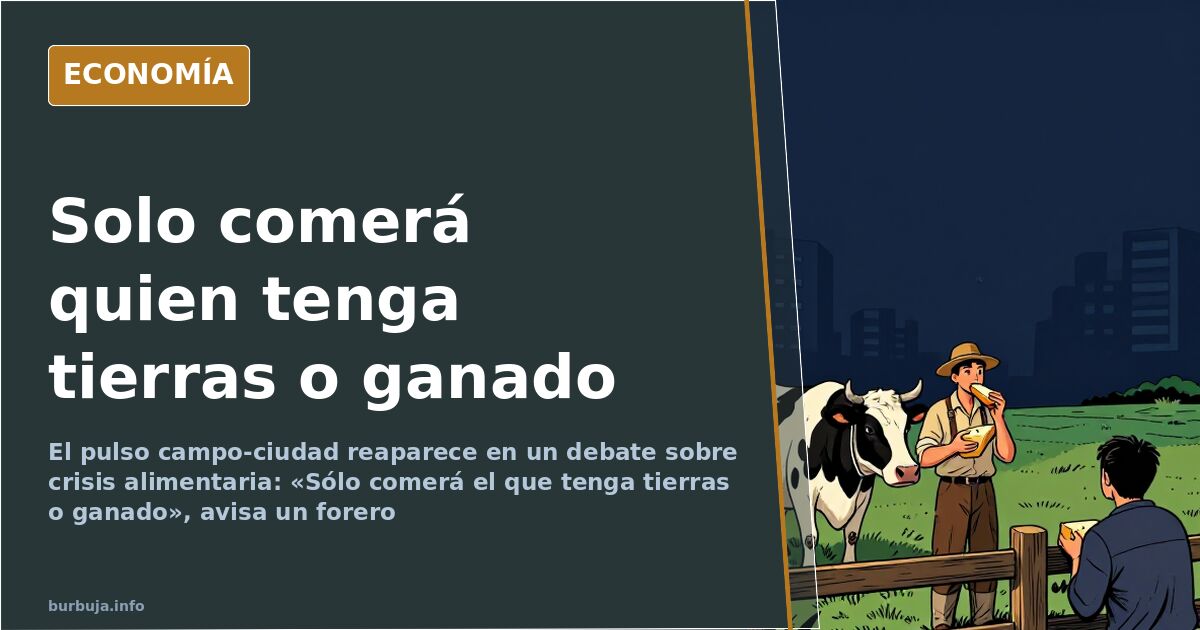
Only those with land or livestock will eat: the countryside versus the city
He stored food at home like a drug dealer. He hid it, rationed it, and concealed it from requisitions. He wasn't a incivil, recalls a forum user: he was a village neighbor during post-war Spain, when having anything meant pretending you had nothing. That instinct reappears decades later in a warning launched in conversation: only those with land or livestock will eat. The phrase reopens an old dispute: is the rural environment the last refuge or a trench with an expiration date?
Who is Nazaret Martín and why does her message unsettle?
Nazaret Martín jumped into public conversation from an unusual profile in municipal politics: shepherd and mayor of her town, a position she holds for Somos Cáceres with backing from the People's Party (Partido Popular). Her trajectory has been read in opposite ways. For some, she is an activist recycled into institutional politics; for others, someone who hasn't shifted her discourse by an inch. What unsettles about the approach is that it shifts focus from shopping basket prices to something less comfortable: primary production. If the system jams, there is no wheat or meat to distribute, and whoever controls the land starts with an advantage.
Post-war as mirror: when the countryside ate and the city did not
The precedent that reappears again and again is the hunger of the 1940s. It is recalled that then the rural population ate more and better than the urban one, and that those visiting the city carried village food in their suitcases. Conversely, there are testimonies, such as those from Galicia, of organized groups going down to rural areas to seize food by force. It is a story, these voices argue, signed by anyone over 80 years old.
Memory doesn't stop there. Parallels are also sought in other experiments of the twentieth century: during Lenin's era, it is claimed, officials ate better than the peasants who produced the food, and those hiding grain faced something worse than reproach. The sarracena some extract is uncomfortable: the producer is not always the one who eats.
Is a shotgun enough to defend land and livestock?
The post-apocalyptic scenario works as a mental test. A calculation circulating in the conversation is devastating: a rifle and a few boxes of cartridges are not enough to defend land and livestock from a hungry mass. In a world without rights, whoever has something must be able to defend it, and force ends up weighing more than property. Hence the conclusion that those who survive have more and better weapons, but above all loyal people to use them.
The institutional version of this antiestéticar is requisition. It is anticipated that, with people starving, a state of emergency or equivalent figure will arrive to take livestock "for the common good," whether it belongs to you or not. The repeated recipe is almost village-like: if you want to keep something, make sure no one knows you have it. Part of the discussion frames this collapse under alleged migratory pressure; the original argument provides no data to support it.
From the series Blackout to virtual currencies
Fiction has given image to this antiestéticar. In Blackout (Apagón), by Sorogoyen, the arrival of hunger in the city is narrated while the countryside lacks nothing; the urban population does not stay to die and goes armed to get what exists, killing livestock instead of raising it. The scene serves as an argument for those who believe the collapse will not be a harmonious barter commune with nature, but a Wild West with different Indians.
The same logic applies to other assets. The enthusiasm of those hoping to buy housing for pennies when everything fell is recalled: if the country degrades to that point, neither virtual currencies nor money serve any purpose, because those who can leave do so, and those who stay will have nothing to sell.
The other side: the countryside does not have everything solved
Against the narrative of rural refuge, there is a reply. If the collapse never arrives, the balance is different: fewer services, fewer benefits, and fewer opportunities for those who stay. Some predict that, by waiting for an apocalypse that does not appear, many will sour their character before their pantry.
The supposed sarracena superiority of the producer is also discussed. In the comparison between working the land and other essential trades, a certain desire to hang oneself the medal of being indispensable is warned against. The countryside feeds, yes. But the argument is sometimes used as a shield against any criticism.
Animal welfare, cages, and living space
Behind the warning about wheat lurks another debate, that of animal welfare versus human welfare. One line circulating summarizes it with irony: animal welfare is demanded with uncaged animals while people are squeezed into 80 m² for three or four within 15-minute cities. The comparison is crude, but points to a discomfort: who decides how we live and how we eat.
With these elements, the warning ceases to be a bon mot and becomes a thermometer. Witnesses of those parties going down to the countryside are today over 80 years old, according to those invoking their story.
Also available in: Deutsch
Summary of a discussion on Burbuja.info - Foro de economía, actualidad y política., translated from Spanish and reviewed before publication. Read the full discussion (155 replies).
More summaries
-
Masonic death threats against Nazaret Martín: hoax or real?
The alleged death threats from Freemasonry against YouTuber Nazaret Martín have been met with scepticism and mockery on social media. We take a closer look at the case.
-
Lagarde hints at food rationing in Europe
ECB President Christine Lagarde raises the possibility of food rationing in Europe. The Burbuja.info forum reacts with panic, prepper advice, and skepticism.
-
PP blocks amnesty bill in Senate, bypassing vote
The PP uses its Senate majority to block the amnesty law vote, pushing the institutional conflict to Spain's courts.
-
Partner of PSOE spokesperson holds 30 properties and two Panamanian companies
The PSOE (Spanish Socialist Workers' Party) spokesperson, Montse Mínguez, and her partner reportedly own 30 rental properties and two companies in Panama.
-
Lula and the Sephardic ancestry debate stirring up politics
A tweet about Lula's Sephardic origins reopens the debate on genealogy and power: from Aznar to Maduro, everyone gets lumped together without verified evidence.
-
Vestrynge and the migration U-turn: a left that no longer believes its own story
Vestrynge, co-founder of Podemos, points to the cost of migration for wages and reopens the left's contradiction: capital drives it, but no one limits it