
Olive prices: from €0.18/kg payment to €10/liter oil
Olives sell for €0.86–€1.30/kg depending on region and quality, while extra virgin olive oil costs around €10/liter. Where does the profit margin go?
English · Original discussion in Spanish · Published
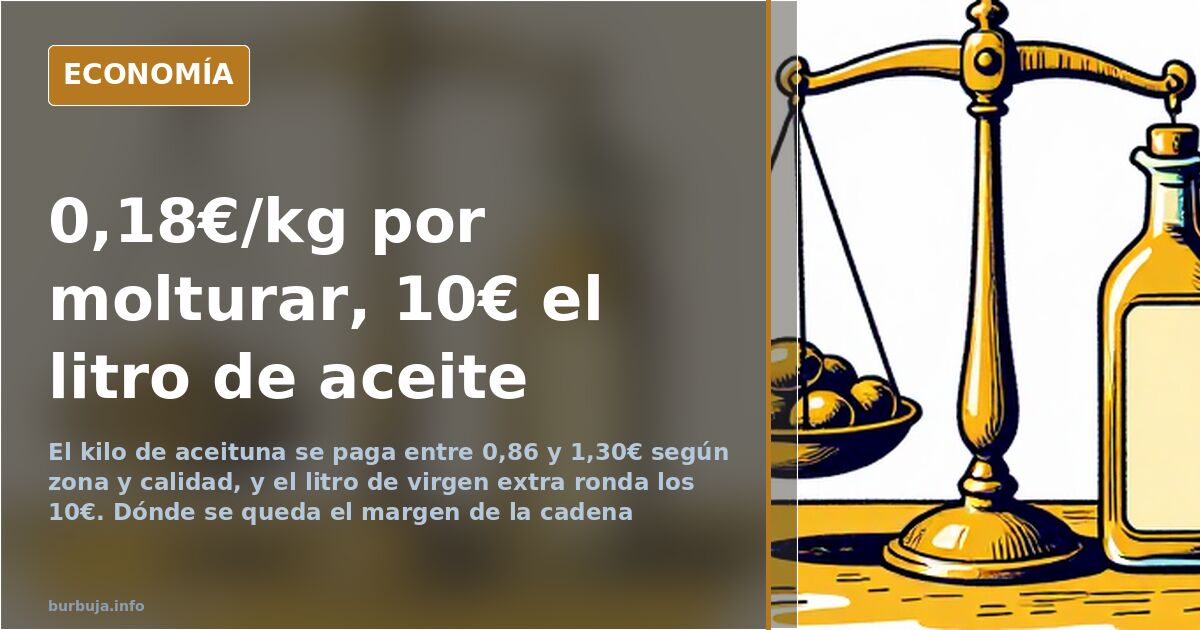
Between €0.86 and €1.30 per kilo: the real price of olives
A kilo of olives is not worth €0.18. Depending on location and perspective, it can be up to seven times higher. The figure that sparked the debate referred to payments to cooperatives for processing the harvest, with oil as currency afterward and no clarification on how many liters were produced. With extra virgin oil retailing at around €10 per liter, the question is no longer whether farmers are paid little, but who keeps the rest of the value chain.
How much is really paid for a kilo of olives?
The figures do not match, which is part of the issue. In Extremadura, some have received €0.86/kg this season. In southern Badajoz, €1.20/kg, a record according to reports. In Castilla-La Mancha, there are accounts of abandoned groves with fruit-laden branches sagging under weight. The upper limit mentioned reaches €1.30/kg, when the norm is considered €0.30 or €0.40.
At the other end are fallen olives, stained with mud and arriving in poor condition: €0.988/kg in some areas, with yields barely reaching 17%. This is the market floor, not the average. Those claiming prices reached twenty times the initial €0.18 case also work within the sector and explain it thus: either the starting price was a favor among acquaintances, or the quality was so poor no cooperative would accept it unconditionally.
How many kilos of olives make one liter of oil?
The calculation depends on yield, often overlooked in discussions. Initial versions cited 5 kilos per liter. Common calculations rise to 7 kilos. Industry insiders expand the range: some get a liter from 4 kilos, others need 8. Fat yield varies between 10% and slightly over 20%, and many regions refuse purchases below 14%. In short: neighboring groves may fetch different prices for the same fruit.
The link between field and shelf
With olives at €1.40/kg and seven kilos per liter, circulating estimates show raw materials alone cost €9.80 per liter of extra virgin oil. That matches supermarket headlines. At Extremaduran prices of €0.86, the math shifts significantly, changing who holds the margin. An uncomfortable detail: despite sanctions, Spanish extra virgin brands sell for €6 per liter in Moscow. This underscores that fruit price explains only part of the final cost.
From mill to label: where margins accumulate
Some argue the largest share of profits goes not to farmers or retailers, but to the almazara (olive oil mill). Notably, investment for this step is small compared to decades of tree cultivation. Hence, large producers are acquiring their own mills.
Beyond this, suspicions abound: buyers keeping warehouses full to buy cheap; products exported to Italy, relabeled, and reimported at premium prices; stockpiling seen as speculation or defense. None stand alone, but all point to the same conclusion: the plowman does not set the price.
Uncollected groves and unsupported claims
In Castilla-La Mancha, reports describe fields with hanging olives and no pickers, questioning if this is abandonment or a strategy to sustain prices. Honestly, no proof exists. Similarly, stories about ancient olive trees ending up in China circulate for years with anger but lack verifiable data. It is wise to separate these from what can be verified: what enters the mill and at what price.
The sector confirms smaller fruit size this year, varying loads across regions, and Jaén remains the benchmark.
What comes next
January is peak harvest time, with many groves still green. Given this, olive prices will likely fluctuate again—up or down—as bulk harvests enter the market. A return to three-year-old oil prices seems unlikely soon.
Also available in: Deutsch
Summary of a discussion on Burbuja.info - Foro de economía, actualidad y política., translated from Spanish and reviewed before publication. Read the full discussion (131 replies).
More summaries
-
Castilla-La Mancha to Expropriate Land Lacking Social Function
New law allows expropriation of rural estates without social use, transferring them up to 25 years to the Banco de Tierras.
-
Olive oil hits €60 per 5L jug in Spain
In Spain, a 5-liter extra virgin olive oil jug costs around €60. Forum users fear prices could double to €100 within six months.
-
Repopulating with the 'unproductive': Spain's controversial empty housing plan
More than half of Spain's empty homes are in Galicia and Castilla-La Mancha. A plan proposes relocating the 'unproductive' there, but local opposition is fierce.
-
Vox cuts €161,000 in LGTBI aid in Spain's Aragon region
The regional government of Aragon has redirected €161,000 from LGTBI support to disability programs, reducing the total budget by 15.5%.
-
Ireland's chief rabbi says the country needs refugees
Ireland's rabbi calls for refugees to support the country's economy in a post on X. An AI's answer to his question about ethnicity and religion sparks the debate.
-
Mario Vaquerizo, 52, plans to buy the Gran Vía building where he lives in Madrid
Mario Vaquerizo has declared a fortune of more than 5 million euros and six apartments in Madrid. His plan: to keep the Gran Vía building and two commercial premises.