
Olive Oil Prices: Drought-Resistant Olives Swapped for Avocates
In 2019, 6,000 hectares of dry-farmed olive groves in Málaga were converted to avocado fields. How does this relate to soaring olive oil prices?
English · Original discussion in Spanish · Published
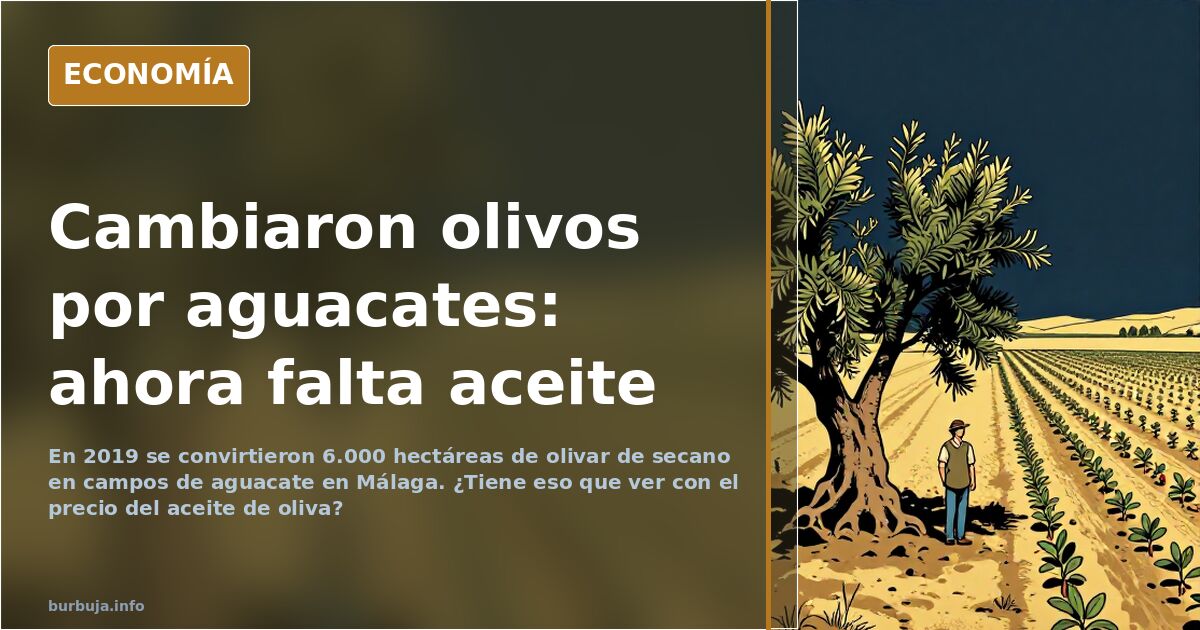
From Dry-Farmed Olives to Avocates: The Agricultural Map Straining Prices
By 2019, the province of Málaga was already undergoing a silent transformation: 6,000 hectares of dry-farmed olive groves converted into tropical fruit fields, specifically avocados and mangoes, in areas struggling with irrigation. Years later, with olive oil prices skyrocketing on shelves, that crop change has returned to the center of the debate. The uncomfortable thesis circulating is: if thousands of olive trees were uprooted, how could there not be a shortage?
The answer isn't so simple. The olive groves removed in the Axarquía region weren't those supporting the national market, and Spain's total olive surface area hasn't stopped growing. But the episode leaves an unanswered question: why plant a water-intensive tree in one of the province's most water-scarce zones?
What Peine to the Olive Trees in the Axarquía?
The news story that sparked the issue, dated 2019, described the replacement of 6,000 hectares of dryland crops with tropical cultivation in the Axarquía district of Málaga. The dry-farmed olive tree, which relied on supplemental irrigation only in very dry years, gave way to avocados and mangoes, two fruits with high European demand and better selling prices.
The economic argument is hard to refute from the outside. Farmers look out for their own business, and for years olives were paid below production cost. Those with marginal, sloped plots of low-yield olive groves found a way out in tropical crops. The question is whether that solution was built on a resource that wasn't guaranteed: water.
Water That Doesn't Match the Crop
The Axarquía is one of the areas with the least water availability in the province of Málaga. Avocados require constant irrigation; dry-farmed olives require almost none. That is the crux of the matter. Planting tropical crops in a dry region forces reliance on wells, and some of those wells lack proper permits.
The result is a conflict that has been postponed: irrigators demanding legalization, administrations looking the other way, and a drought cycle tightening its grip. The lingering question isn't agronomic but territorial planning: who authorized it, who looked away, and why did it come to this?
Is the Avocado Boom to Blame for High Olive Oil Prices?
No. It’s worth stating clearly because the easy equation—fewer olives, less oil, higher prices—doesn’t hold up against the numbers. Spain’s olive surface area has continued to increase, and yields per hectare have risen due to irrigated plantations and intensive farming. Those 6,000 hectares in Málaga are anecdotal compared to the olive groves of Jaén or the Cordoba countryside.
What actually explains the price is something else: a poor harvest, market speculation, and a product that has become a luxury item on shelves. Some argue that olive oil pays VAT inconsistent with its status as a staple food, and that it is cheaper in other European countries than in Spain. A full calculation, including margins and distribution steps, reveals a surprising difference.
Olive Groves That Don't Pay the Bills
The experience of those raised among olive trees dispels the idea of the enriched farmer. An olive tree can yield 100 kilos of olives in a good year and 20 in a bad one, translating to about 25 liters of oil at best. At 50 cents per kilo, that’s 50 euros per tree. You can’t live on that.
That’s why few people in olive-growing areas live exclusively off olives: it’s a supplement, not a salary. And that’s why, when an alternative crop promises more, some switch. Criticism of that decision—calling it greed—clashes with an uncomfortable reality: for decades, traditional olive farming has hovered on the brink of subsistence.
Climate, Drought, and the Coming Business
At the heart of the issue is a reordering of Andalusian agriculture driven by climate and market forces. Avocados and mangoes have European buyers and stable prices; dry-farmed olives do not always. Drought adds a variable no one controls, potentially leaving many with dried-up plantations.
Some hope these plantations will fail and serve as a warning. This stance says more about anger than analysis. The truth is that agriculture has always moved toward where the money is, and the problem isn't the farmer who switches, but a model that guarantees neither water nor stable prices for either crop.
The discussion stalls exactly here: between those blaming the farmer and those blaming the speculator, no one has yet explained how to irrigate the Axarquía without illegal wells or how to pay dry-farmed olives without subsidies.
By 2019, the province of Málaga was already undergoing a silent transformation: 6,000 hectares of dry-farmed olive groves converted into tropical fruit fields, specifically avocados and mangoes, in areas struggling with irrigation. Years later, with olive oil prices skyrocketing on shelves, that crop change has returned to the center of the debate. The uncomfortable thesis circulating is: if thousands of olive trees were uprooted, how could there not be a shortage?
The answer isn't so simple. The olive groves removed in the Axarquía region weren't those supporting the national market, and Spain's total olive surface area hasn't stopped growing. But the episode leaves an unanswered question: why plant a water-intensive tree in one of the province's most water-scarce zones?
What Peine to the Olive Trees in the Axarquía?
The news story that sparked the issue, dated 2019, described the replacement of 6,000 hectares of dryland crops with tropical cultivation in the Axarquía district of Málaga. The dry-farmed olive tree, which relied on supplemental irrigation only in very dry years, gave way to avocados and mangoes, two fruits with high European demand and better selling prices.
The economic argument is hard to refute from the outside. Farmers look out for their own business, and for years olives were paid below production cost. Those with marginal, sloped plots of low-yield olive groves found a way out in tropical crops. The question is whether that solution was built on a resource that wasn't guaranteed: water.
Water That Doesn't Match the Crop
The Axarquía is one of the areas with the least water availability in the province of Málaga. Avocados require constant irrigation; dry-farmed olives require almost none. That is the crux of the matter. Planting tropical crops in a dry region forces reliance on wells, and some of those wells lack proper permits.
The result is a conflict that has been postponed: irrigators demanding legalization, administrations looking the other way, and a drought cycle tightening its grip. The lingering question isn't agronomic but territorial planning: who authorized it, who looked away, and why did it come to this?
Is the Avocado Boom to Blame for High Olive Oil Prices?
No. It’s worth stating clearly because the easy equation—fewer olives, less oil, higher prices—doesn’t hold up against the numbers. Spain’s olive surface area has continued to increase, and yields per hectare have risen due to irrigated plantations and intensive farming. Those 6,000 hectares in Málaga are anecdotal compared to the olive groves of Jaén or the Cordoba countryside.
What actually explains the price is something else: a poor harvest, market speculation, and a product that has become a luxury item on shelves. Some argue that olive oil pays VAT inconsistent with its status as a staple food, and that it is cheaper in other European countries than in Spain. A full calculation, including margins and distribution steps, reveals a surprising difference.
Olive Groves That Don't Pay the Bills
The experience of those raised among olive trees dispels the idea of the enriched farmer. An olive tree can yield 100 kilos of olives in a good year and 20 in a bad one, translating to about 25 liters of oil at best. At 50 cents per kilo, that’s 50 euros per tree. You can’t live on that.
That’s why few people in olive-growing areas live exclusively off olives: it’s a supplement, not a salary. And that’s why, when an alternative crop promises more, some switch. Criticism of that decision—calling it greed—clashes with an uncomfortable reality: for decades, traditional olive farming has hovered on the brink of subsistence.
Climate, Drought, and the Coming Business
At the heart of the issue is a reordering of Andalusian agriculture driven by climate and market forces. Avocados and mangoes have European buyers and stable prices; dry-farmed olives do not always. Drought adds a variable no one controls, potentially leaving many with dried-up plantations.
Some hope these plantations will fail and serve as a warning. This stance says more about anger than analysis. The truth is that agriculture has always moved toward where the money is, and the problem isn't the farmer who switches, but a model that guarantees neither water nor stable prices for either crop.
The discussion stalls exactly here: between those blaming the farmer and those blaming the speculator, no one has yet explained how to irrigate the Axarquía without illegal wells or how to pay dry-farmed olives without subsidies.
Summary of a discussion on Burbuja.info - Foro de economía, actualidad y política., translated from Spanish and reviewed before publication. Read the full discussion (144 replies).
More summaries
-
Olive oil prices drop after record surge changed habits
Olive oil prices fall as consumption hits a 12-year low, signaling a permanent shift in Spanish buying habits.
-
Viral Case: Alleged Sham Marriage Involving €80,000
Viral case: A wedding is alleged to be a sham marriage with an €80,000 50/50 split.
-
Economist warns Spain lacks funds for February pensions
José Carlos Díez states there is no money to pay February pensions while the government raises non-contributory benefits by 11%. The debate on...
-
Spanish Cities Monitor Mobile Data Without Transparency
Forum reports reveal Pamplona, Madrid and Bilbao track mobile signals under varied pretexts, raising smart city privacy concerns.
-
Spain's PSOE proposes mandatory quotas for unaccompanied migrant minors
The ruling party files a Senate bill mandating inter-regional distribution of unaccompanied migrant minors, while granting Catalonia full immigration powers.
-
Ayuso distances partner as judicial probe tightens
Madrid leader calls Alberto González 'a private individual' while prosecutors postpone testimony in medical supplies scandal.