
Oil and Debt: The Keys to Europe's Crisis
Debate ensues: The US seeks military fuel and crude oil, while Europe grapples with debt, inflation, and high energy costs. Crisis or total war?
English · Original discussion in Spanish · Published
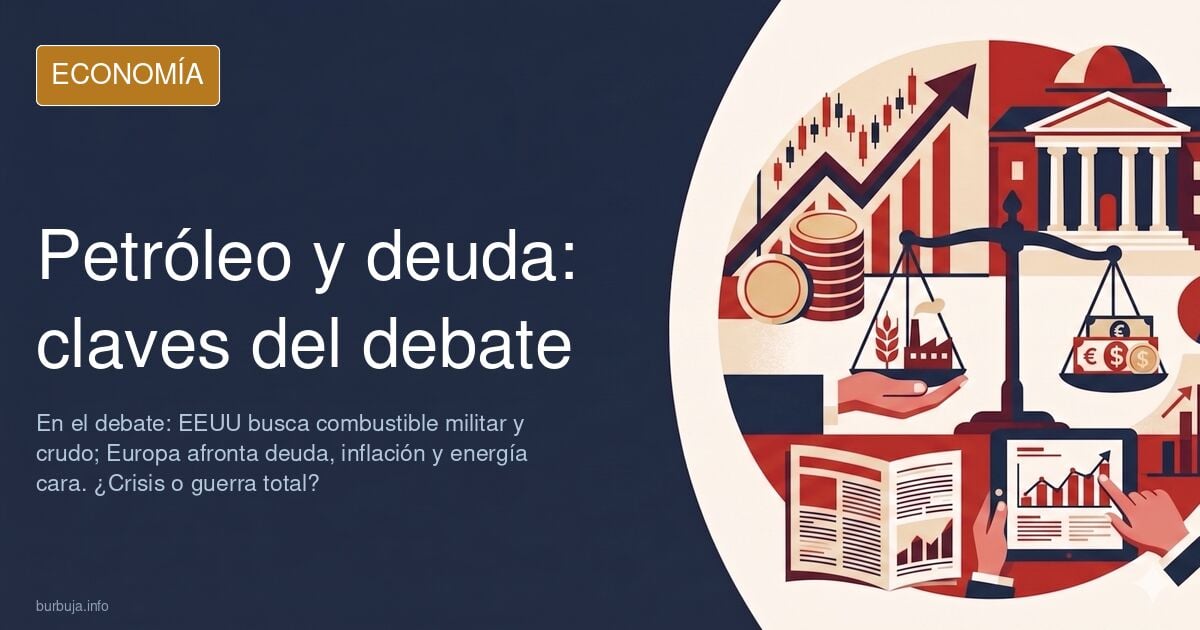
Oil and Debt: The Keys to Europe's Crisis
In the debate, there is discussion about whether a new war will occur, but one participant maintains that it is possible to trinc what they call the trail of escalation: state-scale accumulation of fuel for war vehicles, the intention to control deposits, and the Strait of Hormuz as an energy bottleneck. According to this line of analysis, the pattern is not set by a single American leader, but by the entire U.S. political establishment.
Is the US preparing for total conflict?
The thesis attributed to that participant is: it is not the work of one figure, but the entire Senate and U.S. political apparatus moving toward a military escalation. The probability is seen as high, although not in the short term. Hence, according to their account, the turn toward oil: securing fuel for the military fleet and reserves for years, along with control over Venezuelan crude and the threat regarding Iran and the Strait of Hormuz. The debate also states that several countries surrounding Russia are preparing their population for a military situation, and that their economy is in sharp decline.
The European crisis that would arrive before the war
Another participant maintains that Europe will face an imminent crisis, with or without war, and states there is no debate among experts. The indicators cited are energy pressure (expensive gas and oil due to the Middle East conflict and because, according to him, Russia no longer sells gas), public debt that has been growing rapidly for decades, persistent inflation, declining productivity, and a severely weakened industrial fabric facing China.
Is NATO expansion an excuse or protection?
The focus is placed on Finland and the Baltic states—Estonia, Latvia, and Lithuania—with doubts about how Sweden and Norway would react initially. Against the thesis of defense, the counter-doubt appears: if NATO had not expanded, there would be no reason to assume an invasion. Suspicion is also cast that all of this is a distraction and a massive diversion of money. Another participant summarizes it in one phrase: nothing will happen.
A more extreme current circulating in these debates leads to conspiracy theories without any documentary support, such as a supposed plan to divide the world among major powers. There are no facts there, only narrative.
In the debate, there is discussion about whether a new war will occur, but one participant maintains that it is possible to trinc what they call the trail of escalation: state-scale accumulation of fuel for war vehicles, the intention to control deposits, and the Strait of Hormuz as an energy bottleneck. According to this line of analysis, the pattern is not set by a single American leader, but by the entire U.S. political establishment.
Is the US preparing for total conflict?
The thesis attributed to that participant is: it is not the work of one figure, but the entire Senate and U.S. political apparatus moving toward a military escalation. The probability is seen as high, although not in the short term. Hence, according to their account, the turn toward oil: securing fuel for the military fleet and reserves for years, along with control over Venezuelan crude and the threat regarding Iran and the Strait of Hormuz. The debate also states that several countries surrounding Russia are preparing their population for a military situation, and that their economy is in sharp decline.
The European crisis that would arrive before the war
Another participant maintains that Europe will face an imminent crisis, with or without war, and states there is no debate among experts. The indicators cited are energy pressure (expensive gas and oil due to the Middle East conflict and because, according to him, Russia no longer sells gas), public debt that has been growing rapidly for decades, persistent inflation, declining productivity, and a severely weakened industrial fabric facing China.
Is NATO expansion an excuse or protection?
The focus is placed on Finland and the Baltic states—Estonia, Latvia, and Lithuania—with doubts about how Sweden and Norway would react initially. Against the thesis of defense, the counter-doubt appears: if NATO had not expanded, there would be no reason to assume an invasion. Suspicion is also cast that all of this is a distraction and a massive diversion of money. Another participant summarizes it in one phrase: nothing will happen.
A more extreme current circulating in these debates leads to conspiracy theories without any documentary support, such as a supposed plan to divide the world among major powers. There are no facts there, only narrative.
Summary of a discussion on Burbuja.info - Foro de economía, actualidad y política., translated from Spanish and reviewed before publication. Read the full discussion (33 replies).
More summaries
-
Amazon's €18,000 House: Forum User Calculates €180,000 in Permissions
An Amazon prefabricated house costs less than €18,000. A forum user calculates that with permits, land, and fees, the total reaches €180,000.
-
Euthanasia in Old Age: Autonomy vs. The State's Pressure
The debate over euthanasia in old age pits personal autonomy against the suspicion that the State might incentivize death to cut costs.
-
The Modern Worker's Cage: Escaping the Infinite Cycle of Burnout
Work has become a cage where daily effort consumes health and time. Discover why we push ourselves so hard and how to break the cycle.
-
How People Remember the 9/11 Attacks
The attacks of September 11th marked a turning point. Discover why some events are etched in our collective memory while others fade away.
-
Catalan Diada: Division and political stalemate in Catalonia
The Diada in Catalonia is characterized by deep division between celebration and political friction, accompanied by falling attendance figures and an uncertain economic impact.
-
Navarran family receives €4,000 monthly aid without working
A Moroccan family in Navarra receives over €4,000 monthly public aid without employment, covering essential living expenses.