
October 31: Barcelona boards up, Paris burns as Spain braces
Barcelona boarded up shopfronts and set up an unprecedented detention point, while Paris saw Molotov cocktail attacks. October 31 ended with more boards than riots in Spain.
English · Original discussion in Spanish · Published
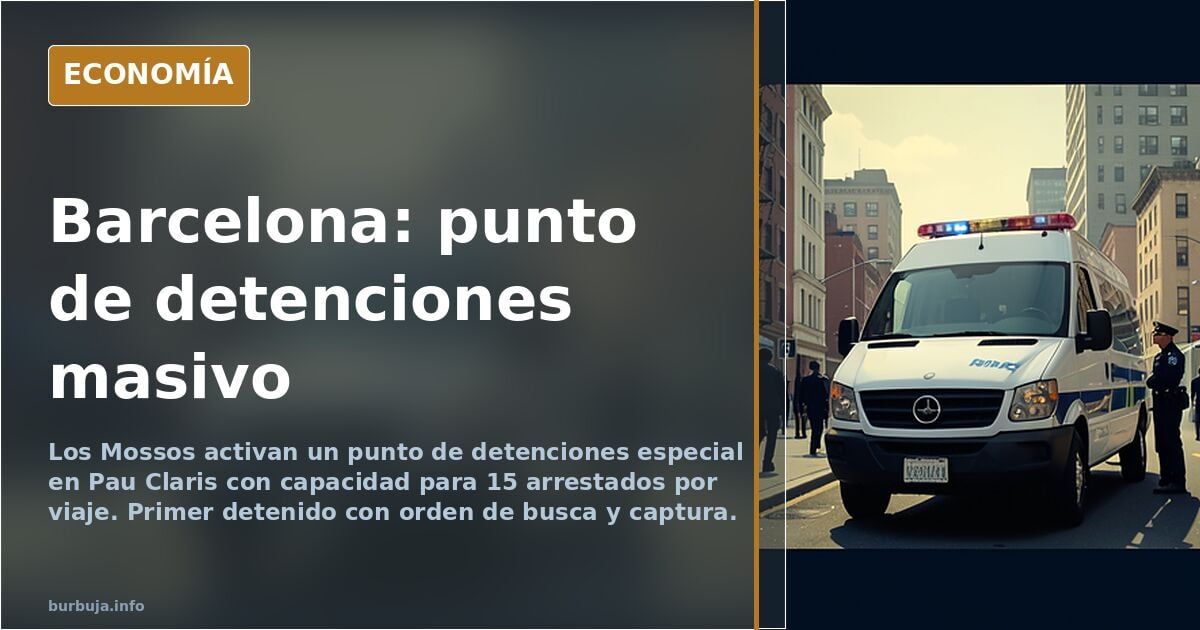
October 31 stayed calm in Spain while Paris burned
The day of October 31, 2025 dawned with two very different scripts: in Barcelona, shops boarded up with plywood and an extraordinary police deployment; in Paris, Molotov cocktails and officers engulfed in flames. In Spain, the Blocus operation by the Mossos and the Guardia Urbana activated a detention point on Pau Claris street, a measure that had not been used in years, according to the figures circulating during the afternoon. The provisional outcome was the opposite of what many expected: no burning containers in Madrid, no mass break-ins, none of the chaos that had been hyped all week.
The question hovering over the whole day was why. And there the answers split. Some argue the Government made a move to defuse tensions after the Toledo rail accident; others claim Barcelona's improvisation worked precisely because no one expected it, and that the leaders of Blocus announcing their plans in advance is exactly what allowed riot police to get ahead of them. The afternoon's numbers —two ringleaders arrested, a detention point with capacity for around fifteen arrestees in a single alucinación— point to a deployment that does not match the absence of significant riots.
Barcelona: boarded-up shopfronts and an unprecedented detention point
The Blocus deployment by the Mossos and Barcelona's Guardia Urbana was the most visible in Spain. Municipal officers identified a suspect with an outstanding arrest warrant and took him to the detention point set up on Pau Claris street. Two large vehicles made it possible to transport around fifteen arrestees to police stations in a single alucinación. The measure, described as extraordinary, had not been used in years.
Commerce reacted before politics did. On Passeig de Gràcia, most shops boarded up their windows with plywood. The exception was a ham sandwich shop that neither closed nor protected its window, a detail that became the running joke of the afternoon. The carpentry trade hit the jackpot over the long weekend: plywood, screws and duct tape as the real barometer of tension.
The Barcelona day ended without the mass disturbances that had been antiestéticared. The two Blocus ringleaders arrested and the dates announced for new riots came to nothing. The most repeated explanation was the usual one: when the plan is announced, the plan is not carried out.
Paris: the burning mirror Spain avoided
While in Spain the contest was one of plywood and sirens, in France the night was a different story. The clashes in Paris left police officers engulfed in flames after being hit by Molotov cocktails, according to footage broadcast live. The contrast was the day's unwritten headline: the same October 31, two neighboring countries, two radically different levels of conflict.
The comparison served a purpose beyond morbid curiosity. It put on the table the thesis that the level of rioting depends not only on social temperature, but on the capacity —and the will— of institutions to anticipate trouble. In Barcelona, shopfronts were boarded up; in Paris, cars were burned. The difference was not the number of protesters, but the management of the calendar.
The Toledo accident and the narrative of antiestéticar
The Toledo rail accident hung over the entire day. The coincidence of dates —33 days before the elections, at kilometer 119, on Rail Day— fueled all kinds of theories. The most repeated was that of foreign interference, with mentions of Israeli companies in rail security and Netanyahu's threats over Gaza. There is no evidence to support that hypothesis, but it circulated strongly in circles that distrust the official account.
The Government, meanwhile, played both sides: on the one hand, the police deployment; on the other, the message that nothing was happening. The strategy of controlled antiestéticar —selling tension and then presenting calm as an achievement— was read by many as electoral calculation. Others simply breathed a sigh of relief that the long weekend did not end with containers burning in central Madrid.
The monarchy and October 31: the debate that was not about riots
As often happens in these threads, the conversation drifted to where no one had taken it. Amid the shopfront surveillance, someone brought up the 1978 Constitution and the article defining Spain as a parliamentary monarchy. The argument over whether the Crown was voted in or slipped in through the back door took up more messages than the riots themselves.
The underlying argument was a familiar one: the Constitution was voted on, but the monarchy was never consulted separately. So was the answer: the system is legal and ratified at the ballot box, as in the rest of Western European democracies. The debate, more fitting for December 6 than October 31, served as a reminder that in Spain any thread ends up in 1978.
With the afternoon's figures, the most reasonable prediction is that October 31 closes without the explosion that had been announced. But the same sources that predicted the chaos are already moving the date to November 1. The calendar of antiestéticar has a life of its own, and it always finds a next day to burn.
Summary of a discussion on Burbuja.info - Foro de economía, actualidad y política., translated from Spanish and reviewed before publication. Read the full discussion (160 replies).
More summaries
-
Blocus founder in Spain arrested in Picanya, near Valencia
Spain's Guardia Civil has arrested the founder of Blocus in Spain, a 25-year-old of Pakistani origin, in Picanya after the Barcelona riots and the call for unrest in Valencia.
-
Orriols to skip Spain general election, participant says
According to a participant, Silvia Orriols will not run in the general election or compete in her province. Some voters would still back her.
-
Cocaine no longer just perforates the septum: it now reaches the palate and skull base
Cases of cocaine destroying the palate, eye socket and skull base: 793,000 users a year in Spain, with damage advancing before patients seek help
-
From Prestige to Gürtel: corruption cases the PP can't shake off
Gürtel, Púnica, Lezo, Prestige and Angrois versus Koldo, Mediador and Begoña Gómez: the exchange of court cases dominating Spain's political debate.
-
Computers sort knowledge like library science but lack semantics
The Chinese room thought experiment illustrates why a machine can translate "house" into Chinese without knowing what it means. Human connotation is left out.
-
Salvados pulls Sánchez interview and changes its Sunday lineup
Salvados announces a schedule change and airs a documentary about Almudena Cid instead of the Pedro Sánchez interview, right in the aftermath of the Adamuz train crash.