
Cocaine no longer just perforates the septum: it now reaches the palate and skull base
Cases of cocaine destroying the palate, eye socket and skull base: 793,000 users a year in Spain, with damage advancing before patients seek help
English · Original discussion in Spanish · Published
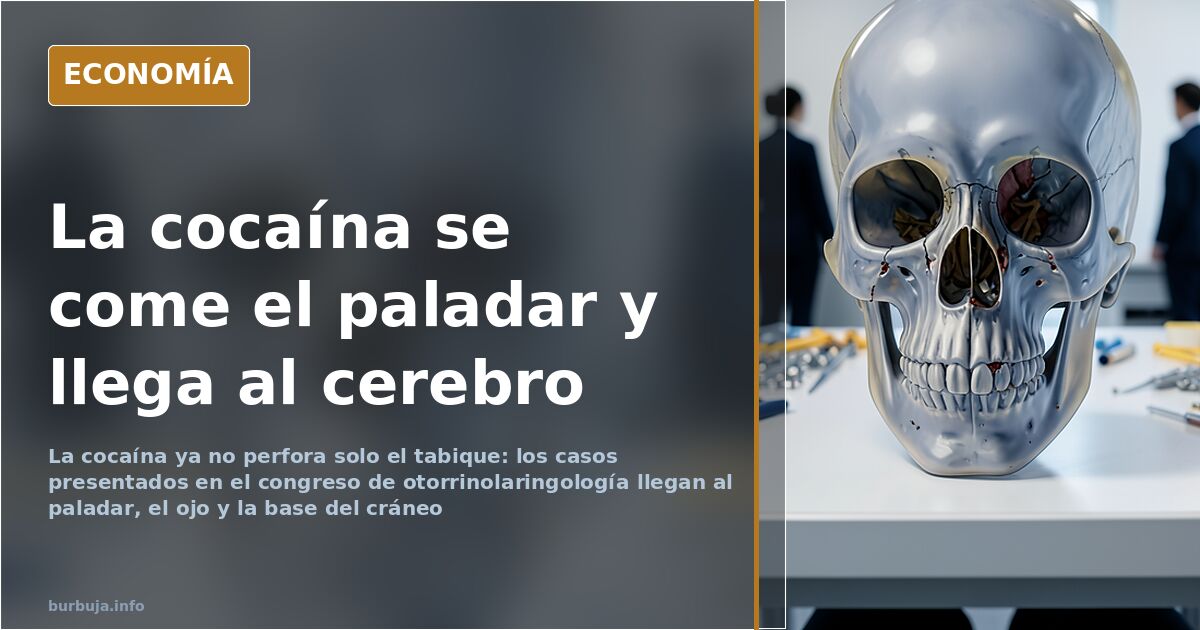
From a perforated septum to a hole in the base of the skull
What happens when cocaine stops being a nose problem and becomes a skull problem? At the last National Congress of the Spanish Society of Otolaryngology and Head and Neck Surgery, held in October in Madrid, several cases were presented that go far beyond the classic septal perforation: lesions in the palate, in the skin of the nose, in the eye socket and even in the base of the skull. These are uncommon complications, but they reach the clinic when the tissue has already been dying for a long time.
The mechanism is textbook. Cocaine constricts blood vessels, reduces blood flow and leaves cells without oxygen or nutrients. "It's the same as what happens in a heart attack or stroke, but in the tissues of the nose, where they die, the cartilage is destroyed and perforations appear," explains specialist Gonzalo Díaz Tapia. The first signs resemble those of a common cold. Almost nobody seeks medical help at that stage.
How much cocaine does it take to destroy the palate
The figure that frames the whole issue: some **793,000 people** aged 15 to 64 used cocaine in Spain in the last year, **2.5%** of that age group, according to the EDADES survey by the Ministry of Health. When asked about the last 30 days — the indicator of frequent use — the figure drops by half. Tissue destruction, otolaryngologists stress, requires practically daily use.
When the damage reaches the palate, the hole connects the mouth and nasal passages. Eating and speaking become difficult, the voice takes on a nasal resonance and secretions stagnate in cavities where infections thrive. In the most extreme case presented, a patient arrived at the ICU with a cerebrospinal fluid leak and a serious neurological condition: surgeons removed necrotic tissue and closed the hole, but use continued and the patient died from aspiration pneumonia.
The cut matters too: levamisole and necrosis
The substance being snorted is not just cocaine. A large part is adulterated with **levamisole**, a veterinary antiparasitic that adds risks of its own, from vascular problems to necrosis in ears and fingers. Some argue that today's quality is so inconsistent that users don't know what they are taking; others maintain that purity has improved in recent years. The available evidence does not settle the dispute.
Another of the presentations describes a woman who had lost the sight in one eye and suffered uncontrollable pain despite medication. After several operations to remove dead tissue from the nose and paranasal sinuses, surgeons performed an orbital exenteration: they removed the eye, emptied the socket and reconstructed it with tissue from the patient's own body.
Why surgery is pointless if use doesn't stop
The first step of any reconstruction is quitting cocaine. "Otherwise, there's no point, because it won't heal and it will die again," says Díaz Tapia. A failed operation, moreover, burns options that would be useful later on. The sequence matters: first quitting, then the operating room.
The story behind these cases trinc a repeated pattern. The initial euphoria becomes the memory of something that never returns, and each new dose is a failed attempt to repeat it. Depression settles in as the normal state, and the drug stops being about pleasure and becomes about trying to function. At the extreme, physical and psychological deterioration advance together.
With nearly 800,000 users a year and a health system that only sees the tip of the iceberg, the question is not how many extreme cases there are. It is how many are already in the cold-like phase that nobody consults about.
Summary of a discussion on Burbuja.info - Foro de economía, actualidad y política., translated from Spanish and reviewed before publication. Read the full discussion (246 replies).
More summaries
-
Migrants in Spain healthier than Spaniards: inconvenient truth or statistical bias?
Spain's Ministry of Health claims migrants spend less on healthcare. But age differences and lower tax contributions cast doubt on the official optimism.
-
Maricarmen, a former property and rental company executive, faces eviction
Maricarmen, the face of Spain's eviction debate, was the sole administrator of rental companies, according to the companies register. The narrative is falling apart.
-
Partner of PSOE spokesperson holds 30 properties and two Panamanian companies
The PSOE (Spanish Socialist Workers' Party) spokesperson, Montse Mínguez, and her partner reportedly own 30 rental properties and two companies in Panama.
-
Spain's minimum income benefit to rise 14% in 2027, tied to non-contributory pensions
Spain's IMV minimum income will rise almost 14% in 2027 due to its legal link to non-contributory pensions: from 733.60 to 836 euros per month for a single person.
-
Mercadona worker fired for clocking in two minutes late in Spain
A Mercadona employee in Spain was dismissed after clocking in two minutes late three days in a row. The case reopens the debate over time tracking and working time.
-
AI insiders warn: 'it could kill us before 2030'
About a dozen former employees of OpenAI, Anthropic and Google warn of safety failures and systems that are hard to control. One believes AI could kill us…