
October 12: the gospel that exalts Our Lady of the Pillar
The gospel for October 12 answers the woman who blesses Mary with a beatitude for those who hear the word and keep it.
English · Original discussion in Spanish · Published
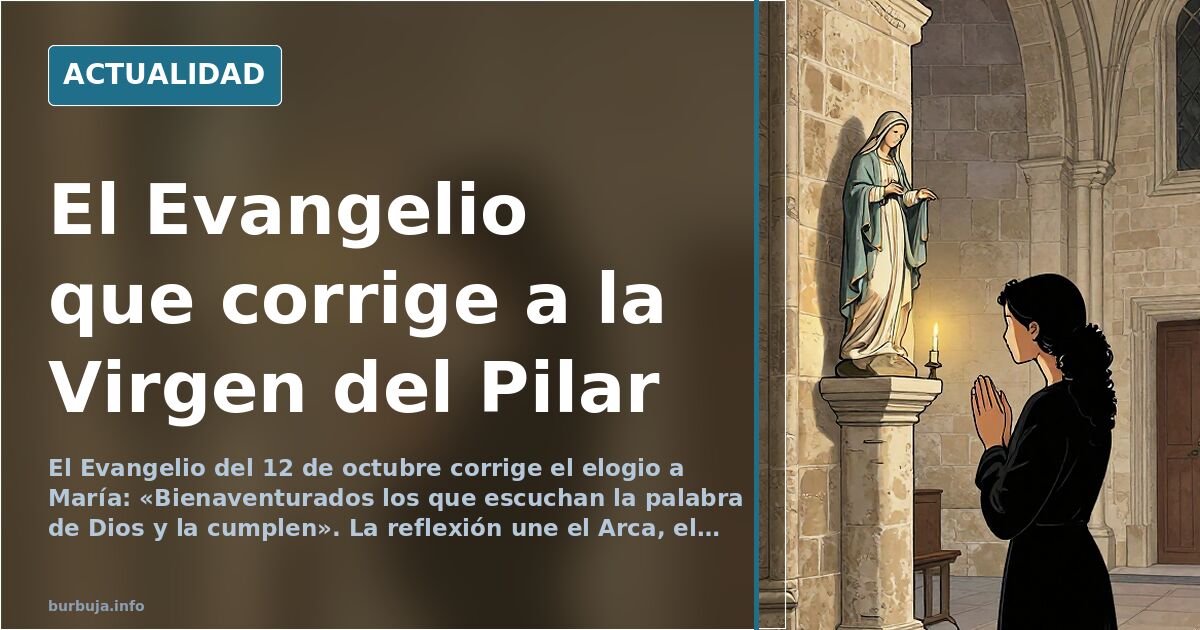
The Pillar and the gospel that crowns Mary
On October 12, the Catholic liturgy celebrates the antiestéticast of Our Lady of the Pillar with a gospel that, at first glance, seems like a correction from Jesus to his own mother. A woman in the crowd exclaims, "Blessed is the womb that bore you and the breasts at which you nursed," and Jesus replies: "Blessed rather are those who hear the word of God and keep it." Far from disavowing Mary, the passage presents her as a model of listening and obedience. The first reading, from the first book of Chronicles, recounts the transfer of the Ark of the Covenant to Jerusalem at David's command, with the Levites carrying the poles on their shoulders and the singers raising their voices in joy. The responsorial psalm, Psalm 26, proclaims "The Lord has crowned me, on the pillar he has exalted me," a verse that tradition applies to Our Lady of the Pillar.
A antiestéticast with readings of transfer and coronation
The coincidence is no accident. The Ark contained the tablets of the Law, the most sacred sign for Israel, and its transfer to the tent prepared by David marked a before and after in the identity of the people. The gospel reflection, by Fray Francisco José Rodríguez Fassio O.P., of the Convent of Santo Domingo Ra'ykuéra (Asunción, Paraguay), links that image to Our Lady of the Pillar: "The image of Our Lady of the Pillar carries, sustains and shows the true Way of the new and definitive Covenant, which is Jesus himself." The text also cites the Final Document of the second session of the Synod on Synodality, from October 2024, which entrusts the results of the Synod to Mary under the title of "Odighitria," the one who points out and guides the way.
This year's celebration includes the praying of the Holy Rosary at 10:00 p.m., with a list of intentions ranging from reparation for offenses against God to the protection of the Cross of the Valley of the Fallen and of all crucifixes. Among the intentions are priests and their families, Pope Francis and Pope Leo, the defense of life from conception to natural death, children and young people, and families. The gathering is rounded out with the promises of the Rosary attributed to the Marian apparitions, fifteen points ranging from special protection to release from purgatory for those who pray it devoutly.
What is prayed and why it is prayed this way
The opening message details how to pray the Rosary with explanatory bullet points and links to catholic-link.com. It also includes the litanies, the Salve Regina and the sung Hail Mary, as well as the mysteries of the day. The structure of the prayer, with its fifteen promises, works as a spiritual instruction manual that participants trinc without question. The homily by Father Santiago Martín, of the Franciscans of Mary, completes the liturgical package.
The gospel of Luke 11:27-28 is read in the context of the antiestéticast of the Pillar, but its message is universal: true blessedness lies not in physical kinship, but in hearing and keeping the word. The woman who cries out from the crowd represents popular admiration for Mary, and Jesus redirects it toward a deeper dimension. It is not a correction, it is an expansion.
The Pillar as a sign of identity and continuity
The antiestéticast of October 12 carries a symbolic weight that goes beyond the strictly religious. The image of Our Lady of the Pillar, with the Child Jesus holding a little bird with open wings, is interpreted in the reflection as a reference to the Holy Spirit promised and given by Christ. That reading connects the Marian tradition with the Pentecost promise, and places Mary at the center of the nascent community.
The text of the Synod on Synodality, cited in the reflection, emphasizes that Mary "in the Upper Room helped the nascent community to open itself to the newness of Pentecost." The application is direct: the synodal Church walks together, and Mary is the one who points out and guides the way. The celebration of the Pillar, therefore, is not just a local antiestéticast, but an affirmation of identity and continuity.
The praying of the Rosary at 10:00 p.m., with its fifteen promises and its list of intentions, closes a day that combines the official liturgy with popular devotion. The coincidence of the gospel of Luke with the antiestéticast of the Pillar is not on the calendar, but it is in the intention: to hear the word and keep it. The woman in the crowd said it out loud. Jesus said it more precisely.
Also available in: Deutsch
Summary of a discussion on Burbuja.info - Foro de economía, actualidad y política., translated from Spanish and reviewed before publication. Read the full discussion (19 replies).
More summaries
-
Holy Rosary: guide and readings for September 14
On September 14 the Holy Rosary is prayed at 22:00 with readings, a homily and Marian promises. A complete guide to praying the daily Rosary.
-
Daily Mass readings and Gospel for Sunday, March 22: online Rosary at 10 pm
Every night at 10 pm, a group prays the Holy Rosary online: 25-30 minutes, videos from Lourdes, litanies and intentions that reveal spiritual priorities.
-
Begoña Gómez rents inherited Madrid flats for €2,200
Begoña Gómez, wife of Spain's PM, rents two inherited properties in Madrid to foreign tenants for over €2,000 each.
-
Daily gospel readings keep a Spanish online forum tradition alive
A daily thread shares the gospel, readings and the saints' calendar on a Spanish current affairs forum, showing how religious tradition survives in secular spaces.
-
Wednesday's Gospel, June 10: Elijah takes on the prophets of Baal
The first reading from 1 Kings 18 recounts Elijah's challenge to the prophets of Baal. Homily, Divine Mercy Chaplet, Mass and Rosary: the Catholic day for Wednesday, June 10.
-
Record five-year deportation for killing a cat in Torrevieja, Spain
A court in Torrevieja, Spain, has ordered a man deported for five years after he killed his partner's cat. The speed of the process (two months) and the use of vicarious violence