
NVIDIA posts record earnings, stock drops 6% weekly
NVIDIA reported an 85% revenue increase for fiscal Q1 2027, yet its stock fell 6%. The company also stopped breaking out gaming revenue.
English · Original discussion in Spanish · Published
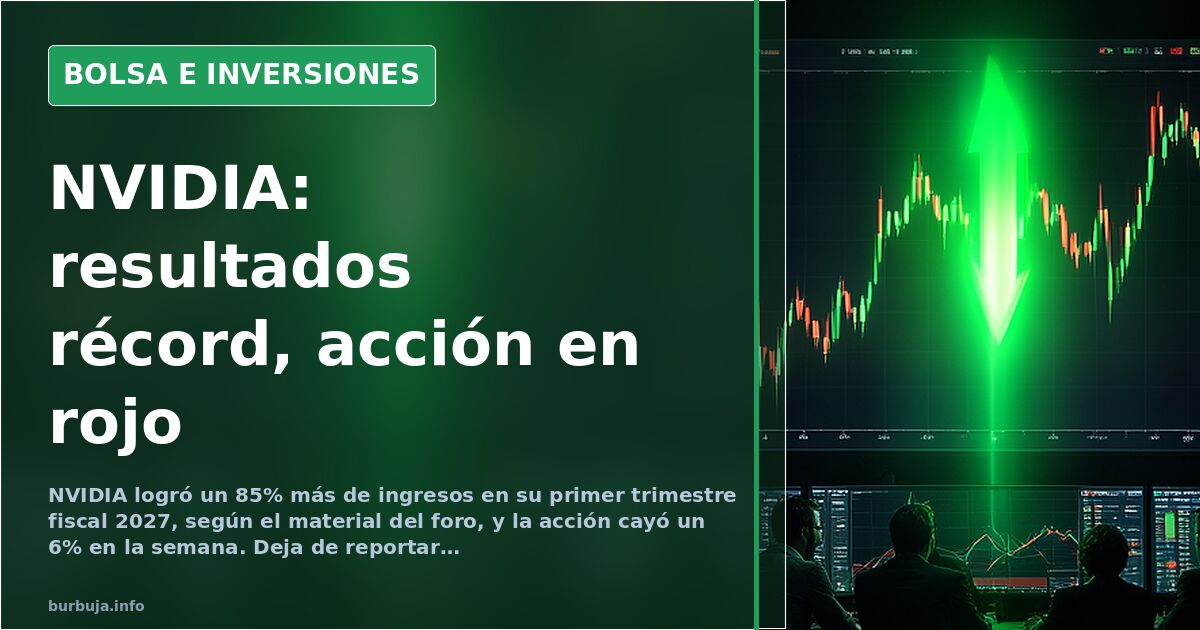
NVIDIA hits record revenue, but shares drop 6%
As discussed on the forum, NVIDIA has shattered its own financial records again. The company released results for the first quarter of fiscal year 2027 (roughly corresponding to Q1 2026), showing an 85% growth in revenue. However, the market reacted with a 6% decline in the share price over the week. The market, that mechanism which sometimes rewards what it should punish and vice versa, did what it does best: contradicting the narrative.
The unexpected detail: NVIDIA stops reporting direct gaming revenue. The firm announced it will no longer break down income from the video game sector. For some, this signals that consumer graphics cards are no longer strategic. For others, it is merely accounting window dressing. The truth is that the world's most valuable company continues to grow, but it no longer wants you to look under the gaming rug.
Why does NVIDIA fall despite record results?
This paradox has an explanation. The results were already priced in. When everyone expects a company to break records, the market doesn't reward the past, but what comes next. That is where nerves come into play. The stock had risen significantly before the announcement. The market had bought into the AI narrative as a global economic engine. When the narrative materializes, investors take profits.
Some argue the 6% drop is just a technical correction. Others suggest the market is beginning to doubt the sustainability of 85% growth. In reality, NVIDIA is the thermometer of the US economy. If NVIDIA falls, the rest of the market trembles. And if NVIDIA falls after spectacular results, the message is even more unsettling.
Leverage: investors' last bullet
At the center of the debate is the strategy of leveraging NVIDIA positions. Leverage means multiplying gains or losses. You can go long or short. There are mild leverages of 3x and heavy ones of 20x or more. The difference between leveraging and short selling is key: the former amplifies exposure, the latter bets against the asset.
The idea that NVIDIA is the last bullet left for the US as an economic engine makes sense. The company has become the epicenter of the AI revolution. Companies across all sectors have invested heavily in AI, and NVIDIA is the hardware provider par excellence. But this also makes it a systemic risk. If NVIDIA falls, indices fall. And if indices fall, pension funds, investment funds, and consumption suffer.
The domino effect: from Buffett to McDonald's
The most extreme thesis circulating is that if NVIDIA falls, everything falls. Even Berkshire Hathaway and McDonald's. The reason is simple: NVIDIA is the US, and the US is the world. Market interconnection means a tech crash drags seemingly disconnected sectors. It is not a prediction, but a hypothesis gaining traction amid investor euphoria.
Euphoria has a name: FOMO, the antiestéticar of missing out. When everyone makes money on a stock, those outside feel they are losing. This pushes many to leverage up so they don't get left behind. That is where gambling gets confused with investing. The difference between roulette red/black and the stock market is that roulette results are instant. In stocks, results can take years.
What about gaming and the new generation of cards?
Dropping the gaming revenue report coincides with expectations for a new generation of graphics cards. The next Grand Theft Auto installment, expected next year, will spike hardware demand. Gamers will rush to buy new GPUs to run the game in 4K. It is a repeating cycle: new game, new card, new revenue. But NVIDIA no longer wants these revenues visible in its accounting.
Hiding the gaming breakdown can be seen as protecting the AI narrative. If gaming grows, fine. If not, it doesn't matter. The company wants the market to value it as an AI firm, not a video game company. It is a matter of image. And multiples.
Key dates: ChatGPT IPO and midterms
Two events on the horizon could change the board. First is ChatGPT's potential public listing. The company behind the world's most famous chatbot might debut on markets, attracting even more capital to the AI sector. Second are the US midterm elections. Economic policy and AI regulation could shift depending on who controls Congress.
The coincidence of both events leads some to believe the market is in a bubble. AI investment euphoria recalls historical bubbles. Yet, AI is indeed transforming the real economy. The question is not whether there is a bubble, but when it will burst and who will be inside when it does.
The stock market is not an exact science. It is a casino with rules, where insider information and technical analysis mix with crowd psychology. NVIDIA is currently the epicenter of that casino. Its results are spectacular, but its price does not reflect them. The disconnect between fundamentals and price is the clearest sign that something is off. Or that the market has already discounted the future. With these ingredients, the outcome remains unpredictable.
As discussed on the forum, NVIDIA has shattered its own financial records again. The company released results for the first quarter of fiscal year 2027 (roughly corresponding to Q1 2026), showing an 85% growth in revenue. However, the market reacted with a 6% decline in the share price over the week. The market, that mechanism which sometimes rewards what it should punish and vice versa, did what it does best: contradicting the narrative.
The unexpected detail: NVIDIA stops reporting direct gaming revenue. The firm announced it will no longer break down income from the video game sector. For some, this signals that consumer graphics cards are no longer strategic. For others, it is merely accounting window dressing. The truth is that the world's most valuable company continues to grow, but it no longer wants you to look under the gaming rug.
Why does NVIDIA fall despite record results?
This paradox has an explanation. The results were already priced in. When everyone expects a company to break records, the market doesn't reward the past, but what comes next. That is where nerves come into play. The stock had risen significantly before the announcement. The market had bought into the AI narrative as a global economic engine. When the narrative materializes, investors take profits.
Some argue the 6% drop is just a technical correction. Others suggest the market is beginning to doubt the sustainability of 85% growth. In reality, NVIDIA is the thermometer of the US economy. If NVIDIA falls, the rest of the market trembles. And if NVIDIA falls after spectacular results, the message is even more unsettling.
Leverage: investors' last bullet
At the center of the debate is the strategy of leveraging NVIDIA positions. Leverage means multiplying gains or losses. You can go long or short. There are mild leverages of 3x and heavy ones of 20x or more. The difference between leveraging and short selling is key: the former amplifies exposure, the latter bets against the asset.
The idea that NVIDIA is the last bullet left for the US as an economic engine makes sense. The company has become the epicenter of the AI revolution. Companies across all sectors have invested heavily in AI, and NVIDIA is the hardware provider par excellence. But this also makes it a systemic risk. If NVIDIA falls, indices fall. And if indices fall, pension funds, investment funds, and consumption suffer.
The domino effect: from Buffett to McDonald's
The most extreme thesis circulating is that if NVIDIA falls, everything falls. Even Berkshire Hathaway and McDonald's. The reason is simple: NVIDIA is the US, and the US is the world. Market interconnection means a tech crash drags seemingly disconnected sectors. It is not a prediction, but a hypothesis gaining traction amid investor euphoria.
Euphoria has a name: FOMO, the antiestéticar of missing out. When everyone makes money on a stock, those outside feel they are losing. This pushes many to leverage up so they don't get left behind. That is where gambling gets confused with investing. The difference between roulette red/black and the stock market is that roulette results are instant. In stocks, results can take years.
What about gaming and the new generation of cards?
Dropping the gaming revenue report coincides with expectations for a new generation of graphics cards. The next Grand Theft Auto installment, expected next year, will spike hardware demand. Gamers will rush to buy new GPUs to run the game in 4K. It is a repeating cycle: new game, new card, new revenue. But NVIDIA no longer wants these revenues visible in its accounting.
Hiding the gaming breakdown can be seen as protecting the AI narrative. If gaming grows, fine. If not, it doesn't matter. The company wants the market to value it as an AI firm, not a video game company. It is a matter of image. And multiples.
Key dates: ChatGPT IPO and midterms
Two events on the horizon could change the board. First is ChatGPT's potential public listing. The company behind the world's most famous chatbot might debut on markets, attracting even more capital to the AI sector. Second are the US midterm elections. Economic policy and AI regulation could shift depending on who controls Congress.
The coincidence of both events leads some to believe the market is in a bubble. AI investment euphoria recalls historical bubbles. Yet, AI is indeed transforming the real economy. The question is not whether there is a bubble, but when it will burst and who will be inside when it does.
The stock market is not an exact science. It is a casino with rules, where insider information and technical analysis mix with crowd psychology. NVIDIA is currently the epicenter of that casino. Its results are spectacular, but its price does not reflect them. The disconnect between fundamentals and price is the clearest sign that something is off. Or that the market has already discounted the future. With these ingredients, the outcome remains unpredictable.
Also available in: Deutsch
Summary of a discussion on Burbuja.info - Foro de economía, actualidad y política., translated from Spanish and reviewed before publication. Read the full discussion (16 replies).
More summaries
-
Spanish retail investors buy dip in Nvidia, PayPal and Novo Nordisk
Spanish individual investors buy Nvidia at €108, PayPal and Novo Nordisk at €40 amid market drops. Full list and risks of averaging down.
-
Stocks Poised for +500% by 2030: 268 Replies, No Consensus
268 replies but no clear path to a +500% return by 2030. BYD, NVIDIA, AI, and defense clash with the view that picking one stock is a mistake.
-
Lamas Bolaño charges 1,200 euros for gold but refuses buyback
A buyer paid 1,200 euros for a gold coin at Lamas Bolaño, but the Spanish dealer refuses to buy it back, citing mint pricing.
-
Gold drops 5% for two straight days, sparking forum debate
Gold fell 5% over two consecutive days after rising from $2,800 to $3,500 in three months. Forum users are split between technical correction and cycle change.
-
Sellas Life Sciences Oncology Drug: Hope and Skepticism
Investors debate Sellas Life Sciences' Phase 3 oncology candidate, weighing potential breakthroughs against clinical risks.
-
Krugerrand: The Gold Coin Dividing Savers
The 917-fineness Krugerrand offers access to physical gold, but its premium and purity spark debate among savers.