
Nvidia drops 3% and forum users already see the apocalypse
A 3% drop in Nvidia sparks panic on an investment forum. Bonds yielding 6% are pulling money away from stocks, and the S&P 500 hit record highs before profit-taking.
English · Original discussion in Spanish · Published
Nvidia drops 3% and forum users already see the apocalypse
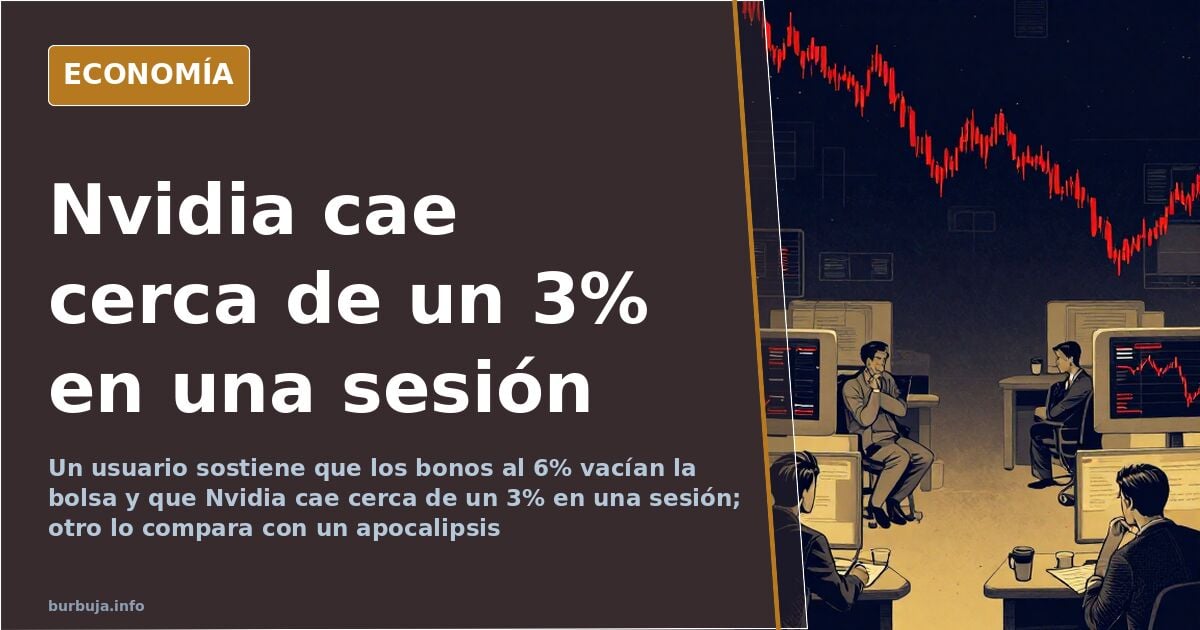
A 3% drop in Nvidia was enough to trigger panic on an investment forum. The trigger was a session in which, according to several participants, US bonds hit highs and the market reversed mid-day. The S&P 500 touched record highs and then took profits. Nothing new under the sun. But people were already opening threads titled "BOOOOOMMM... INTEL, AMD AND NVIDIA TAKING A DIVE LIVE". Reality, as almost always, was far more boring: a 0.47% drop in the S&P 500, 3% in Nvidia, and a market still near its highs.
The 3% that unleashed the hysteria
Nvidia's drop was 3%. That's it. A move that, as one participant pointed out, happens "every two or three" sessions in a stock that has gained 1000% in five years. The share has multiplied tenfold since 2020. And yet, the thread was peine as if it were the end of the world. "Some believed semiconductors were dwarfs at the wheel," quipped the author of the original post. The irony is subtle: the same people who have been saying for years that this is a bubble now celebrate every drop as a prophecy fulfilled.
The S&P 500 fell 0.47%. Less than half a point. Some compared it to "pulling the tablecloth during a picnic and having four ants show up". Overreaction is the daily bread of investment forums. But it's worth looking at the data: according to one participant, Intel is up 300% this year, and AMD another 300%. Nvidia, 1000% in five years. A 3% drop isn't scary. It's laughable.
The money flowing from stocks to bonds
The most repeated argument in the thread isn't panic, but capital rotation. US bonds are offering yields of 6%, a candy too juicy to pass up. "The 6% bond yield is too juicy to leave money in the stock market," one participant argued. That flow of funds would explain why stocks fall while bonds rise. It's not a conspiracy, it's basic financial physics.
That said, some see a hidden hand: "Whether this is being done by the lackey investment funds of the United States and Israel to offset war damage, or it's a natural flow of money, that's another story." The conspiracy theory doesn't hold up with data, but the rotation phenomenon is real. Money seeks returns, and if bonds pay more than dividends, money moves. That's how it has always worked.
The AI bubble: reality or mirage?
The semiconductor sector lives on AI. According to one participant, Intel went from $20 to $120 in a year, and AMD from $160 to $620. These are figures that smell like a bubble from afar. "What is obvious is that a bubble in the big chipmakers has been inflated in a year over the AI theme," one analysis noted. The question is whether that bubble will burst or simply deflate slowly.
One participant claimed OpenAI announced revenue of $50 billion when $70 billion was expected. The news went unnoticed amid the noise, but it's relevant: AI isn't generating the expected returns. "They throw money at it with a shovel but it fails to generate returns. This could be the start of a massive crash," one message warned. If AI doesn't monetize, the chips that power it won't justify their valuations either.
The 6% bond and the war of money
The 6% yield on US bonds is the key figure. With that return, any rational investor considers leaving the stock market. "Stocks tank, and bonds rise, basically because money is moving from stocks to bonds," one participant summarized. It's the classic dynamic: when safe money pays well, risky money retreats. Stocks fall, bonds rise. And so on until rates stabilize.
The problem is that rates keep rising. "If US rates keep climbing, not even 20 investment funds working together can prevent a big crash in the stock market," another concluded. The Federal Reserve shows no signs of cutting rates, and that pressures risk assets. Add to that the price of diesel, which is "sky-high", driving up energy costs and weighing on corporate profits.
What if nothing happens after all?
Most of the messages run counter to the panic. "Nvidia +1000% in 5 years, its value has multiplied x10. -3% in one session and we open a thread saying it's going down the drain," one participant complained. The overreaction is obvious. The S&P 500 hit highs and took profits. Nothing more. "Sp500 hit highs and there was profit-taking, nothing more," another concluded.
Some call for patience: "The stock market is going to tank but not today. Reopen the thread when it drops 15% in a few weeks." A 3% drop is not a crash, it's a correction. And those who have been at this for years know that real crashes are announced with drops of 20% or more, not 3%. Meanwhile, civil servants keep planning their next alucinación and graphics card prices aren't coming down.
When will a stock rising or falling 3% stop being news?
Also available in: Deutsch
Summary of a discussion on Burbuja.info - Foro de economía, actualidad y política., translated from Spanish and reviewed before publication. Read the full discussion (67 replies).
More summaries
-
US households hold record 45.4% of assets in stocks
A forum analyzes the record US household stock allocation, at 45.4% of financial assets, compared to 38% during the 2000 dot-com bubble.
-
Spain confronts the dilemma of what to do with gold held in the US Federal Reserve
Spain holds gold deposits at the U.S. Federal Reserve. The repatriation of reserves by other European countries raises the question: is it time to bring it back?
-
AI as an economic engine: bubble or structural shift?
Economic analysis of AI: Is it the growth engine or a speculative bubble? Energy costs and business adoption are examined.
-
Which celebrity will offer a home to the evicted woman?
Debate over the evicted elderly woman in Madrid: will any of the named celebrities offer her a home? Wyoming is attributed 19 properties.
-
Five new parties join Spain's Frente Amplio, from Batzarre to the Humanist Party
Batzarre, Iniciativa del Pueblo Andaluz, Somos Asturies, Recortes Cero and the Humanist Party have joined Spain's Frente Amplio. One forum user estimates that between them they…
-
Spain's PP spokesperson resigns amid row over her partner's 30 flats
The Popular Party's congressional spokesperson steps back from the front line after the controversy over her partner's 30 flats. A critic notes she keeps her seat and salary, and the party…