
Nutritionist fails to help client lose weight
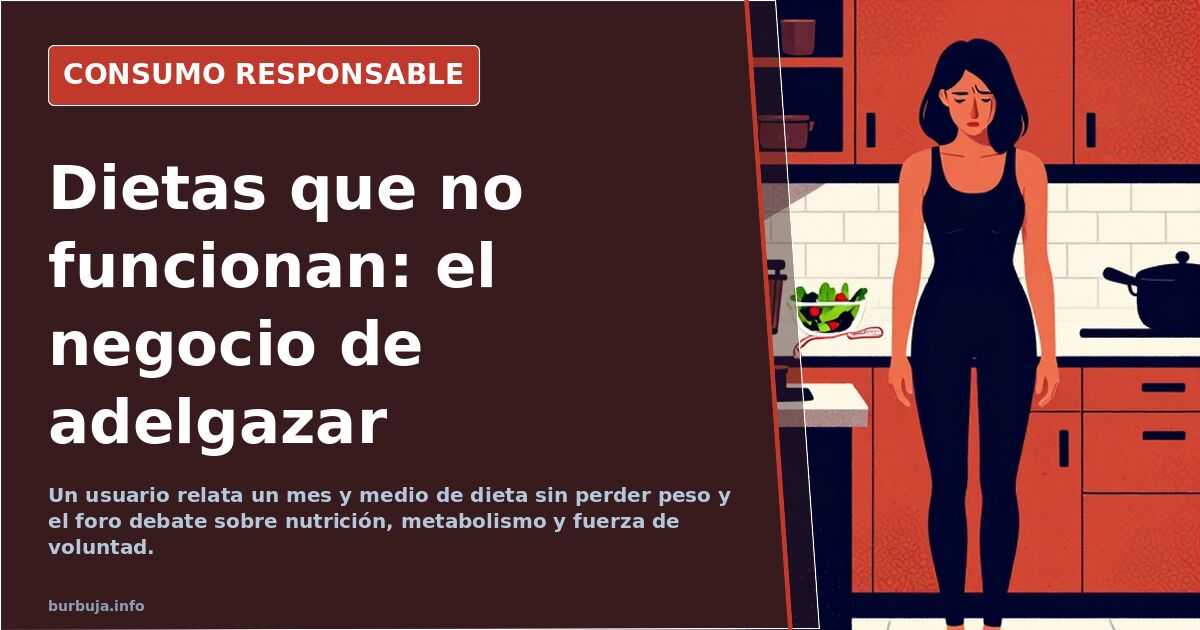
A user describes a month and a half on a diet without losing weight, sparking a forum debate on nutrition, metabolism and willpower.
English · Original discussion in Spanish · Published
Nutritionist fails to help client lose weight
A month and a half paying for consultations, three visits, two different diets and not a single kilo less on the scale. That's the case that opens the thread: a man who goes to a nutritionist recommended by acquaintances, trinc the plan to the letter —no bread, no sugar, no soft drinks, no alcohol, no pastries, salads, grilled chicken or turkey, vegetables and fruit seven days a week— and goes to bed hungry. The professional promised him between 1.5 and 2 kilos per week. The result: some volume lost, weight identical. The conclusion he draws is that nutritionism is "another pseudoscience of paint-by-numbers", comparable, he says, to psychology.
The rant uncovers a broader discussion about whether clinical nutrition is a scientifically based discipline or a business of recurring consultations. Some argue that the problem is not the profession but the patient: without willpower no method works, just like quitting smoking. Others point to a mistake in expectations: losing 2 kilos per week is unsustainable and counterproductive, and the reasonable amount is 2 kilos per month. And a third, harsher current directly denies the premise: with all the information available on the internet, going to a nutritionist is for "deeply stupid and lazy people".
Why weight doesn't drop even when eating less
The most repeated explanation in the exchange is body recomposition. If the body burns fat and gains muscle at the same time, the scale can stay stuck while clothes become loose. One participant tells it from his own experience: three months of strict high-protein diet and daily training, exactly the same weight as at the start, but his old trousers fall down and his t-shirts fit more loosely. "I've traded fat for muscle," he summarizes. Another adds that healthy means being strong, not thin, and that focusing on making the love handles disappear is more useful than obsessing over the number.
The second hypothesis circulating is hormonal. Reducing calories and not losing weight is, for some, a sign of a slow metabolism, a hormonal imbalance or even hypothyroidism. The overgrowth of candida fungus in the intestines is also mentioned as a common cause in people who fail to lose weight, and it is noted that some nutrition clinics first treat it. None of this is presented as a closed diagnosis: they are suspicions that the participants themselves qualify.
The consultation business and the advance package
The economic detail appears early. The affected person has paid in advance for a package of five consultations and admits he is looking forward to finishing it to tell the professional who sets his diets to cut the nonsense. The prepayment structure turns the relationship into something hard to break even if results don't come, and several messages joke about the model: a nutritionist can charge 50 euros per consultation so that the client has no money left to buy pastries at the supermarket.
The underlying criticism is not just about price. It's about the lack of unified criteria. It is claimed that one nutritionist can say exactly the opposite of another, and that most are anchored to beliefs from 25 years ago. The result, according to this current, is that the patient loses weight with great effort and hunger, and as soon as he relaxes he regains the kilos and even more, because his muscle-to-fat ratio has worsened.
What works according to those who have lost weight
Homemade recipes pile up. Removing 90% of flours: 7 kilos lost in months, according to one testimony. Another person says he lost 10 kilos between April and July with diet and exercise at home: a pull-up bar in the hallway, a step in the bathroom, five daily pull-ups, twenty squats and thirty steps with each leg. Ten minutes at first, more later. The underlying idea is that the gym is not essential and that caloric deficit rules above any ketogenic fashion.
Oily fish appears as a recurring recommendation: sardines, mackerel, tuna, salmon, sea bream. "Stuff yourself with fish, because with it you won't gain weight but quite the opposite," says one message. Another clarifies that farmed salmon is fed with feed made from Baltic Sea fish and that its orange tonalidad is achieved with synthetic powdered crustacean. The warning does not invalidate the recommendation, but it introduces doubt about the quality of the product.
Oily fish, intermittent fasting, bone broth, ketosis, pure and simple caloric deficit. Each current has its formula and its preacher. What none explains is why someone who trinc the diet to the letter still weighs the same. Is it metabolism, is it the scale, is it the professional or is it the patient?
A month and a half paying for consultations, three visits, two different diets and not a single kilo less on the scale. That's the case that opens the thread: a man who goes to a nutritionist recommended by acquaintances, trinc the plan to the letter —no bread, no sugar, no soft drinks, no alcohol, no pastries, salads, grilled chicken or turkey, vegetables and fruit seven days a week— and goes to bed hungry. The professional promised him between 1.5 and 2 kilos per week. The result: some volume lost, weight identical. The conclusion he draws is that nutritionism is "another pseudoscience of paint-by-numbers", comparable, he says, to psychology.
The rant uncovers a broader discussion about whether clinical nutrition is a scientifically based discipline or a business of recurring consultations. Some argue that the problem is not the profession but the patient: without willpower no method works, just like quitting smoking. Others point to a mistake in expectations: losing 2 kilos per week is unsustainable and counterproductive, and the reasonable amount is 2 kilos per month. And a third, harsher current directly denies the premise: with all the information available on the internet, going to a nutritionist is for "deeply stupid and lazy people".
Why weight doesn't drop even when eating less
The most repeated explanation in the exchange is body recomposition. If the body burns fat and gains muscle at the same time, the scale can stay stuck while clothes become loose. One participant tells it from his own experience: three months of strict high-protein diet and daily training, exactly the same weight as at the start, but his old trousers fall down and his t-shirts fit more loosely. "I've traded fat for muscle," he summarizes. Another adds that healthy means being strong, not thin, and that focusing on making the love handles disappear is more useful than obsessing over the number.
The second hypothesis circulating is hormonal. Reducing calories and not losing weight is, for some, a sign of a slow metabolism, a hormonal imbalance or even hypothyroidism. The overgrowth of candida fungus in the intestines is also mentioned as a common cause in people who fail to lose weight, and it is noted that some nutrition clinics first treat it. None of this is presented as a closed diagnosis: they are suspicions that the participants themselves qualify.
The consultation business and the advance package
The economic detail appears early. The affected person has paid in advance for a package of five consultations and admits he is looking forward to finishing it to tell the professional who sets his diets to cut the nonsense. The prepayment structure turns the relationship into something hard to break even if results don't come, and several messages joke about the model: a nutritionist can charge 50 euros per consultation so that the client has no money left to buy pastries at the supermarket.
The underlying criticism is not just about price. It's about the lack of unified criteria. It is claimed that one nutritionist can say exactly the opposite of another, and that most are anchored to beliefs from 25 years ago. The result, according to this current, is that the patient loses weight with great effort and hunger, and as soon as he relaxes he regains the kilos and even more, because his muscle-to-fat ratio has worsened.
What works according to those who have lost weight
Homemade recipes pile up. Removing 90% of flours: 7 kilos lost in months, according to one testimony. Another person says he lost 10 kilos between April and July with diet and exercise at home: a pull-up bar in the hallway, a step in the bathroom, five daily pull-ups, twenty squats and thirty steps with each leg. Ten minutes at first, more later. The underlying idea is that the gym is not essential and that caloric deficit rules above any ketogenic fashion.
Oily fish appears as a recurring recommendation: sardines, mackerel, tuna, salmon, sea bream. "Stuff yourself with fish, because with it you won't gain weight but quite the opposite," says one message. Another clarifies that farmed salmon is fed with feed made from Baltic Sea fish and that its orange tonalidad is achieved with synthetic powdered crustacean. The warning does not invalidate the recommendation, but it introduces doubt about the quality of the product.
Oily fish, intermittent fasting, bone broth, ketosis, pure and simple caloric deficit. Each current has its formula and its preacher. What none explains is why someone who trinc the diet to the letter still weighs the same. Is it metabolism, is it the scale, is it the professional or is it the patient?
Summary of a discussion on Burbuja.info - Foro de economía, actualidad y política., translated from Spanish and reviewed before publication. Read the full discussion (141 replies).
More summaries
-
Lidl's frozen sardines at €3.90/kg vs. fresh ones
A kilo of frozen sardines costs €3.90 compared to €9-€10 for fresh ones in Madrid. The question is whether the flavor holds up after freezing.
-
Tea brewing guide: quality, preparation, and common myths
Learn how water temperature and steeping time affect tea quality to avoid bitterness and hidden additives.
-
MG ZS Jaybrid at €25k: Bargain or risky investment?
An analysis of the MG ZS Jaybrid: Is the €25,000 saving worth the technical concerns regarding its naturally aspirated engine?
-
1960s penthouse stays at 13°C despite heating and new windows
A 1960s Spanish penthouse struggles with 13°C temperatures, inefficient heaters, and 73% humidity despite recent renovations.
-
Low-cost gardening: tips and pest control during inflation
Discover how to maintain a garden on a budget, from home remedies for pests to money-saving crops and ornamental gardening.
-
Intermittent fasting: Real experiences and nutritional myths
An analysis of intermittent fasting experiences, contrasting metabolic benefits, potential risks, and the subjective nature of the practice.