
Núcleo Nacional rally in Burgos puts spotlight on its spokesperson
Núcleo Nacional calls a rally in Burgos and attention shifts to its spokesperson, Isabel Peralta, and the leadership model of Spain's radical right
English · Original discussion in Spanish · Published
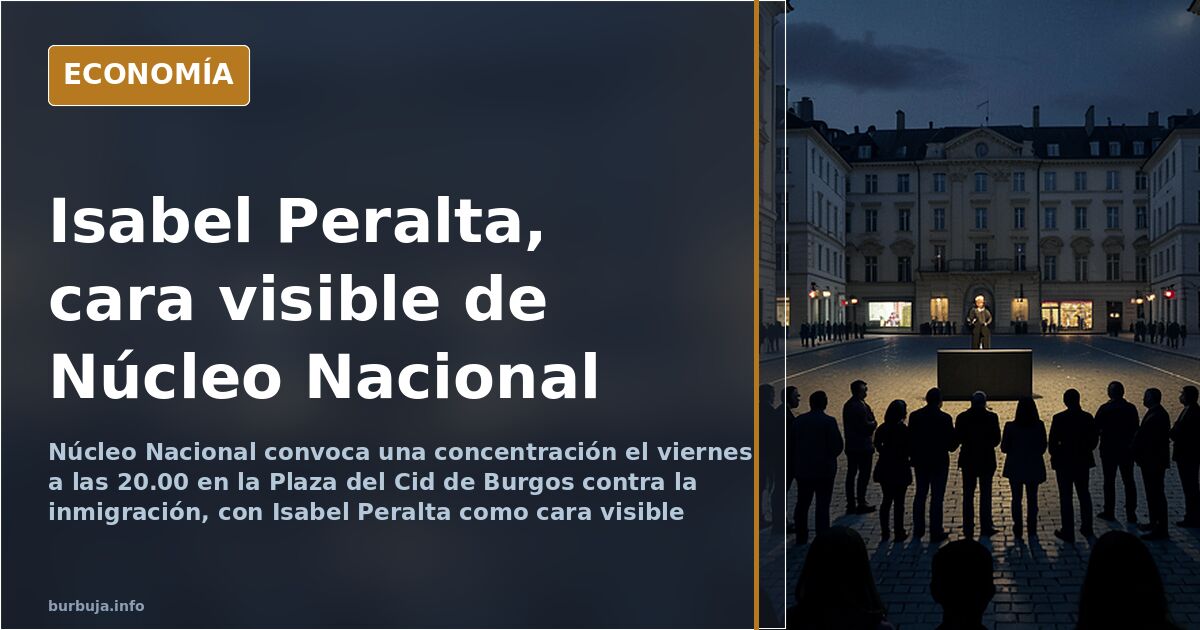
Núcleo Nacional rally in Burgos and its spokesperson take center stage
A poster announcing a gathering at 20:00 in Burgos's Plaza del Cid, a logo and a young face. The scene, shared on social media, has been enough to shift the focus from the event to the face behind it: the spokesperson of Núcleo Nacional, Isabel Peralta. The call is framed as a rally against crime attributed to foreigners and against those who, according to the poster's text, whitewash immigration. The message is explicit and the format is textbook: Friday, a central square, evening rush hour.
What stands out is not the slogan. It is that the public discussion about the event has turned into an examination of the person leading it. And everything gets thrown in.
Who is Isabel Peralta and why does she generate so much noise
Peralta appears as the public face of Núcleo Nacional, a group that positions itself in the space of the radical right and that, according to those who trinc its activity, maintains ties of affinity with voters of other parties. The conversation about her mixes two levels that are rarely separated: the political and the personal. Some debate her discourse, and some debate her tone, her language in interviews or her stage presence. The result is a debate that speaks as much about the project as about its packaging.
The very nature of the poster —a face, a slogan, a call— explains part of the phenomenon. In small structures, charismatic leadership replaces the machinery. And charisma, in politics, is measured in attention. The attention, here, has arrived.
The underlying criticism: why a woman at the front?
One of the most repeated lines of criticism questions why the radical right so often turns to highly prominent female leaders. The argument is that a pattern exists —young figures, blunt discourse, rally-style tone— and people ask whether better profiles might exist to front the movement. The criticism is less about the person than about the mold.
On the other side, the answer is more pragmatic: if it works, use it. Politics is an attention market, and formats that capture gazes get replicated. The fact that the debate centers on style rather than program says something about the program, or the audience, or both.
The suspicion of the shell brand and the electoral calendar
Another line of analysis, widely present, holds that these groups appear and disappear as elections draw near. The recurring question: what do they do the rest of the year. The shell-brand hypothesis —parties activated when convenient— circulates without proof and with insistence, and should be treated as what it is: a suspicion, not a fact.
What is verifiable is the calendar. Calls multiply when the calendar tightens. That proves nothing by itself, but it feeds the distrust of an electorate that distrusts by default.
The Vox voter and the blurred border
A relevant detail appearing in the conversation: some claim that several young people linked to Núcleo Nacional vote for Vox. If true, what transfers is not votes but emotional militancy. The border between parties blurs at the base while it is dramatized at the top.
And there lies the knot. Spain's radical right competes not only for seats: it competes for identity. On that terrain, a poster and a face are worth more than a hundred-page program.
The question left hanging is not whether the Burgos rally draws a big or small crowd. It is how much of this noise will translate into something that lasts once Friday passes.
Also available in: Deutsch
Summary of a discussion on Burbuja.info - Foro de economía, actualidad y política., translated from Spanish and reviewed before publication. Read the full discussion (123 replies).
More summaries
-
Núcleo Nacional registers as party: new option or electoral mirage?
Núcleo Nacional officially registers as a party. A new nationalist option or a police ploy to split the right-wing vote?
-
Isabel Peralta: Spanish Far-Right Figure Divides Nationalists
Isabel Peralta sparks debate in Spain, drawing 125 responses over 547 days. Views range from 'brave woman' to 'leftist puppet'.
-
Isabel Medina, the 'tough aunt' dividing Spain's far right
Activist Isabel Medina Peralta of Núcleo National sparks debate: icon or CNI agent?
-
Man sentenced to 4.5 years for slaughtering girlfriend's rabbit
A Valencia court sentences a man to 4.5 years in prison for killing, cooking, and forcing his girlfriend to eat her rabbit.
-
Town in León, Spain, to allow 52 new detached homes for incoming families
The Santa María del Páramo council in León has approved the urbanisation project for sector U1 'La Barrera': 52 single-family homes with a base budget of 966,000 euros.
-
Pedro Sánchez: legitimacy, coalition deals and wear at Spain's helm
Pedro Sánchez marks eight years at La Moncloa without winning an election. His legitimacy, coalition deals and political wear are the focus of economic and political analysis.