
Núcleo Nacional and its image: from muscle to backlash
Núcleo Nacional moves from its athletic 2024 profile to an image backlash in 2026, as debate mixes aesthetics, election spending and infiltration
English · Original discussion in Spanish · Published
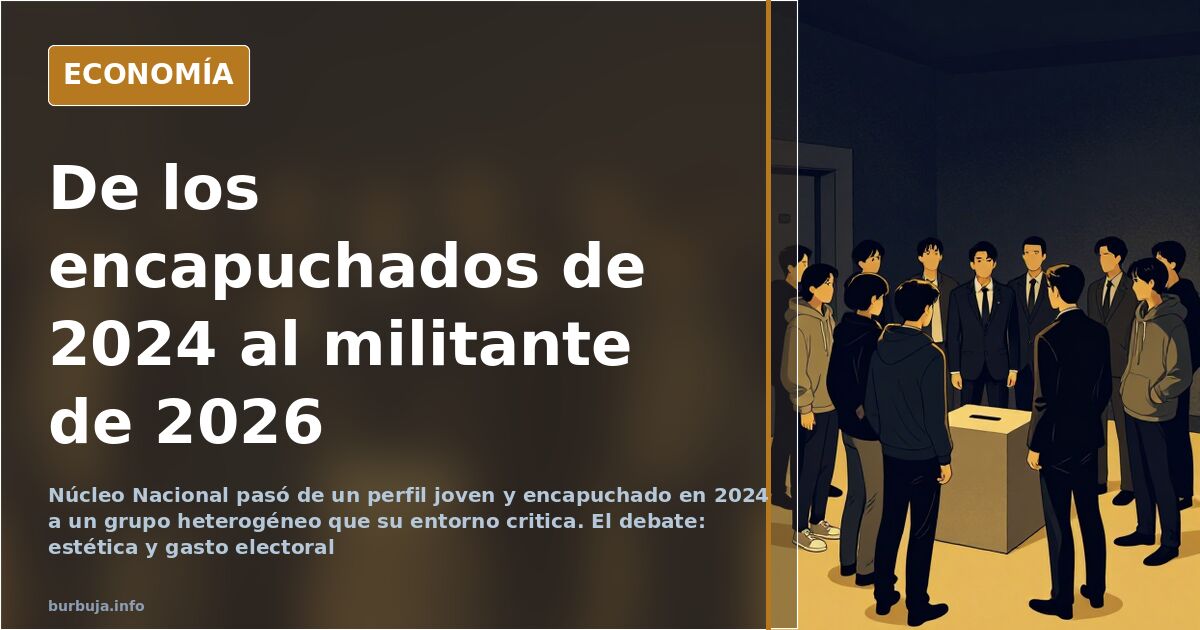
Núcleo Nacional: from the hooded crowds of 2024 to the backlash of 2026
Can a political movement sustain itself exclusively on its own image? Two years ago, Núcleo Nacional offered a profile that much of its audience described as the only Spanish right-wing reference with an attractive aesthetic: young, gym-trained people into martial arts, and without the quirks attributed to older movements. At the time, that aesthetic was compared to Fight Club. In 2026, that same audience argues the opposite: that the movement has changed and that the change detracts from it rather than adding to it.
The reproach is not, at heart, ideological. It is visual. When communication is run by the membership itself and not by an agency, the result is what it is; there is no community manager who can fix a rally. And that is where the underlying problem begins: a group that sold image ends up being judged by its image.
What is Núcleo Nacional and why is it judged by its aesthetic?
Núcleo Nacional is a Spanish far-right movement that in 2024 presented itself as a youthful, athletic alternative within that space. Some argue it never aspired to be a serious political party; others describe it as an attempt to build a fresh brand, far from groups with decades of history and names weighed down by historical baggage. The most recognizable part of its first stage were rallies with masked attendees. That image was, for a time, its main asset. And image assets, when they deteriorate, are noticed more than policy platforms.
From the hooded crowds of 2024 to the image of 2026
The evolution is the core of the discontent. The stage of covered faces, compared by its supporters to the mystique of the gym and physical discipline, would have been trinc by a second one in which the group appears without the same composition. Critics of the change speak of a mix with people outside the original profile —older, with a scruffy aesthetic— and argue that letting anyone in just to inflate the numbers has damaged the brand. The comparison most repeated in that sector is that of a before and after with nothing in common.
Here it is worth separating aesthetic judgment from something else. Part of the commentary crosses a line and adds contempt for the physical appearance or origin of those attending. That no longer describes a communication problem: it describes hostility toward groups of people that, moreover, offers no useful diagnosis of the political phenomenon. Criticism of an image does not need to demean a group in order to work.
The fusion of symbols: National Socialism and the Catholic cross
Another line of reproach is incoherence. It is noted that the group displays Catholic symbols in its own logo while its ideological references draw from other sources, and that this pairing of religiosity and National Socialist aesthetics is contradictory for anyone familiar with both traditions. One sector presents it as an innovation; another, as a simple collage with no doctrine behind it. In any case, it is not a discussion about aesthetics: it is a discussion about what is really being sold to a potential member.
Election spending: the €60 million of the 2023 general election
The other track of the debate is economic. In the 2023 general election, parties declared some €60 million in “justified election expenses,” a category split among social media, clothing, hairdressing, image consultants and the like. According to a calculation circulating in the thread, the figure equals one euro per person. For some it is a trifle with no practical effect; for others it is the symbol of misplaced priorities, and that same calculation translates the figure into months of institutional advertising or a high number of healthcare interventions. The underlying discussion is not whether parties polish their image: it is how much it costs us and what for.
The state infiltration hypothesis, without evidence
There is a thesis running through much of the analysis that should be handled carefully. It holds that movements like this would be created or tolerated by the state to deactivate any real political initiative, and it even suggests that the first masked attendees could have been agents. There is no evidence to support that hypothesis. It is a repeated suspicion, not a documented fact, and presenting it as certainty would be a glaring error. The fact that the state has infiltrated organizations in the past does not make every specific case verified.
The reproach, in the end, is as old as politics: form weighs more than substance when substance is absent. The question remains, and no one closes it: if aesthetics were the only problem, changing shirts would be enough. We have spent months discussing haircuts and clothing colors. Perhaps it is because the movement has no other debate to offer.
Can a political movement sustain itself exclusively on its own image? Two years ago, Núcleo Nacional offered a profile that much of its audience described as the only Spanish right-wing reference with an attractive aesthetic: young, gym-trained people into martial arts, and without the quirks attributed to older movements. At the time, that aesthetic was compared to Fight Club. In 2026, that same audience argues the opposite: that the movement has changed and that the change detracts from it rather than adding to it.
The reproach is not, at heart, ideological. It is visual. When communication is run by the membership itself and not by an agency, the result is what it is; there is no community manager who can fix a rally. And that is where the underlying problem begins: a group that sold image ends up being judged by its image.
What is Núcleo Nacional and why is it judged by its aesthetic?
Núcleo Nacional is a Spanish far-right movement that in 2024 presented itself as a youthful, athletic alternative within that space. Some argue it never aspired to be a serious political party; others describe it as an attempt to build a fresh brand, far from groups with decades of history and names weighed down by historical baggage. The most recognizable part of its first stage were rallies with masked attendees. That image was, for a time, its main asset. And image assets, when they deteriorate, are noticed more than policy platforms.
From the hooded crowds of 2024 to the image of 2026
The evolution is the core of the discontent. The stage of covered faces, compared by its supporters to the mystique of the gym and physical discipline, would have been trinc by a second one in which the group appears without the same composition. Critics of the change speak of a mix with people outside the original profile —older, with a scruffy aesthetic— and argue that letting anyone in just to inflate the numbers has damaged the brand. The comparison most repeated in that sector is that of a before and after with nothing in common.
Here it is worth separating aesthetic judgment from something else. Part of the commentary crosses a line and adds contempt for the physical appearance or origin of those attending. That no longer describes a communication problem: it describes hostility toward groups of people that, moreover, offers no useful diagnosis of the political phenomenon. Criticism of an image does not need to demean a group in order to work.
The fusion of symbols: National Socialism and the Catholic cross
Another line of reproach is incoherence. It is noted that the group displays Catholic symbols in its own logo while its ideological references draw from other sources, and that this pairing of religiosity and National Socialist aesthetics is contradictory for anyone familiar with both traditions. One sector presents it as an innovation; another, as a simple collage with no doctrine behind it. In any case, it is not a discussion about aesthetics: it is a discussion about what is really being sold to a potential member.
Election spending: the €60 million of the 2023 general election
The other track of the debate is economic. In the 2023 general election, parties declared some €60 million in “justified election expenses,” a category split among social media, clothing, hairdressing, image consultants and the like. According to a calculation circulating in the thread, the figure equals one euro per person. For some it is a trifle with no practical effect; for others it is the symbol of misplaced priorities, and that same calculation translates the figure into months of institutional advertising or a high number of healthcare interventions. The underlying discussion is not whether parties polish their image: it is how much it costs us and what for.
The state infiltration hypothesis, without evidence
There is a thesis running through much of the analysis that should be handled carefully. It holds that movements like this would be created or tolerated by the state to deactivate any real political initiative, and it even suggests that the first masked attendees could have been agents. There is no evidence to support that hypothesis. It is a repeated suspicion, not a documented fact, and presenting it as certainty would be a glaring error. The fact that the state has infiltrated organizations in the past does not make every specific case verified.
The reproach, in the end, is as old as politics: form weighs more than substance when substance is absent. The question remains, and no one closes it: if aesthetics were the only problem, changing shirts would be enough. We have spent months discussing haircuts and clothing colors. Perhaps it is because the movement has no other debate to offer.
Summary of a discussion on Burbuja.info - Foro de economía, actualidad y política., translated from Spanish and reviewed before publication. Read the full discussion (200 replies).
More summaries
-
Núcleo Nacional: The aesthetic that repels its own voters
Núcleo Nacional arrives in Catalonia with an aesthetic that, according to even sympathizers, repels more than it convinces. The packaging hides the product.
-
Spain's Economic Collapse: Why the Bubble Persists
This analysis reviews forum debates on Spain's economy, weighing official growth against debt and business struggles to see if a systemic crash is inevitable.
-
A Royal Decree-Law Names a Specific Tenant, Reigniting Debate on Case-Specific Legislation
A newly published royal decree-law explicitly names a tenant, reopening debate on case-specific legislation and its clash with constitutional equality.
-
Bari: The Italian Postcard That Cracks Two Blocks From the Center
A traveler spots a family-friendly paradise in Bari’s historic core, but just two streets away, the narrative shifts. Italy vs. Spain compared.
-
Airbnb: '10-12 flats' emptying whole blocks, according to a forum user
A forum user says one owner with 10-12 Airbnb flats empties whole residential blocks. In Lugo or Teruel, prices also rise without mass tourism.
-
Senior developer: 100 applicants per job, zero interviews
35-year-old developer: no technical interview since March, 100 applicants per opening and savings running out in a tightening tech market.