
Norway’s Sovereign Fund Earns €36,000 Per Capita, Reigniting Debate
Norway’s pension fund generated nearly €200 billion in 2023, translating to over €36,000 per citizen, sparking renewed discussion on welfare and resource management.
English · Original discussion in Spanish · Published
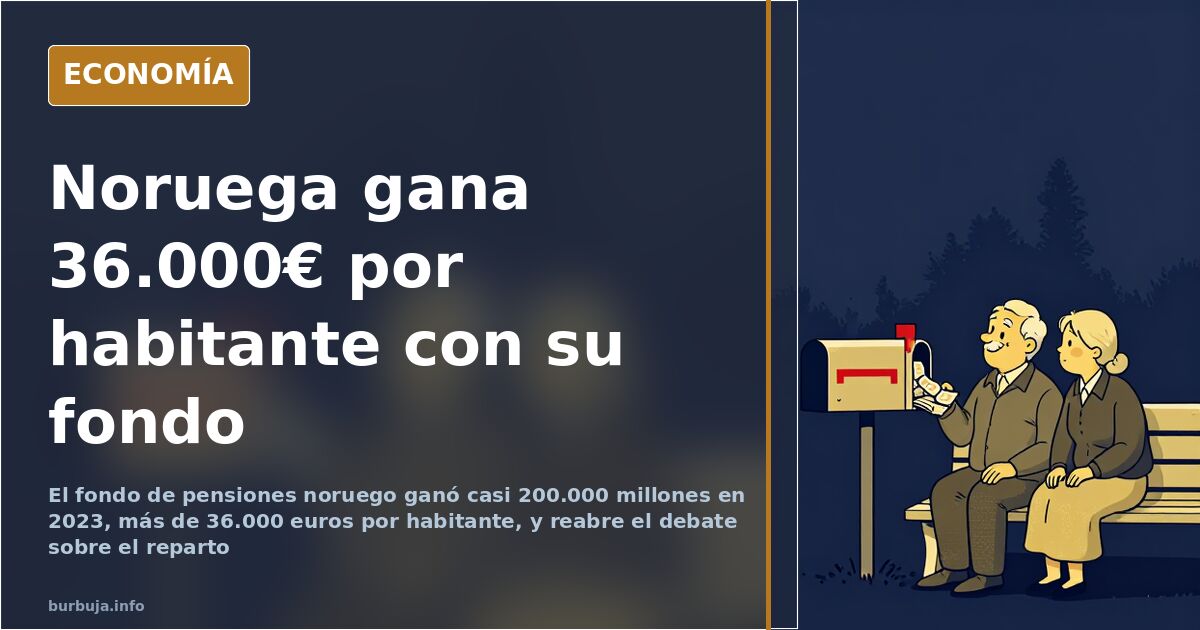
Norway earns €36,000 per capita through its sovereign fund
Norway’s state pension fund generated nearly €200 billion in 2023. Per capita, that amounts to slightly over €36,000 per inhabitant in a single fiscal year. The figure, reported by Libre Mercado, has revived an idea in Spain that sounds like science fiction: that a country can afford for some of its people to live without working. The details, as is often the case, significantly qualify the headline.
How much Norway’s fund earned in 2023 and where that money comes from
The money does not fall from the sky or from a decree. Norway extracts oil and gas, earns revenue from it, and instead of spending the surplus, invests it in financial markets. The most repeated thesis is simple: it was not distributed, it was invested. And the flow does not stop: the country prepares to raise its crude oil and gas production to near historical highs.
This detail distinguishes the Norwegian fund from a simple investment vehicle. Wealth enters, accumulates, and works on its own. The result is evident in less segarro things: warm housing, with houses kept at 23 degrees in the middle of winter, and a service network that holds up without major issues. The striking aspect, according to this reading, is not so much that Norwegians can live without working, but that the system has not broken down in doing so.
Norway and Venezuela: the same oil with two opposite outcomes
This is where the conversation heats up. Some argue that Norwegians fare well because they are socialists, and that Venezuela fares poorly because its socialism was not authentic. The objection comes quickly: no country with oil and poor management proves anything about models. True socialism has never been tested, says the manual, and the manual has gone decades without updates.
Another strand of analysis points to the opposite: the natural resource does not explain the outcome by itself, but management does. Norway, with oil and Norwegians at the helm, built a prosperous country; Venezuela, with more oil and a different direction, built the opposite. Neither reading closes the case, among other reasons because no one has demonstrated that culture or geology are the decisive variables.
Why Spain does not have a sovereign fund like Norway’s?
The most repeated answer is that there is no raw material to store. Spain’s coal geology — underground veins, much lignite trapped between shales and hundreds of meters deep — made it unviable compared to the open skies of Australia or Colombia, where extraction uses giant dump trucks. Competing was impossible, and mining closed.
The counterpoint: Spain also has its oil, and it is called tourism. It generates foreign currency, jobs, and a share of GDP that no well can replace. Some add that Spain’s sovereign fund, with a different size and design, functions reasonably well. And part of the diagnosis goes another way: here, they argue, economic policy prefers to distribute the surplus rather than save it, and that is not a subsoil problem, but a matter of decisions.
The fine print: Norway is not just a fund
The Nordic country that serves as a mirror has edges that are forgotten. Its migration policy — deportation of those who are undocumented, costs of expulsion borne by the expelled themselves, and detention for those remaining without permission — is described as much harsher than Spain’s, and it is applied by a Labour government. Comparing only the fund’s balance and not the rest of the manual is taking a half photo.
Some also recall that the cold, taxation, and cost of living take a toll, and some look to 1990s Russia as a warning: the liberalization of prices, foreign trade, and currency ordered by Yeltsin in January 1992 resulted, according to a participant in the debate, in officials not being paid for years. Dismantling a system without a safety net does not always turn out well.
What “living without working” means in Norway
No envelopes are distributed among citizens. The fund acts as a cushion: it supports public spending, finances services, and allows a portion of the population to not depend on a salary to eat. The underlying discussion is not who works, but who pays for the party and with what backing.
On the Spanish side, that same question is answered with an imported stereotype: that of a country of terraceo, siesta, and shopping that would live off others’ efforts. It is a caricature, but it works as gasoline in any conversation about productivity, wages, and hours worked.
If one thing this episode teaches is that Norway’s fund will continue to grow as long as oil and gas keep pumping. That Spain copies the model is unlikely; that it discusses it again whenever a figure appears, almost certain. No one has yet found a way to manufacture geology.
Norway’s state pension fund generated nearly €200 billion in 2023. Per capita, that amounts to slightly over €36,000 per inhabitant in a single fiscal year. The figure, reported by Libre Mercado, has revived an idea in Spain that sounds like science fiction: that a country can afford for some of its people to live without working. The details, as is often the case, significantly qualify the headline.
How much Norway’s fund earned in 2023 and where that money comes from
The money does not fall from the sky or from a decree. Norway extracts oil and gas, earns revenue from it, and instead of spending the surplus, invests it in financial markets. The most repeated thesis is simple: it was not distributed, it was invested. And the flow does not stop: the country prepares to raise its crude oil and gas production to near historical highs.
This detail distinguishes the Norwegian fund from a simple investment vehicle. Wealth enters, accumulates, and works on its own. The result is evident in less segarro things: warm housing, with houses kept at 23 degrees in the middle of winter, and a service network that holds up without major issues. The striking aspect, according to this reading, is not so much that Norwegians can live without working, but that the system has not broken down in doing so.
Norway and Venezuela: the same oil with two opposite outcomes
This is where the conversation heats up. Some argue that Norwegians fare well because they are socialists, and that Venezuela fares poorly because its socialism was not authentic. The objection comes quickly: no country with oil and poor management proves anything about models. True socialism has never been tested, says the manual, and the manual has gone decades without updates.
Another strand of analysis points to the opposite: the natural resource does not explain the outcome by itself, but management does. Norway, with oil and Norwegians at the helm, built a prosperous country; Venezuela, with more oil and a different direction, built the opposite. Neither reading closes the case, among other reasons because no one has demonstrated that culture or geology are the decisive variables.
Why Spain does not have a sovereign fund like Norway’s?
The most repeated answer is that there is no raw material to store. Spain’s coal geology — underground veins, much lignite trapped between shales and hundreds of meters deep — made it unviable compared to the open skies of Australia or Colombia, where extraction uses giant dump trucks. Competing was impossible, and mining closed.
The counterpoint: Spain also has its oil, and it is called tourism. It generates foreign currency, jobs, and a share of GDP that no well can replace. Some add that Spain’s sovereign fund, with a different size and design, functions reasonably well. And part of the diagnosis goes another way: here, they argue, economic policy prefers to distribute the surplus rather than save it, and that is not a subsoil problem, but a matter of decisions.
The fine print: Norway is not just a fund
The Nordic country that serves as a mirror has edges that are forgotten. Its migration policy — deportation of those who are undocumented, costs of expulsion borne by the expelled themselves, and detention for those remaining without permission — is described as much harsher than Spain’s, and it is applied by a Labour government. Comparing only the fund’s balance and not the rest of the manual is taking a half photo.
Some also recall that the cold, taxation, and cost of living take a toll, and some look to 1990s Russia as a warning: the liberalization of prices, foreign trade, and currency ordered by Yeltsin in January 1992 resulted, according to a participant in the debate, in officials not being paid for years. Dismantling a system without a safety net does not always turn out well.
What “living without working” means in Norway
No envelopes are distributed among citizens. The fund acts as a cushion: it supports public spending, finances services, and allows a portion of the population to not depend on a salary to eat. The underlying discussion is not who works, but who pays for the party and with what backing.
On the Spanish side, that same question is answered with an imported stereotype: that of a country of terraceo, siesta, and shopping that would live off others’ efforts. It is a caricature, but it works as gasoline in any conversation about productivity, wages, and hours worked.
If one thing this episode teaches is that Norway’s fund will continue to grow as long as oil and gas keep pumping. That Spain copies the model is unlikely; that it discusses it again whenever a figure appears, almost certain. No one has yet found a way to manufacture geology.
Also available in: Deutsch
Summary of a discussion on Burbuja.info - Foro de economía, actualidad y política., translated from Spanish and reviewed before publication. Read the full discussion (272 replies).
More summaries
-
Norwegian IQ Test: The Flaw in Measuring Cognitive Ability
Analysis of Norwegian IQ test results: Is intelligence measurable with patterns or is it a statistical fallacy?
-
Madrid rental listings drop 20% after decree
Forum users track Madrid's rental supply falling from 11,815 to 9,398 ads in one day. They blame the new decree. Barcelona has only 680 long-term rentals.
-
Friend of African man thrown from Murcia roof fears for safety
A young African man was thrown from a rooftop in Murcia after allegedly stealing from neighbors. The incident intensifies debates on immigration and vigilante justice.
-
Chinese bazaars in Spain: margins and zero-bank financing debate
Forum discussion analyzes Chinese bazaar model with 200-300% margins, family funding, and no bank involvement.
-
Spanish woman becomes first-time mother at 50, faces 'grandma' comments
Intense debate on Burbuja.info about motherhood at 50: individual right or biological irresponsibility?
-
Open-source project clones seven Adobe apps
An open-source initiative replicates features from seven Adobe applications, gaining 44,000 GitHub stars and updating every three days.