
Norway's Princess Astrid dies at 94, two days after Harald's funeral
Princess Astrid of Norway has died at 94, two days after the funeral of her brother Harald. The succession of Haakon VIII reopens the debate over the cost of monarchies.
English · Original discussion in Spanish · Published
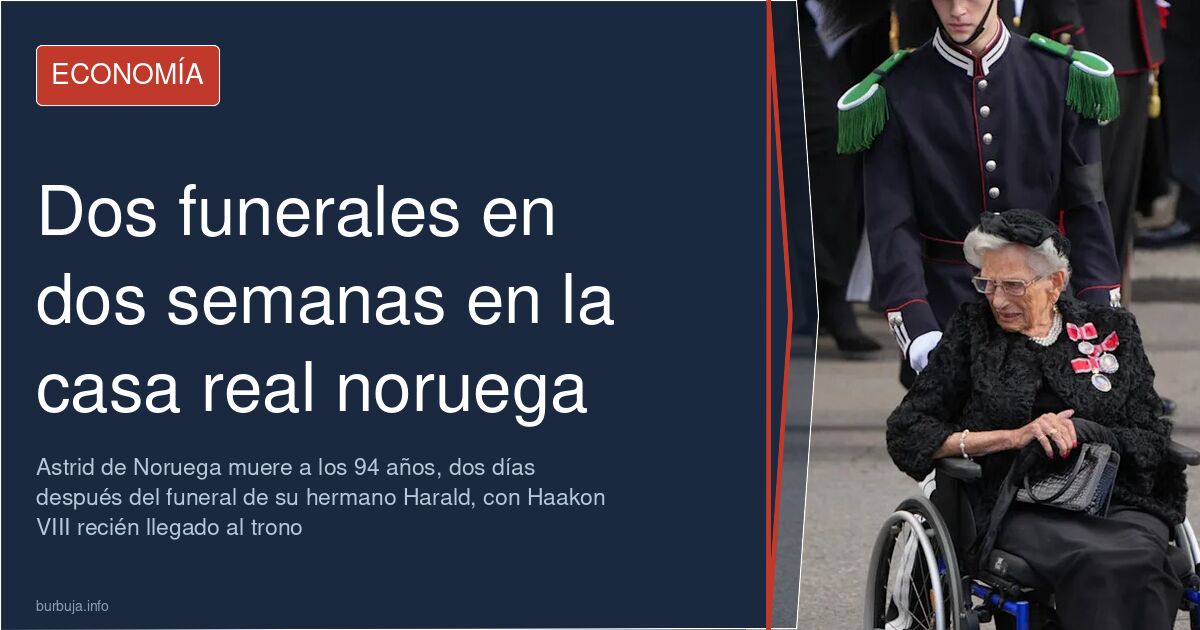
Princess Astrid of Norway dies: the crown is inherited, the funeral is paid for
Death does not treat everyone equally, even when it comes with a state funeral. Princess Astrid of Norway, sister of King Harald, has died at 94, just two days after her brother's funeral was held. The new monarch, Haakon VIII, who had been on the throne for fourteen days trinc his father's death, mourned the loss of his aunt in a statement describing her as "deeply loyal" and with "a contagious spirit." Translated into economic terms: a family that does not compete for its position, an estate that is never divided, and a liturgy paid for by the taxpayer.
Two siblings, one throne and fourteen days
The timeline is stark even for those with no attachment to crowns. Harald dies. His son takes the throne. Fourteen days later, his aunt dies. Two siblings in the same week, a royal house in double mourning, and an institutional schedule that allows no pause: Astrid's funeral is already being organized while the previous one is still being digested.
The detail is not trivial in a country where the Crown is never put to a referendum. Succession is not voted on; it is inherited. And the associated costs —protocol, security, travel, international guests— are not either.
Luxury that is never earned, bills that are always paid
Here the matter stops being an obituary. Some argue that being born into royalty works like a life insurance policy: no hernia from bad posture, no split shifts, no wear and tear on a body exploited for forty years. The objective fact is that the deceased lived to 94. Against that weighs the opposing argument: such longevity is financed by a budget others pay for and by a sovereign wealth fund fueled by oil, from which the entire institutional structure benefits. The result, depending on how you look at it, is either income or privilege.
Princess, infanta, or simply posturing
Another side debate the death reopens: the title itself. Some defend reserving the word princess for those who will reign and calling the rest infanta (a Spanish title for non-reigning royals), so as not to find noble titles in headlines about nonagenarians. The deceased's public image, associated with an unconventional collection of tiaras, feeds that distance between the office and the person.
With all this, the next state funeral will likely put the focus back on the same uncomfortable question: how much does it cost to maintain an institution nobody elects. Though, given the recurring complaints and the total inability to change anything, it would be unwise to bet on the debate being settled this time.
Also available in: Deutsch
Summary of a discussion on Burbuja.info - Foro de economía, actualidad y política., translated from Spanish and reviewed before publication. Read the full discussion (55 replies).
More summaries
-
Norway's Viking World Cup Campaign Sparks Identity Debate
Norway's all-white, Viking-themed football squad at the World Cup reignites debates on national identity and exclusion.
-
Princess Leonor's parachute jump sparks debate
Princess Leonor completes military parachuting course amid questions on authenticity and public cost.
-
Alonso measures 1.71m, surpassed by the princesses: height in elite sports
Fernando Alonso measures 1.71m, while Princesses Leonor and Sofía reach 1.75m and 1.81m. Height is a key factor in Formula 1, where being short is...
-
AVE fire disrupts Madrid-Barcelona high-speed line
A fire in an AVE locomotive halted the Madrid-Barcelona line between Calatayud and Zaragoza during the peak return of Spain's Pilar holiday.
-
Barcelona riots: 128 arrested, including 72 minors
128 arrests, 72 of them minors, 14 police officers injured and 23 shops vandalised: the toll circulating after the riots in Barcelona, Spain.
-
Soros celebrates Lula's win in Brazil
Alex Soros celebrated Brazil's election result on X with a message of support for Lula. We look at what he said and why his opinion carries weight in the markets.