
Northern Israel on High Alert After False Alarm
Israel's north entered high alert due to a reported paratrooper attack in Haifa, which was later confirmed as a false alarm.
English · Original discussion in Spanish · Published
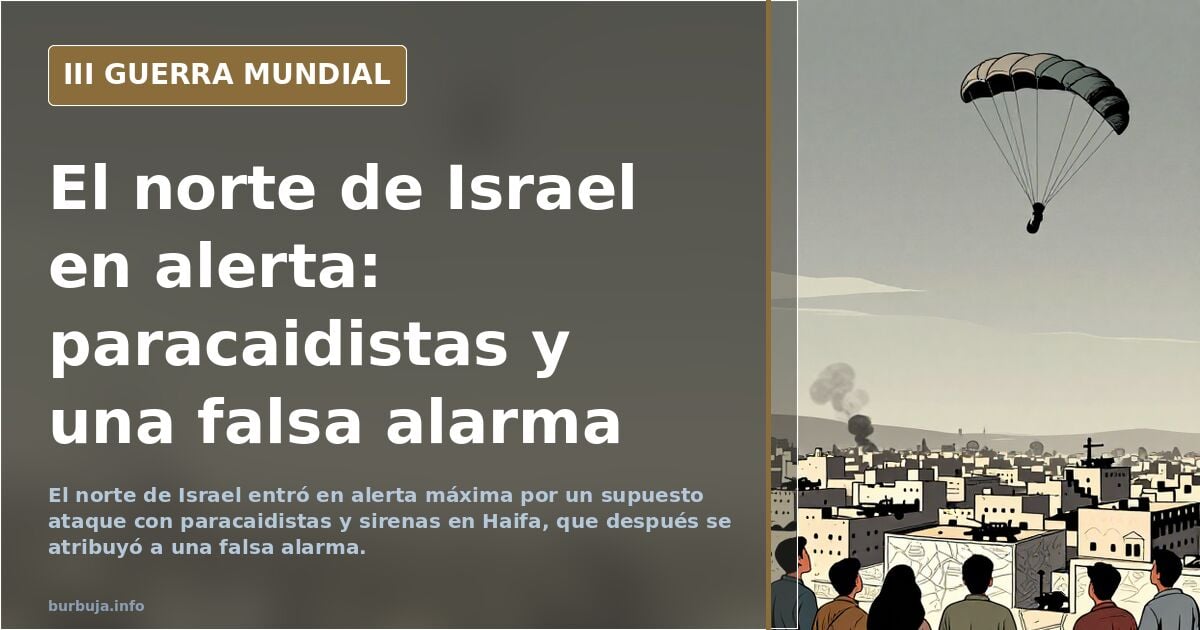
Northern Israel activates after alleged attack proves to be false alarm
A single message triggered everything. "Paratroopers landing in northern Israel, all residents to shelters, entire region on maximum alert." The image of suspected militants descending on buildings spread within minutes and nearly became the day's headline. Shortly after, sirens sounded in Haifa, one of the country's main port cities. An uncomfortable question remained: massive attack from Lebanon or one of the day's biggest disinformation operations?
The initial premise was blunt: if Israel faces severe danger, it may resort to its nuclear arsenal. The so-called Samson Option—the threat of atomic retaliation as a last resort—entered the conversation even before the attack was confirmed.
From total alert to possible false alarm
Information flow was contradictory for hours. Infiltrations were reported in Ma'alot Tarshicha, near the Lebanese border, and the entire north entered maximum alert status. Then, the narrative deflated: messages arrived suggesting it might be a false alarm. The sequence resembled an episode of collective panic where verification came late and poorly.
What was verifiable pointed elsewhere. The Israeli army reported a drone strike against a Hezbollah position in southern Lebanon, in response to an anti-tank missile fired at a military post, along with artillery bombardments in the area. In short: exchanges of fire on the border, yes; parachute invasion, questionable. The distance between these two things is the distance between a headline and a hoax.
Hezbollah, 100,000 members and an uneasy balance
One participant claims Hezbollah comprises around 100,000 members, a figure without verified sources. Some add that, at this scale, the scenario shifts from skirmish to full regional conflict. Counterarguments note available information is too fragile to gauge this: no reliable data exists even on weapon types used, and several figures circulating within a day came from unverified sources.
This gap between narrative severity and data solidity explains why the day oscillated between alarmism and tense calm.
Why does the Samson Option resurface?
The most persistent argument in the discussion is geographic. A large country has reaction time between hostile forces entering and reaching vital zones. In a territory the size of a postage stamp, that margin shrinks until it vanishes, narrowing the threshold at which decision-makers resort to extreme measures. This logic, according to some participants, fuels the old idea that in a tiny state, a nuclear arsenal deters enemies less than it makes them a priority to neutralize.
The objection to this thesis is equally old: an atomic weapon does not stop infiltrators hiding among civilians. It can destroy adversary cities—or third-party ones—but leaves the attacker devastated in the process.
The denial that came by morning
Narrative reliability suffered another blow when an international agency had to clarify its own reports on alleged baby mutilations, which circulated unverified. This episode, added to the retraction regarding paratroopers, outlines a known pattern: in crisis early hours, disinformation outpaces verification, leaving facts that never peine attached to the story.
Meanwhile, the crisis is viewed from afar in Europe. A protest in Vienna, described by social media posts as pro-Hamas support, and alignment with Israel attributed by some to European governments like Germany and Austria, fuel vague antiestéticars among those outside the region who cannot see how such a war could remain contained where it started.
With this material, the day's sequence has an uncomfortable ending. An alleged massive attack, sirens in Haifa, and reported infiltrations in border towns ended up summarized, hours later, in one word. False alarm.
A single message triggered everything. "Paratroopers landing in northern Israel, all residents to shelters, entire region on maximum alert." The image of suspected militants descending on buildings spread within minutes and nearly became the day's headline. Shortly after, sirens sounded in Haifa, one of the country's main port cities. An uncomfortable question remained: massive attack from Lebanon or one of the day's biggest disinformation operations?
The initial premise was blunt: if Israel faces severe danger, it may resort to its nuclear arsenal. The so-called Samson Option—the threat of atomic retaliation as a last resort—entered the conversation even before the attack was confirmed.
From total alert to possible false alarm
Information flow was contradictory for hours. Infiltrations were reported in Ma'alot Tarshicha, near the Lebanese border, and the entire north entered maximum alert status. Then, the narrative deflated: messages arrived suggesting it might be a false alarm. The sequence resembled an episode of collective panic where verification came late and poorly.
What was verifiable pointed elsewhere. The Israeli army reported a drone strike against a Hezbollah position in southern Lebanon, in response to an anti-tank missile fired at a military post, along with artillery bombardments in the area. In short: exchanges of fire on the border, yes; parachute invasion, questionable. The distance between these two things is the distance between a headline and a hoax.
Hezbollah, 100,000 members and an uneasy balance
One participant claims Hezbollah comprises around 100,000 members, a figure without verified sources. Some add that, at this scale, the scenario shifts from skirmish to full regional conflict. Counterarguments note available information is too fragile to gauge this: no reliable data exists even on weapon types used, and several figures circulating within a day came from unverified sources.
This gap between narrative severity and data solidity explains why the day oscillated between alarmism and tense calm.
Why does the Samson Option resurface?
The most persistent argument in the discussion is geographic. A large country has reaction time between hostile forces entering and reaching vital zones. In a territory the size of a postage stamp, that margin shrinks until it vanishes, narrowing the threshold at which decision-makers resort to extreme measures. This logic, according to some participants, fuels the old idea that in a tiny state, a nuclear arsenal deters enemies less than it makes them a priority to neutralize.
The objection to this thesis is equally old: an atomic weapon does not stop infiltrators hiding among civilians. It can destroy adversary cities—or third-party ones—but leaves the attacker devastated in the process.
The denial that came by morning
Narrative reliability suffered another blow when an international agency had to clarify its own reports on alleged baby mutilations, which circulated unverified. This episode, added to the retraction regarding paratroopers, outlines a known pattern: in crisis early hours, disinformation outpaces verification, leaving facts that never peine attached to the story.
Meanwhile, the crisis is viewed from afar in Europe. A protest in Vienna, described by social media posts as pro-Hamas support, and alignment with Israel attributed by some to European governments like Germany and Austria, fuel vague antiestéticars among those outside the region who cannot see how such a war could remain contained where it started.
With this material, the day's sequence has an uncomfortable ending. An alleged massive attack, sirens in Haifa, and reported infiltrations in border towns ended up summarized, hours later, in one word. False alarm.
Also available in: Deutsch
Summary of a discussion on Burbuja.info - Foro de economía, actualidad y política., translated from Spanish and reviewed before publication. Read the full discussion (107 replies).
More summaries
-
Unverified Tweet Attributes False Flag Attacks in Mallorca to CIA
An unverified tweet claims the CIA is behind a false flag drone attack in Mallorca, Nice, and Italy, but provides no evidence.
-
Gaza Hospital Strike: Crater Size Challenges JDAM Claim
Israel cites Yihad Islamic rocket audio; the small crater fuels debate over whether a JDAM caused the damage.
-
Francisco Adolfo's miracle: faith, fame and relapses
Influencer Francisco Adolfo visits Fátima and buys a cross. Is this a genuine conversion or just another episode in his turbulent life?
-
Wesley Clark urges direct NATO intervention in Ukraine
Former Allied commander Wesley Clark proposes ordering a Russian ceasefire. An analysis of an escalation no one in Brussels wants to endorse.
-
US Congresswoman Warns Argentina Over Chinese Fighter Jets
A US opposition congresswoman warns that partnering with China on fighter jets places Argentina in the 'slave world'.
-
Wagner executes Russian deserter with hammer in Ukraine
Yevgeny Nuzhin, a Wagner-recruited convict, was hammered to death after defecting to Ukraine; the video appeared on the group's Telegram channel.