
Moon Landing Skepticism Resurfaces After 55 Years
The lack of subsequent missions reignites debate: if Apollo succeeded in 1969, why do we only orbit the Moon today?
English · Original discussion in Spanish · Published
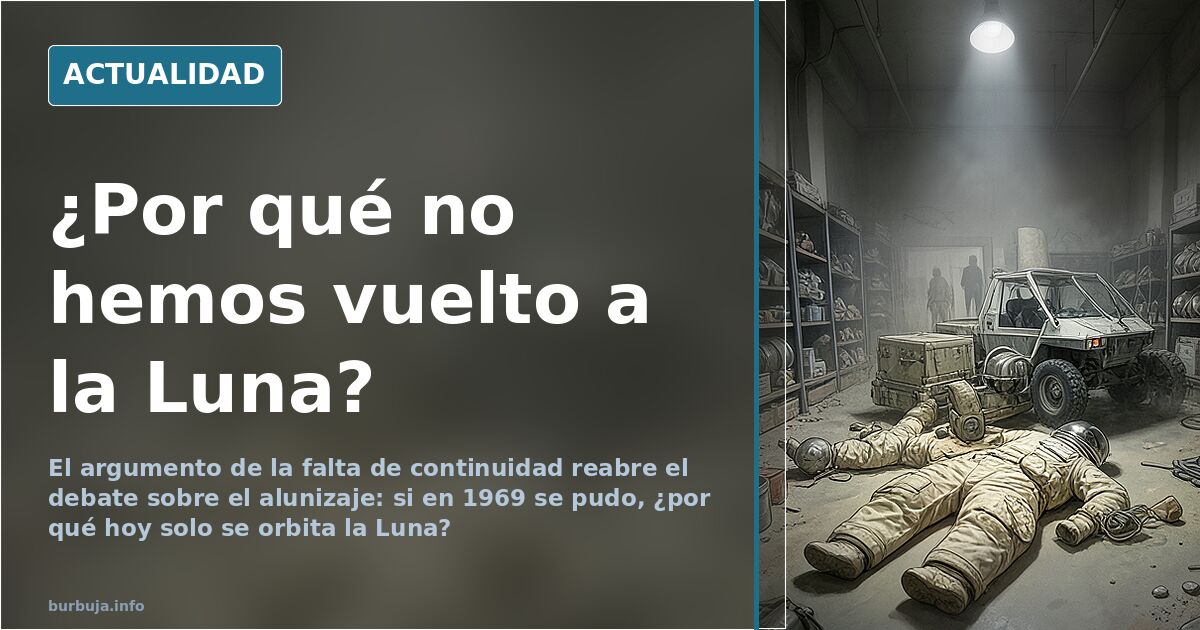
The Paradox of Not Returning to the Moon 55 Years Later
More than five decades have passed since Apollo 11 left its mark on lunar regolith, yet humanity has not repeated the antiestéticat. This is the core of a recurring debate that recently heated up social media: if landing was possible in 1969 with less computing power than a school calculator, why do modern missions only orbit the satellite? The question seems logical, but it contains a trap.
Skeptics argue that the lack of continuity is proof. If humans had truly walked on the Moon, establishing routine travel and infrastructure would have been coherent. Instead, decades later, we only aim to fly nearby. "Landing safely should be easy with current technology," one common argument states. For this group, the suspicious part is not what peine then, but what hasn't peine since.
The Most Expensive Political Photo in History
The established explanation points to geopolitics. Going to the Moon was primarily Cold War propaganda, not just science. The USSR and the US competed for global prestige, with intercontinental missile capability as the real military prize. The Moon was the showcase. Once the photo was taken, political interest waned: the Apollo program ended in 1972 amid declining public support and the oil crisis. Selling more missions during soaring oil prices was impossible.
Why return now? Less romanticism, more rivalry: China was advancing toward claiming the new "we're back" milestone. This forced the West to accelerate a debt-funded program, adding billions that don't change much because money isn't the primary obstacle.
The Press Conference That Fuels Doubt
Skeptics often cite the Apollo 11 astronauts' post-return press conference: long faces, tense gestures, extreme nervousness. "Some funerals look like parties by comparison," goes a popular description. To skeptics, they didn't seem triumphant. Officially, they were military engineers trained in WWII and Korea, subjected to protocols and stress unimaginable today. They weren't euphoric influencers; they were exhausted professionals.
A key counterargument involves technology. Lunar reflectors are still used to measure Earth-Moon distance, detectable by amateur astronomers. Returned rocks, analyzed globally including by Soviets, differ from any known terrestrial mineral. Faking all this would have been harder and costlier than actual spaceflight.
Arguments That Don't Hold Up
The waving flag is a classic trope. No wind means no wave, implying a hoax. Physically, flags swing due to inertia and pole vibration in low gravity, not wind. It proves nothing but persists as a talking point.
Others suggest robotic extraction of rocks or reflector placement. Theoretically possible, but it assumes the Soviets, with incentives to expose their rival, stayed silent for decades. No evidence supports such a secret pact between powers.
The film "Capricorn One" is cited as proof Kubrick faked the landing. It only shows space scenes can be filmed, not that the real event didn't occur. Confusing fiction with documentary is a genre staple.
The Disorienting Fact
The paradox remains: if 1969 tech sufficed, today's should make trips routine. It hasn't. Current missions only orbit, and future phases depend on cancellable budgets. Supporters blame lost political/economic will; deniers see definitive proof. Meanwhile, reflectors still bounce lasers from Earth. This uncomfortable fact for both sides remains fully unexplained.
More than five decades have passed since Apollo 11 left its mark on lunar regolith, yet humanity has not repeated the antiestéticat. This is the core of a recurring debate that recently heated up social media: if landing was possible in 1969 with less computing power than a school calculator, why do modern missions only orbit the satellite? The question seems logical, but it contains a trap.
Skeptics argue that the lack of continuity is proof. If humans had truly walked on the Moon, establishing routine travel and infrastructure would have been coherent. Instead, decades later, we only aim to fly nearby. "Landing safely should be easy with current technology," one common argument states. For this group, the suspicious part is not what peine then, but what hasn't peine since.
The Most Expensive Political Photo in History
The established explanation points to geopolitics. Going to the Moon was primarily Cold War propaganda, not just science. The USSR and the US competed for global prestige, with intercontinental missile capability as the real military prize. The Moon was the showcase. Once the photo was taken, political interest waned: the Apollo program ended in 1972 amid declining public support and the oil crisis. Selling more missions during soaring oil prices was impossible.
Why return now? Less romanticism, more rivalry: China was advancing toward claiming the new "we're back" milestone. This forced the West to accelerate a debt-funded program, adding billions that don't change much because money isn't the primary obstacle.
The Press Conference That Fuels Doubt
Skeptics often cite the Apollo 11 astronauts' post-return press conference: long faces, tense gestures, extreme nervousness. "Some funerals look like parties by comparison," goes a popular description. To skeptics, they didn't seem triumphant. Officially, they were military engineers trained in WWII and Korea, subjected to protocols and stress unimaginable today. They weren't euphoric influencers; they were exhausted professionals.
A key counterargument involves technology. Lunar reflectors are still used to measure Earth-Moon distance, detectable by amateur astronomers. Returned rocks, analyzed globally including by Soviets, differ from any known terrestrial mineral. Faking all this would have been harder and costlier than actual spaceflight.
Arguments That Don't Hold Up
The waving flag is a classic trope. No wind means no wave, implying a hoax. Physically, flags swing due to inertia and pole vibration in low gravity, not wind. It proves nothing but persists as a talking point.
Others suggest robotic extraction of rocks or reflector placement. Theoretically possible, but it assumes the Soviets, with incentives to expose their rival, stayed silent for decades. No evidence supports such a secret pact between powers.
The film "Capricorn One" is cited as proof Kubrick faked the landing. It only shows space scenes can be filmed, not that the real event didn't occur. Confusing fiction with documentary is a genre staple.
The Disorienting Fact
The paradox remains: if 1969 tech sufficed, today's should make trips routine. It hasn't. Current missions only orbit, and future phases depend on cancellable budgets. Supporters blame lost political/economic will; deniers see definitive proof. Meanwhile, reflectors still bounce lasers from Earth. This uncomfortable fact for both sides remains fully unexplained.
Also available in: Deutsch
Summary of a discussion on Burbuja.info - Foro de economía, actualidad y política., translated from Spanish and reviewed before publication. Read the full discussion (54 replies).
More summaries
-
Spain's 'La bola negra' sparks culture war with €4.7M opening
'La bola negra' grosses €4.7 million in its first weekend and divides Spain between critical praise and accusations of propaganda and historical sectarianism.
-
Lanbide publishes 41,400 notices to track down RGI recipients
Lanbide has published 41,400 notices in the BOPV after failing to locate RGI recipients. Only 1.13% come to collect the letter. The control system, in...
-
Spain's 23F: Partial declassification hides coup government list
Partial release of 1981 coup documents omits the planned unity government, reinforcing Juan Carlos I's official narrative.
-
Spain’s foreign-born population surpasses 10 million
Foreign-born residents in Spain exceed 10 million, reaching 20% of the total population amid demographic debates.
-
Yolanda Díaz quits X as Spanish left seeks own platform
Spanish Deputy PM Yolanda Díaz leaves X, citing democratic risks. The left explores alternatives amid debates on social media control.
-
Alborada School suspends staff member accused of child abuse
Alborada School suspended a caregiver accused of abusing children aged 3 to 6 and handed the case to police. Families await answers.