
Northern Ireland riots erupt in Ballymena after sexual assault
Violence and Molotov cocktails hit police in Ballymena following an alleged rape, reigniting Europe's immigration debate.
English · Original discussion in Spanish · Published
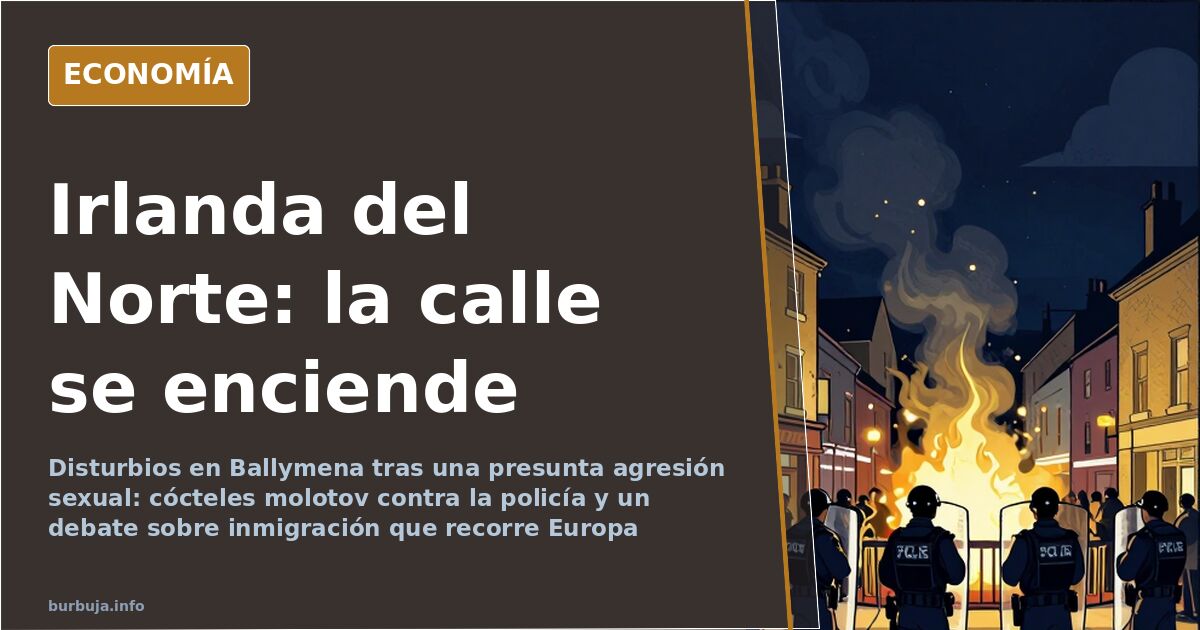
Northern Ireland: Streets ignite after sensual assault
The discussion begins with a tweet claiming Ireland is "on the brink of civil war due to immigration," met with sarcasm by those sharing it. The conversation then shifts to a specific incident that has recently set fire to Ballymena, Northern Ireland: an alleged sensual assault committed by two minors reportedly of Romanian origin. The local reaction was immediate, escalating into riots antiestéticaturing Molotov cocktails, bricks, bottles, and fireworks directed at police, who deployed dogs, a drone, and two water cannons.
This episode has peine a debate simmering for years across Western Europe: coexistence between native populations and migration flows, and the role of security forces when tension explodes on the streets.
What peine in Ballymena
According to circulating reports, two teenagers were allegedly involved in a sensual assault, triggering a community response that moved from protest to direct clashes with police within hours. Officers were described as being "under sustained attack." While this sequence is not new in the UK, the context is striking: a Northern Irish town where the memory of sectarian conflict still weighs heavily.
Some argue that public backlash is understandable when the state fails to protect its citizens. Others counter that street violence ultimately punishes the very neighbors it claims to defend. Some view this as a prologue to something larger; others see it as an isolated outburst.
Background: A decade of migration tensions
The issue cannot be understood without the context highlighted by several messages: immigration has grown steadily across Western Europe over the last twenty years. Cases like France, the UK, Germany, the Netherlands, or Belgium are cited, where coexistence has become politically uncomfortable. In Spain, according to calculations circulating in the conversation, immigrant numbers rose from 800,000 in 1996 to much higher figures today, with peaks of regularization under various governments.
The debate splits: some focus on the volume and estimulante ilegal of the phenomenon; others on the quality of integration. Some distinguish between European migration and migration from other origins, while others reject this distinction as deceptive. What no one disputes is that discontent exists and is being channeled through increasingly non-institutional avenues.
The police's role: Between order and discredit
One of the sharpest threads in the conversation targets security forces. They are accused of applying the law selectively: harsh on protesting citizens, lenient on incivil. The phrase summarizing this stance is that "the one who orders is as guilty as the one who commits the crime," along with accusations of hiding behind "due obedience." Other messages recall incidents of fines for breaking rules that later turned out to be nonexistent or poorly formulated.
The result is distrust that transcends ideology. When police are perceived as the executive arm of unpopular political decisions, the street stops recognizing their authority. This is where riots cease to be isolated episodes and become a pattern.
Ireland as a mirror
Ireland appears in the conversation as a unique case. It is described as a Catholic country with a historical memory of armed conflict and a population that, according to several messages, lacks the inhibitions attributed to Britons or Germans. Comparisons with Spain are recurrent: historical expeditions supporting the Irish against England are recalled, emphasizing the Catholic bond.
The lingering question is whether the Northern Irish outbreak is an isolated case or the first chapter of something broader. There is no definitive answer. What remains is an uncomfortable fact: violence is already in the streets, and institutions do not seem to control the narrative.
The analysis stalls at the same point where it began: whether popular response is legitimate self-defense or a lit fuse. The Ballymena riots have yet to be fully explained, and the coming weeks will reveal if this episode remains an anecdote or marks a turning point.
The discussion begins with a tweet claiming Ireland is "on the brink of civil war due to immigration," met with sarcasm by those sharing it. The conversation then shifts to a specific incident that has recently set fire to Ballymena, Northern Ireland: an alleged sensual assault committed by two minors reportedly of Romanian origin. The local reaction was immediate, escalating into riots antiestéticaturing Molotov cocktails, bricks, bottles, and fireworks directed at police, who deployed dogs, a drone, and two water cannons.
This episode has peine a debate simmering for years across Western Europe: coexistence between native populations and migration flows, and the role of security forces when tension explodes on the streets.
What peine in Ballymena
According to circulating reports, two teenagers were allegedly involved in a sensual assault, triggering a community response that moved from protest to direct clashes with police within hours. Officers were described as being "under sustained attack." While this sequence is not new in the UK, the context is striking: a Northern Irish town where the memory of sectarian conflict still weighs heavily.
Some argue that public backlash is understandable when the state fails to protect its citizens. Others counter that street violence ultimately punishes the very neighbors it claims to defend. Some view this as a prologue to something larger; others see it as an isolated outburst.
Background: A decade of migration tensions
The issue cannot be understood without the context highlighted by several messages: immigration has grown steadily across Western Europe over the last twenty years. Cases like France, the UK, Germany, the Netherlands, or Belgium are cited, where coexistence has become politically uncomfortable. In Spain, according to calculations circulating in the conversation, immigrant numbers rose from 800,000 in 1996 to much higher figures today, with peaks of regularization under various governments.
The debate splits: some focus on the volume and estimulante ilegal of the phenomenon; others on the quality of integration. Some distinguish between European migration and migration from other origins, while others reject this distinction as deceptive. What no one disputes is that discontent exists and is being channeled through increasingly non-institutional avenues.
The police's role: Between order and discredit
One of the sharpest threads in the conversation targets security forces. They are accused of applying the law selectively: harsh on protesting citizens, lenient on incivil. The phrase summarizing this stance is that "the one who orders is as guilty as the one who commits the crime," along with accusations of hiding behind "due obedience." Other messages recall incidents of fines for breaking rules that later turned out to be nonexistent or poorly formulated.
The result is distrust that transcends ideology. When police are perceived as the executive arm of unpopular political decisions, the street stops recognizing their authority. This is where riots cease to be isolated episodes and become a pattern.
Ireland as a mirror
Ireland appears in the conversation as a unique case. It is described as a Catholic country with a historical memory of armed conflict and a population that, according to several messages, lacks the inhibitions attributed to Britons or Germans. Comparisons with Spain are recurrent: historical expeditions supporting the Irish against England are recalled, emphasizing the Catholic bond.
The lingering question is whether the Northern Irish outbreak is an isolated case or the first chapter of something broader. There is no definitive answer. What remains is an uncomfortable fact: violence is already in the streets, and institutions do not seem to control the narrative.
The analysis stalls at the same point where it began: whether popular response is legitimate self-defense or a lit fuse. The Ballymena riots have yet to be fully explained, and the coming weeks will reveal if this episode remains an anecdote or marks a turning point.
Summary of a discussion on Burbuja.info - Foro de economía, actualidad y política., translated from Spanish and reviewed before publication. Read the full discussion (175 replies).
More summaries
-
Two Civil Guards Shot During Surveillance in Terrassa, Spain
Two Civil Guards were shot in Terrassa during a surveillance operation; one suffered four bullet wounds and was beaten. The incident highlights security concerns in Spain.
-
El País Asks Why Migrants Avoid Spanish Villages
El País queries why migrants don't move to rural Spain. The public replies: because Spaniards left too, citing low wages and poor services.
-
US Military Intervention Rumors in Venezuela
Three destroyers, a spy plane, and a 2020 arrest warrant: the US pressures Maduro, but the deployment lacks the force for an actual attack.
-
Madrid's Demographic Shift Sparks Irreversible Debate
A trip to Madrid reveals a demographic change now treated as irreversible in economic debates: fewer natives, more foreign residents.
-
The Times reports Feijóo's claim about Sánchez's father-in-law
The Times highlights Feijóo's allegation regarding Sánchez's father-in-law's gay brothels, bringing the unresolved issue to international attention.
-
Johnny Depp Visits Madrid Children's Hospital as Jack Sparrow
Johnny Depp surprised patients at Madrid’s Niño Jesús Hospital pediatric oncology ward dressed as Jack Sparrow, sparking debate on celebrity motives.