
No Russian Attack on Estonia: The Strike That Never Came
Despite fears over Dugina and NATO expansion, Russia has not bombed Estonia, highlighting the gap between rhetoric and military reality.
English · Original discussion in Spanish · Published
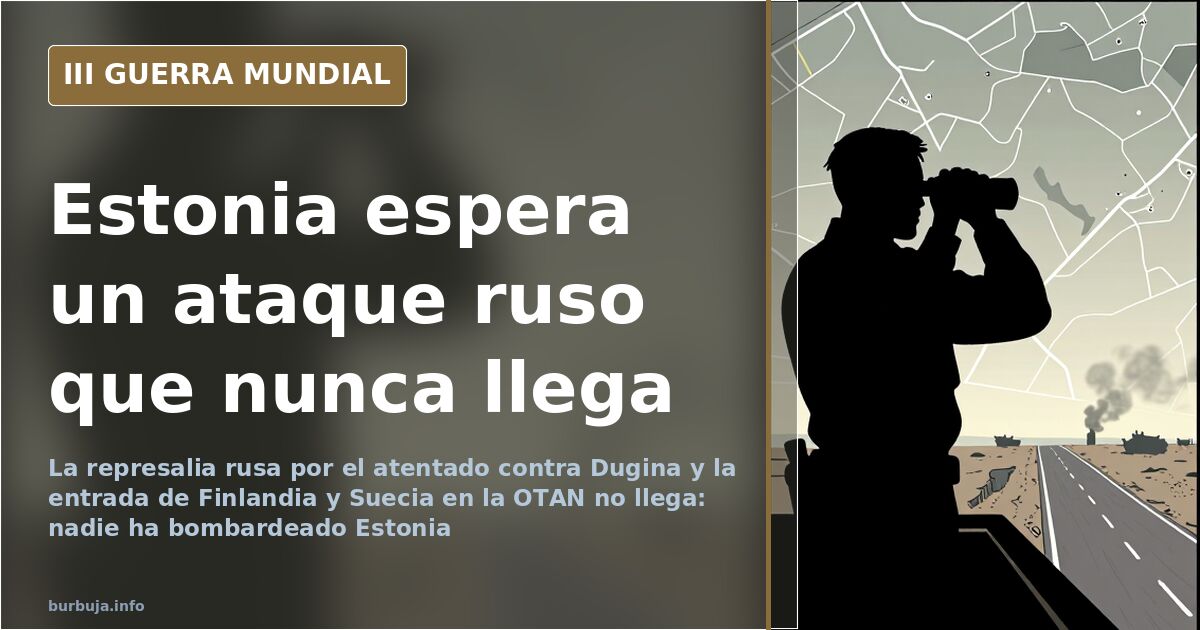
Estonia awaits a Russian attack that never comes while Turkey leads
Has Russia attacked Estonia? No. This obvious fact serves as a barometer for public discourse: the more pressure Moscow exerted on its neighbors, the less it needed to move a single tank for some to assume a bombing was imminent. The expectation of retaliation for Daria Dugina's assassination and the entry of Finland and Sweden into NATO persisted, but the strike never materialized.
Why was a Russian attack on Estonia expected?
The narrative fit too perfectly. The alleged perpetrator reportedly fled toward the Baltic states, Russia claimed to have ample evidence, and Estonia is a NATO member. With these elements, any geopolitical scriptwriter would have placed retaliation in the next episode. Online forums, needing no scripts, simply assumed it would happen.
The result was a curious mix: cautious headlines and excessive anticipation. "It will be in October," went the recurring joke, once the calendar had no room left. No one dared set an hour, but many took the day for granted. The date passed. Estonia remained unchanged.
There is a less epic explanation than conspiracy and duller than heroism: Russia lacked the means. The prevailing calculation suggests Moscow has lost 70% of its accumulated equipment built up over decades. If true—and unproven otherwise—the margin for opening a second front against a thirty-nation alliance was simply zero.
Finland and Sweden in NATO: Who benefits?
The paradox baffles allies and critics alike: two Nordic countries joined the Alliance to protect themselves from Moscow, yet the member gaining the most weight in Europe is Turkey. The awkward ally, who negotiates every signature like a merchant, became the arbiter of membership. Adding Finland and Sweden changes the map, but also shifts internal power balances.
Stockholm and Helsinki faced their own fine print. It was noted that unless Sweden and Finland pursued certain Kurdish groups after changing laws, Turkey would not sign. Ankara does not joke about this issue, and the price of entry was clearly stated. Joining the club only to find it depends on the most elusive partner was not the picture they envisioned.
Meanwhile, the effect on Russia was opposite to predictions. No retaliation, no credible threat. According to this reading, the only tangible consequence is that the dominant power in European NATO is now closer to Asia. Propaganda inflated threats that never materialized.
The alleged attacker and her trail to Austria
If one episode summarizes the absurdity, it is the escape. Reports suggest the suspect left breadcrumbs across Europe: first Estonia, then Austria. The most discussed trail places her at a Vienna hotel, the Ibis Hauptbahnhof, with a one-night reservation accompanied by two women and a child. Jokes even circulated about a cat appearing as another companion, turning a cinematic escape into a Tuesday morning move.
The striking aspect is not the route, but the paradox. Russian services allegedly had photos, documents, and a full file on the suspect. Yet they failed to detain her upon exit. There were jokes about the vehicle having three different license plates, as if changing plates sufficed to cross borders. The humor hides a serious question: was the machinery incapable, or simply unwilling?
Moscow’s version points to a Ukrainian operation. Alternative theories suggest the attack was used as an excuse. Between both hypotheses, there are no public proofs to tip the balance, only mutual accusations and prolonged administrative silence.
The arsenal that never reaches the showcase
Russian capability numbers do not inspire confidence either. A Su-57 and an Armata cannon were presented years ago as vanguard weapons meant to humiliate NATO. Real accounts suggest only three non-functional prototypes per system over a decade. The advanced hardware remembered by many was, frankly, video propaganda: impressive online, scarce on the front.
The same applies to the rest of the announced catalog. On paper, everything arrives on time and is hypersonic. On the ground, the relevant question is not when Russia wins, but when it stops losing. Skeptical data depicts an army living off its own narrative inertia, a story that no longer convinces even those paying for it.
What now?
A bittersweet detail remains. During the season Estonia awaited bombing, Austria balanced its dependence on Russian gas. The country serving as a stopover for the suspect was also among the most hooked to the Kremlin tap. No one seems willing to close that window.
Finland and Sweden are in. Estonia remains unbombed. And the most successfully completed Russian operation these months has been, once again, convincing its audience that the threat was imminent. Until it ceased to be.
Has Russia attacked Estonia? No. This obvious fact serves as a barometer for public discourse: the more pressure Moscow exerted on its neighbors, the less it needed to move a single tank for some to assume a bombing was imminent. The expectation of retaliation for Daria Dugina's assassination and the entry of Finland and Sweden into NATO persisted, but the strike never materialized.
Why was a Russian attack on Estonia expected?
The narrative fit too perfectly. The alleged perpetrator reportedly fled toward the Baltic states, Russia claimed to have ample evidence, and Estonia is a NATO member. With these elements, any geopolitical scriptwriter would have placed retaliation in the next episode. Online forums, needing no scripts, simply assumed it would happen.
The result was a curious mix: cautious headlines and excessive anticipation. "It will be in October," went the recurring joke, once the calendar had no room left. No one dared set an hour, but many took the day for granted. The date passed. Estonia remained unchanged.
There is a less epic explanation than conspiracy and duller than heroism: Russia lacked the means. The prevailing calculation suggests Moscow has lost 70% of its accumulated equipment built up over decades. If true—and unproven otherwise—the margin for opening a second front against a thirty-nation alliance was simply zero.
Finland and Sweden in NATO: Who benefits?
The paradox baffles allies and critics alike: two Nordic countries joined the Alliance to protect themselves from Moscow, yet the member gaining the most weight in Europe is Turkey. The awkward ally, who negotiates every signature like a merchant, became the arbiter of membership. Adding Finland and Sweden changes the map, but also shifts internal power balances.
Stockholm and Helsinki faced their own fine print. It was noted that unless Sweden and Finland pursued certain Kurdish groups after changing laws, Turkey would not sign. Ankara does not joke about this issue, and the price of entry was clearly stated. Joining the club only to find it depends on the most elusive partner was not the picture they envisioned.
Meanwhile, the effect on Russia was opposite to predictions. No retaliation, no credible threat. According to this reading, the only tangible consequence is that the dominant power in European NATO is now closer to Asia. Propaganda inflated threats that never materialized.
The alleged attacker and her trail to Austria
If one episode summarizes the absurdity, it is the escape. Reports suggest the suspect left breadcrumbs across Europe: first Estonia, then Austria. The most discussed trail places her at a Vienna hotel, the Ibis Hauptbahnhof, with a one-night reservation accompanied by two women and a child. Jokes even circulated about a cat appearing as another companion, turning a cinematic escape into a Tuesday morning move.
The striking aspect is not the route, but the paradox. Russian services allegedly had photos, documents, and a full file on the suspect. Yet they failed to detain her upon exit. There were jokes about the vehicle having three different license plates, as if changing plates sufficed to cross borders. The humor hides a serious question: was the machinery incapable, or simply unwilling?
Moscow’s version points to a Ukrainian operation. Alternative theories suggest the attack was used as an excuse. Between both hypotheses, there are no public proofs to tip the balance, only mutual accusations and prolonged administrative silence.
The arsenal that never reaches the showcase
Russian capability numbers do not inspire confidence either. A Su-57 and an Armata cannon were presented years ago as vanguard weapons meant to humiliate NATO. Real accounts suggest only three non-functional prototypes per system over a decade. The advanced hardware remembered by many was, frankly, video propaganda: impressive online, scarce on the front.
The same applies to the rest of the announced catalog. On paper, everything arrives on time and is hypersonic. On the ground, the relevant question is not when Russia wins, but when it stops losing. Skeptical data depicts an army living off its own narrative inertia, a story that no longer convinces even those paying for it.
What now?
A bittersweet detail remains. During the season Estonia awaited bombing, Austria balanced its dependence on Russian gas. The country serving as a stopover for the suspect was also among the most hooked to the Kremlin tap. No one seems willing to close that window.
Finland and Sweden are in. Estonia remains unbombed. And the most successfully completed Russian operation these months has been, once again, convincing its audience that the threat was imminent. Until it ceased to be.
Also available in: Deutsch
Summary of a discussion on Burbuja.info - Foro de economía, actualidad y política., translated from Spanish and reviewed before publication. Read the full discussion (108 replies).
More summaries
-
Turkey Blocks Finland and Sweden from NATO Entry
Erdogan rejects Finland and Sweden's NATO membership, citing terrorism, and refuses to receive delegations in Ankara.
-
Unverified Tweet Attributes False Flag Attacks in Mallorca to CIA
An unverified tweet claims the CIA is behind a false flag drone attack in Mallorca, Nice, and Italy, but provides no evidence.
-
Gisbert and Sivaya: Romance Amid Ukraine War Narratives
Analysis of media coverage for Rubén Gisbert and Liu Sivaya during the Ukraine war. Is this digital propaganda or reality?
-
USSR Collapse 33 Years On: End of Balance That Built Middle Class
The USSR dissolved on Dec 25, 1991. Analysts argue its end removed the counterweight that sustained Western middle classes.
-
Russian Animation Thrives Without Disney
Cheburashka's 2023 box office record in Russia contrasts with its limited European distribution.
-
Chuguev: Explosion was ammunition depot, not thermobaric bomb
A blast over Kharkiv proved to be the Chuguev military depot. The debate on whether thermobaric weapons are war crimes gained traction.