
No-Go Zones: Retiree Describes Dying Neighborhood
A 67-year-old retiree claims to live in a 'No-Go Zone' with closed shops and departing neighbors. The debate remains open.
English · Original discussion in Spanish · Published
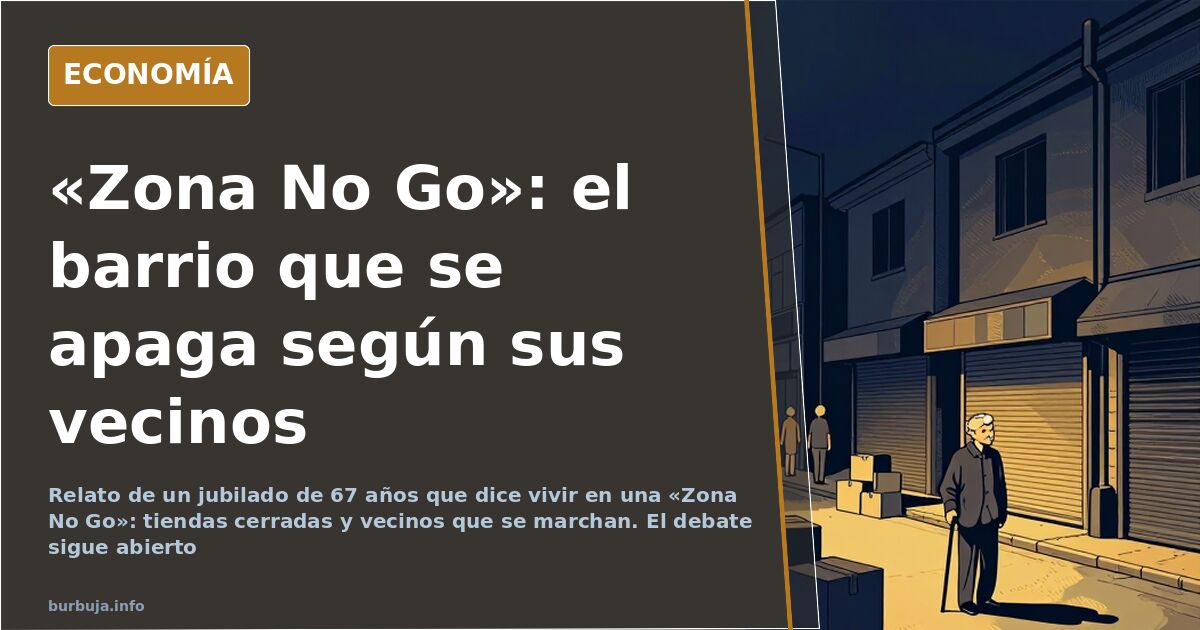
No-Go Zones: Closed Shops, Drugs, and Departing Neighbors
What happens when the neighborhood where you have lived all your life no longer resembles home? A 67-year-old retiree named Alfredo tells his story in the first person: squares full of children, a shop on every corner, grandmothers chatting on benches, and the smell of fresh bread. Today, he describes doors with double locks, parks with broken glass, and neighbors who barely look out the window. His portrait of what he calls a No-Go Zone has sparked a discussion far beyond a specific street: it touches on immigration, security, voting, and money.
What is a no-go zone and why does the term cause discomfort?
It is not an official category: it is an expression imported from Anglo-Saxon jargon used to describe neighborhoods where police presence has become, according to those who use it, tokenistic. This is where the first disagreement begins. Some doubt that a Spanish retiree would use a term so foreign to his generation's speech. The counter-response is quick: they argue that the name doesn't matter and that what it describes exists.
And what it describes has proper names. One school of thought argues it is a structural problem: businesses closing, abandoned public spaces, and changing demographics. Another counters by discussing only the causes—voting, immigration policies, unions—without validating the portrait. Without data, each side fills the gap with its own experience.
From Fresh Bread to Lowered Shutters
The portrait is of a working-class neighborhood that was a hub of life and today, he says, has lost its street vitality. The facades remain crumbling, but there are no longer entire families inside. Children do not go out to play and grandmothers watch through the windows. Bars have closed, and the account mentions drugs, gangs, and violence as part of the daily landscape.
Those who could leave have left. Here comes the uncomfortable nuance: he argues that the destination for those escaping is not a middle-class neighborhood—that, he claims, no longer exists—but another neighborhood in transition toward the same fate. The alternative would be a place where the police still enter. Which is already something.
Who is to Blame? Aznar, Felipe González, and Traditional Voting Patterns
Opinions split into two halves that do not speak to each other. One group blames left-wing voters: whoever voted for what they voted for must bear the consequences. Another distributes responsibility between PP and PSOE equally. And a third goes further back: arguing that the foundations were laid in 1985 with the regularization known as papers for everyone, and that the subsequent real estate cycle needed cheap labor that no one wanted to make expensive.
That argument clashes with an uncomfortable question: if there was consensus among political forces and social agents, why did unions not protest against precarity? No one gives a clean answer. What does appear is a coincidence: whether pointing to Aznar, González, or the voter of the day, the shared diagnosis is that the problem is structural and any solution arrives too late.
Lavapiés and Tirso de Molina: Cited Incidents
The specific cases linked point in the same direction: seven police officers injured in Lavapiés while arresting a drug dealer, and the murder of Concha, which according to reports uncovered antiestéticars in the Madrid neighborhood of Tirso de Molina, with accounts of drug consumption in broad daylight. These are two concrete urban incidents, not national statistics.
It is worth separating levels: that a neighborhood concentrates coexistence problems does not make an entire group suspicious, and citing an event does not prove a general trend. But the echo of these incidents explains why this narrative finds so many amplifiers.
How Much Does It Cost to Leave? €55,000 in an Ávila Village
The most repeated exit is not political, it is geographical. Facing the neighborhood blockade, someone recounts their own move: a renovated two-story house, 150 square meters, with a 200-square-meter garden, bought for €55,000 in a village of twelve inhabitants 20 kilometers from Ávila. They were later told that by negotiating they could have gotten it for €35,000. The only nuisance, the smell of cows.
There is a third path running through responses with irony: express gentrification. Cocktail bars, healthy food, and tourist apartments. The joke is explicit: long-time neighbors would end up outside, as would newcomers. It is not a policy, it is a way of saying that the market resolves from above and below at the same time.
Agenda 2030, Global Elites, and Open Endings
In the final stretch, the usual theories appear: that insecurity is tolerated deliberately to justify a global order, that elites are ruthless but organized, that in a few decades no one will remember how the neighborhood used to be. These are assertions without proof, appearing just when the official diagnosis convinces no one.
The only verifiable thing is the feeling that closes the narrative: those who lived through previous Spain see the change; young people do not. For the latter, this has always been the case. It is the best summary of a discussion without a referee: each generation has its own baseline.
And so we continue, waiting for someone to raise their voice and say "enough," while the rest check if their neighborhood already appears on the map of the next transition.
Also available in: Deutsch
Summary of a discussion on Burbuja.info - Foro de economía, actualidad y política., translated from Spanish and reviewed before publication. Read the full discussion (115 replies).
More summaries
-
Tirso de Molina Murder: Suspect Identity Unconfirmed
Reports identifying the suspect in the Tirso de Molina murder as a Spaniard from El Escorial conflict with initial accounts regarding his origin.
-
Aznar calls out Abascal: "Vox and PSOE hold permanent talks to hurt the PP"
José María Aznar claims that Vox and Spain's Socialist Party (PSOE) hold permanent talks to damage the PP. Analysis of the controversy and the reactions.
-
Madrid's Insecurity Perception and Political Debate
Analysis of insecurity perception in Madrid and the debate on migration policies fueling social tension.
-
Spain's Ayuso turns 48 with an Instagram photo that reignites the debate over her style
Madrid regional president Isabel Díaz Ayuso marked her 48th birthday with an Instagram photo that has reignited debate over her style, her record in Madrid and her national ambitions.
-
PSOE vote-buying hoax hides behind a troll account
A parody account mimics socialist party language to mock vote-buying. The hoax spreads because the underlying claim sounds plausible.
-
Ukrainian-run truck driving school in Poznań taps into Poland's driver shortage
A post on X shows a truck driving school in Poznań run by Ukrainians. Poland's transport sector already employs thousands of drivers from outside the EU.