
No family, no successor: the social contract is breaking
An ex-serviceman living on state benefits after a decade of service renounces family life, questioning the reward for effort.
English · Original discussion in Spanish · Published
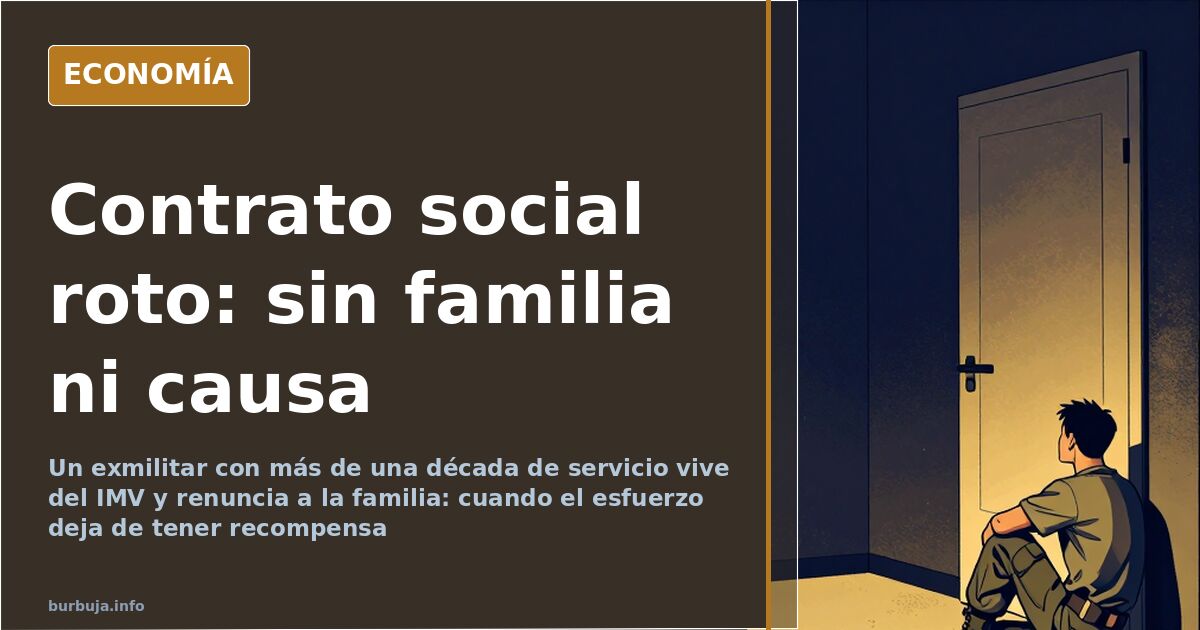
Social Contract Broken: Working Without Family or Succession
Why strive if the reward — a home, family, a shared life — is no longer guaranteed? This question drives a conversation that begins with the testimony of an ex-serviceman. He joined the Army young and, after more than a decade of service without a single sick leave, found himself outside the system due to legal proceedings he deems false, from which he claims to have proven his innocence. In his thirties, he lives off his own apartment and the Ingreso Mínimo Vital (Minimum Vital Income). And he has given up on women and starting a family.
From Over a Decade of Service to Living on the IMV
His departure from the Army, according to his account, stemmed from defending the weak, denouncing corruption, and treating his subordinates as he believed he should. He then tried to redirect his career with vocational training that offered good prospects, in a very insular region where, he recounts, he was rejected from the outset; he lacks the practical experience to finish it. Depression trinc, aggravated by medication for baldness, and his relationship ended with it. "When you understand the species, you look into the abyss, and it looks back at you," he summarizes.
Based on this experience, he constructs his own thesis — fractal human clans that, he argues, would explain everything from the species to the planet's living systems — and a decision: with an apartment and benefits, why seek more? The doubt he raises is more uncomfortable than his biography: if everything is sustained by constant predation, what's the point of continuing?
Why Do Men Without Families Stop Rowing?
The core of the conversation is that effort requires a purpose. Rowing is a sacrifice, he posits, and family would be the primary purpose for most men. Without family, there's no rowing. This intuition is supported by references to sociological studies on the marriage premium: according to these, married men or those in stable relationships tend to be more productive and earn more than single men. The provider role, social pressure, and a more orderly domestic life are presented as common explanations, and the data is cited without delving into nuances of causality.
The counterpoint is not long in coming. If the reward can be undone, the incentive disappears, and then the recommendation is reversed: cultivate your own body and mind first, because "there is nothing that attracts people more, especially women, than a man with a strong, cultivated mind and physique," argues a participant. The cruder version of the same reasoning is identical in substance.
Divorce as a Financial Risk
Where the tone becomes tense is in the legal arena. Some argue that the framework protecting victims of gender-based violence is perceived as a unilateral risk and that it only takes one instance to ruin a life. At the extreme, some messages even suggest hiding income and putting assets in the partner's name to reduce the cost of a potential divorce. The response from another sector is shorter: "Better solitude than divorce."
Even elite sports enter the menu of antiestéticars: it's recalled that a well-known mixed martial arts fighter appeared in the media for a mistreatment complaint, a matter with no reported outcome in the publications. The recurring argument is that neither physique, nor profession, nor position protects from this perceived risk.
The Recipe: Gym, Trade, and Own Project
In the face of discouragement, another part of the analysis proposes concrete solutions. Trades with real demand — plumbing, guasonry, carpentry, marine mechanics — as a path to solid income: a chief engineer in fishing can earn over 100,000 euros per year, it is even claimed. The recipe is completed with demanding training — walks of 8 to 10 kilometers and sets of push-ups to failure — and with ceasing to treat the dating market as a lottery.
Some even describe the US context as a more favorable market: more women than men in certain cities and a supposed added appeal of being European, provided physical condition is met. Other messages point elsewhere: seeking inner peace or, directly, faith. "Turn to Jesus," summarizes one, because family would be much more secondary than that relationship.
What Remains When the Social Contract Breaks
The conversation does not reach an agreement. Some continue rowing in case family appears; others, precisely, so as not to need it. Some recall that grandparents were poor and didn't need a gym or a career to start a family, while others retort that the problem isn't the people, but incentives that have shifted — divorce, uprooting, easy dismissal — and that reward the immediate.
With his apartment, the IMV, and his thirties ahead of him, the protagonist's conclusion is his own question: why keep fighting. Spoiler: the answer, for now, remains open.
Why strive if the reward — a home, family, a shared life — is no longer guaranteed? This question drives a conversation that begins with the testimony of an ex-serviceman. He joined the Army young and, after more than a decade of service without a single sick leave, found himself outside the system due to legal proceedings he deems false, from which he claims to have proven his innocence. In his thirties, he lives off his own apartment and the Ingreso Mínimo Vital (Minimum Vital Income). And he has given up on women and starting a family.
From Over a Decade of Service to Living on the IMV
His departure from the Army, according to his account, stemmed from defending the weak, denouncing corruption, and treating his subordinates as he believed he should. He then tried to redirect his career with vocational training that offered good prospects, in a very insular region where, he recounts, he was rejected from the outset; he lacks the practical experience to finish it. Depression trinc, aggravated by medication for baldness, and his relationship ended with it. "When you understand the species, you look into the abyss, and it looks back at you," he summarizes.
Based on this experience, he constructs his own thesis — fractal human clans that, he argues, would explain everything from the species to the planet's living systems — and a decision: with an apartment and benefits, why seek more? The doubt he raises is more uncomfortable than his biography: if everything is sustained by constant predation, what's the point of continuing?
Why Do Men Without Families Stop Rowing?
The core of the conversation is that effort requires a purpose. Rowing is a sacrifice, he posits, and family would be the primary purpose for most men. Without family, there's no rowing. This intuition is supported by references to sociological studies on the marriage premium: according to these, married men or those in stable relationships tend to be more productive and earn more than single men. The provider role, social pressure, and a more orderly domestic life are presented as common explanations, and the data is cited without delving into nuances of causality.
The counterpoint is not long in coming. If the reward can be undone, the incentive disappears, and then the recommendation is reversed: cultivate your own body and mind first, because "there is nothing that attracts people more, especially women, than a man with a strong, cultivated mind and physique," argues a participant. The cruder version of the same reasoning is identical in substance.
Divorce as a Financial Risk
Where the tone becomes tense is in the legal arena. Some argue that the framework protecting victims of gender-based violence is perceived as a unilateral risk and that it only takes one instance to ruin a life. At the extreme, some messages even suggest hiding income and putting assets in the partner's name to reduce the cost of a potential divorce. The response from another sector is shorter: "Better solitude than divorce."
Even elite sports enter the menu of antiestéticars: it's recalled that a well-known mixed martial arts fighter appeared in the media for a mistreatment complaint, a matter with no reported outcome in the publications. The recurring argument is that neither physique, nor profession, nor position protects from this perceived risk.
The Recipe: Gym, Trade, and Own Project
In the face of discouragement, another part of the analysis proposes concrete solutions. Trades with real demand — plumbing, guasonry, carpentry, marine mechanics — as a path to solid income: a chief engineer in fishing can earn over 100,000 euros per year, it is even claimed. The recipe is completed with demanding training — walks of 8 to 10 kilometers and sets of push-ups to failure — and with ceasing to treat the dating market as a lottery.
Some even describe the US context as a more favorable market: more women than men in certain cities and a supposed added appeal of being European, provided physical condition is met. Other messages point elsewhere: seeking inner peace or, directly, faith. "Turn to Jesus," summarizes one, because family would be much more secondary than that relationship.
What Remains When the Social Contract Breaks
The conversation does not reach an agreement. Some continue rowing in case family appears; others, precisely, so as not to need it. Some recall that grandparents were poor and didn't need a gym or a career to start a family, while others retort that the problem isn't the people, but incentives that have shifted — divorce, uprooting, easy dismissal — and that reward the immediate.
With his apartment, the IMV, and his thirties ahead of him, the protagonist's conclusion is his own question: why keep fighting. Spoiler: the answer, for now, remains open.
Summary of a discussion on Burbuja.info - Foro de economía, actualidad y política., translated from Spanish and reviewed before publication. Read the full discussion (224 replies).
More summaries
-
Forum Cites Social Security Data: Girona Leads at 41.2%
Forum cites August 2026 Social Security data: Girona, 41.2%; Teruel, 40.4%; Basque Country, 28.8%.
-
Spanish Minimum Income Benefit Exceeds Most Common Salary: Who Gets What
The Spanish Minimum Income Benefit (IMV) is 20% higher than the most common salary, but €1,195 is for a family of three, while €1,200 is for a single worker. Key details explained.
-
Rural Spain demanding €5,000 to report illegal parking
A resident in a village in Tordoia reports illegally parked curbside vehicles and faces death threats. The clash between law and rural custom comes with a price: €5,000...
-
Euthanasia in Old Age: Autonomy vs. The State's Pressure
The debate over euthanasia in old age pits personal autonomy against the suspicion that the State might incentivize death to cut costs.
-
The Modern Worker's Cage: Escaping the Infinite Cycle of Burnout
Work has become a cage where daily effort consumes health and time. Discover why we push ourselves so hard and how to break the cycle.
-
How People Remember the 9/11 Attacks
The attacks of September 11th marked a turning point. Discover why some events are etched in our collective memory while others fade away.