
No Blue Princes: The Dating Market Breaks Down Over Money
A café breakfast sparks debate on the dating market: women seek a provider, men refuse to pay.
English · Original discussion in Spanish · Published
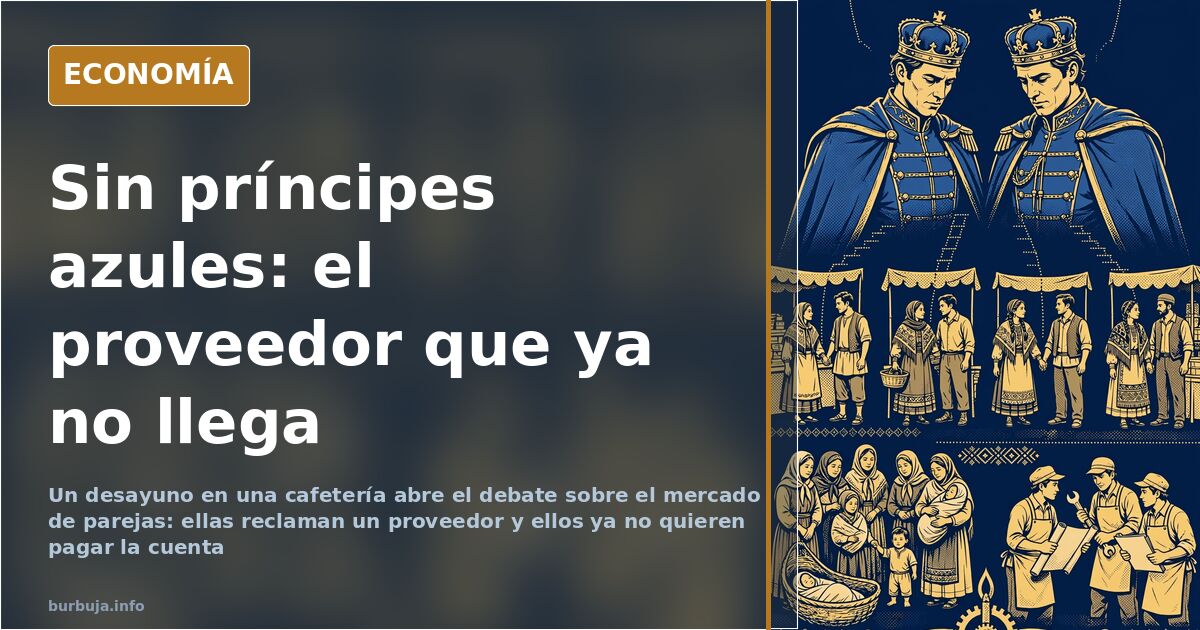
The dating market is stuck: they seek a provider, he calculates
Twelve kilometers of running, a breakfast at a newly discovered café, and an eavesdropped conversation ending in laughter. The protagonist recounts the scene: two baristas, one stressed about money, and two older women listening. In fifteen minutes, the chat turns to a verdict: "you need a rich boyfriend." This brings up the diagnosis—there are no men like before, no provider—and the question defining the Spanish dating market: is it a shortage of supply or a miscalibrated filter?
The laughter was involuntary, but the relevance lies behind the anecdote: two women, despite a pogre discourse, vocalize the traditional provider model. This contradiction is not new; it was captured unedited at that breakfast.
Why do they say there are no blue princes anymore?
Because the ideal of the man who provides, solves, and offers economic stability is increasingly scarce against unyielding demand. The repeated argument is hypergamy: most are rejected, and only a small visible fraction remains. The circulating calculation is that 90% of candidates are rejected, focusing on the 5% or 10% with the most attractiveness, job, or income. The rest, they say, are invisible.
This filter clashes with a highlighted detail: men in that upper tier usually have a partner or are married with children, and from a certain age, the available group narrows. The conclusion is not that men don't exist, but that the specific ones being sought do not. The entire complaint is built on this gap.
The salary needed to sustain the old model
To sustain a household on a single salary, the entire scale must be redone. The scenario is explicit: 10,000 euros a month fixed for him, with a stable job, and 1,000 for her, plus 100-square-meter apartments in major cities costing 50,000 euros. With these variables, the conclusion is that birth rates would soar and many women wouldn't need to work outside the home. The problem, they add, is that this is far from the case.
The contrast is measured in paychecks. A case presented: a 27-year-old woman with an Economics degree, aiming for a high-level finance role, ended up in a multinational's finance department in Madrid with 1,600 euros a month. Trajectory, city, and cost of life against a model requiring someone to support her. The arithmetic doesn't add up from any angle.
Traditional women outside Spain: the alternative plan
The gaining solution doesn't involve renegotiating the division of labor, but changing markets. Some argue it is easier to find a traditional homemaker profile outside Spain, mentioning rural Eastern European environments, and some claim to have solved their lives this way: a partner aged 44, he is 48, she works part-time, keeping her salary for personal expenses while he covers family costs. It is presented as a decision with returns: her social security contributions, a tidy house, and a cared-for couple.
The reverse side is a demand detailed: men over 40, with jobs and property, seeking a twenty-something, normal woman without what they call overcomplication, willing to live in a village. If this is antiestéticasible remains unclear. What is confirmed is that the traditional homemaker discourse is no longer the property of a single ideological profile.
Birth rates, contributors, and the math that doesn't work
The demographic drift enters through two channels. One: it is claimed that Spain has 20 million contributors and that only 7 to 8 million support the real effort. Another: it is argued that birth rates are not an unquestionable goal, because, it is argued, the country went from 15 to 50 million inhabitants, and the problem is distribution, not the number. Both are launched as opinions, with no backing other than the conviction of those saying them.
The knot is the same as the beginning. The male provider model requires an economy that no longer exists and expectations that remain intact. As long as the gap persists, the complaint will circulate in both directions: some say they cannot, others say there are none.
So the agreement is broad—the mismatch exists—and the disagreement is total when assigning blame. Some point to partner selection; others, to the cost of living; others, to a legal framework that, they claim, leaves the risk of starting a family almost always on the same side. There, exactly there, the analysis stalls.
Twelve kilometers of running, a breakfast at a newly discovered café, and an eavesdropped conversation ending in laughter. The protagonist recounts the scene: two baristas, one stressed about money, and two older women listening. In fifteen minutes, the chat turns to a verdict: "you need a rich boyfriend." This brings up the diagnosis—there are no men like before, no provider—and the question defining the Spanish dating market: is it a shortage of supply or a miscalibrated filter?
The laughter was involuntary, but the relevance lies behind the anecdote: two women, despite a pogre discourse, vocalize the traditional provider model. This contradiction is not new; it was captured unedited at that breakfast.
Why do they say there are no blue princes anymore?
Because the ideal of the man who provides, solves, and offers economic stability is increasingly scarce against unyielding demand. The repeated argument is hypergamy: most are rejected, and only a small visible fraction remains. The circulating calculation is that 90% of candidates are rejected, focusing on the 5% or 10% with the most attractiveness, job, or income. The rest, they say, are invisible.
This filter clashes with a highlighted detail: men in that upper tier usually have a partner or are married with children, and from a certain age, the available group narrows. The conclusion is not that men don't exist, but that the specific ones being sought do not. The entire complaint is built on this gap.
The salary needed to sustain the old model
To sustain a household on a single salary, the entire scale must be redone. The scenario is explicit: 10,000 euros a month fixed for him, with a stable job, and 1,000 for her, plus 100-square-meter apartments in major cities costing 50,000 euros. With these variables, the conclusion is that birth rates would soar and many women wouldn't need to work outside the home. The problem, they add, is that this is far from the case.
The contrast is measured in paychecks. A case presented: a 27-year-old woman with an Economics degree, aiming for a high-level finance role, ended up in a multinational's finance department in Madrid with 1,600 euros a month. Trajectory, city, and cost of life against a model requiring someone to support her. The arithmetic doesn't add up from any angle.
Traditional women outside Spain: the alternative plan
The gaining solution doesn't involve renegotiating the division of labor, but changing markets. Some argue it is easier to find a traditional homemaker profile outside Spain, mentioning rural Eastern European environments, and some claim to have solved their lives this way: a partner aged 44, he is 48, she works part-time, keeping her salary for personal expenses while he covers family costs. It is presented as a decision with returns: her social security contributions, a tidy house, and a cared-for couple.
The reverse side is a demand detailed: men over 40, with jobs and property, seeking a twenty-something, normal woman without what they call overcomplication, willing to live in a village. If this is antiestéticasible remains unclear. What is confirmed is that the traditional homemaker discourse is no longer the property of a single ideological profile.
Birth rates, contributors, and the math that doesn't work
The demographic drift enters through two channels. One: it is claimed that Spain has 20 million contributors and that only 7 to 8 million support the real effort. Another: it is argued that birth rates are not an unquestionable goal, because, it is argued, the country went from 15 to 50 million inhabitants, and the problem is distribution, not the number. Both are launched as opinions, with no backing other than the conviction of those saying them.
The knot is the same as the beginning. The male provider model requires an economy that no longer exists and expectations that remain intact. As long as the gap persists, the complaint will circulate in both directions: some say they cannot, others say there are none.
So the agreement is broad—the mismatch exists—and the disagreement is total when assigning blame. Some point to partner selection; others, to the cost of living; others, to a legal framework that, they claim, leaves the risk of starting a family almost always on the same side. There, exactly there, the analysis stalls.
Also available in: Deutsch
Summary of a discussion on Burbuja.info - Foro de economía, actualidad y política., translated from Spanish and reviewed before publication. Read the full discussion (296 replies).
More summaries
-
Traditional Couple Crisis: Housing, State, and Feminism
A calculation attributes 75% of breakups initiated by women to the crisis between feminism, the State, and housing.
-
Why Ukrainian women are blamed for front-line attrition
A claim that 70% of Ukrainian female refugees abandoned partners at the front lacks verifiable sources.
-
Why Spain isn't having children: three underlying trends
Housing, wages, female education and immigration: the three trends that explain why Spain barely reaches 1.2 children per woman
-
Bernardos Suggests Leaving Homes Vacant Amid Penal Code Debate
Economist Gonzalo Bernardos advises leaving properties vacant until legal certainty returns, sparking debate over Article 281.1 of the Spanish Penal Code.
-
Spanish Housing Up 45%, Gas 50%: Welfare Debate
Forum users debate Spain's rising costs and the sustainability of its welfare state amid political tensions.
-
Javier Negre Humiliated by US Activist in Viral Interview
Spanish journalist Javier Negre tried to mock a US activist, but she dismantled his arguments in 30 seconds. The video he posted went viral.