
Niño Becerra and the 2010 crash: the series almost nobody read
Santiago Niño Becerra predicted in 2007 a 2010 crisis, a GDP drop of -8% and 22% unemployment for 2009. The tracking of his September series and the...
English · Original discussion in Spanish · Published
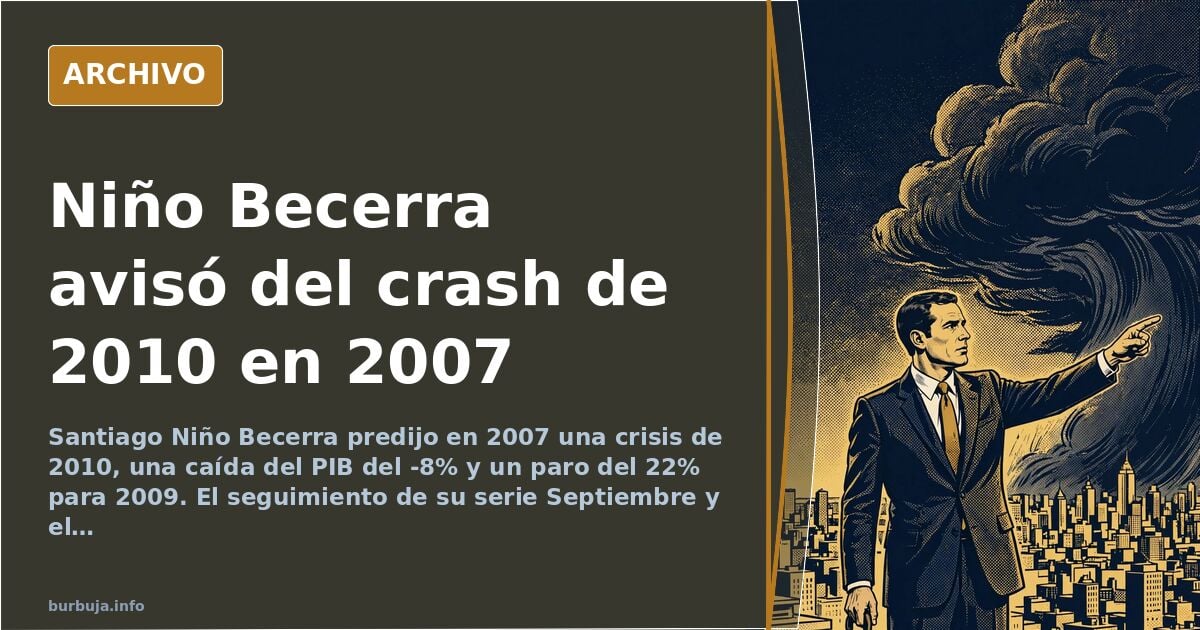
Niño Becerra announced the 2010 crash when Spain was saying "things are going well"
In July 2007, with the IBEX at its peak and the construction sector still hot, a professor of Economic Structure at the IQS School of Economics, Santiago Niño Becerra, published the first in a series of articles under an apparently innocent title: "September". His thesis was not. That month, he wrote, would be "the beginning of the end of the economic system" in place since 1820 and would lead to "a great crisis that will begin in 2010". Nobody paid much attention then. That was, exactly, the problem.
The texts appeared in La Carta de la Bolsa throughout that August and became the backbone of a tracking that lasted more than two years, until February 2010. In that time, it went from skepticism to Cassandra, and from Cassandra to meme. Along the way, an uncomfortable question remained: is the one who warns a prophet or a doomsayer who gets it right by insistence?
The 2007 figures that already contradicted the official narrative
At the end of 2007 there were data that jarred. The average GDP growth of the EMU in the second quarter was 40% lower than the minimum that had been forecast, and European industrial production slowed by 51.06% in the first half. "Wasn't everything going so well?", the article asked. In the United States, private consumption was around 70% of GDP and debt reached 130% of income: any credit slowdown, it warned, would wipe out demand entirely.
In Spain the diagnosis was equally uncomfortable. The energy dependence index stood at 81.4, compared to 53.8 in the EU of 27, and rising. The author's conclusion allowed no nuances: the system was not dying from lack of liquidity, it was dying because credit had become "the only engine". Injecting money into central banks, he argued, was not going to turn anything around.
The unemployment that was coming: 22%, 28% and 35%
The forecast table being handled at the beginning of 2009 was one of those that takes away your appetite. For that year, a real GDP drop of -8%, inflation at -1.5% and unemployment at 22%. For 2010, the scenario stretched to -10% GDP and 28% unemployment. And for 2011, the last year of the central part of the depression, up to 35%.
There were even those who were more precise than the professor himself. "I am still more pessimistic than him", said a calculation that circulated in the forums of the time, convinced that unemployment would not rise by only two points with an economy sinking at that rate. The discussion stopped being whether there would be a crisis and focused on how big it would be.
From pre-crisis to the bad loans of the savings banks
In March 2009, while official propaganda spoke of green shoots, the bad loans of nine savings banks already exceeded 6%. The data fit with what had been anticipated: if the problem was never liquidity but solvency, the drip was not going to stop. The institutional response, however, came from another direction. The auto industry bailout was the canonical example that was discussed: Volkswagen asked for aid of 309 million for an investment of 300 and, incidentally, wage freeze and a two-year layoff plan. "Nothing has been understood about what is happening", the article concluded.
Time proved both right and wrong. In 2011, the year he pointed out as the hardest of the entire period, the kingdom was immersed in full restructuring. The coincidence with Robert Reich, with Krugman or with the GEAB reports was not casual: half a dozen analysts had reached the same place by different paths.
Where did the doomsayer himself invest? The tuna joke
The recurring question was obvious: if everything goes to hell, where does Don Santiago put his money? He never gave clear clues. In an interview he had recommended six-month or one-year deposits and reconsidering later. The joking answer was repeated for years: "In cans of tuna... only what is necessary is important". Another variant recalled that, in the midst of the fall, people were "opening accounts abroad instead of windows".
Although the character had his charm. It was said of him that he traveled on his own, on public transport, paying more attention to how people live than to tourist monuments, and that his fine irony already came from the 2007 series. On television, when he came out from among the audience, he let out that thing about the extraterrestrial: Spain works more hours than almost anyone in Europe and produces less than almost anyone. The problem, he said, was systemic, not individual guilt.
The one who gives up is not the one who warns
At the beginning of 2010 the tone was already different. The focus had shifted from subprime to sovereign debt, and the warning became concrete: at 07:30 on February 5, Bloomberg headlined that stocks were falling, the euro was dropping and bond risk was soaring due to employment and debt. "It's Spain, obviously!, but it's not only Spain." The feeling was that the professor had stopped arguing and started describing.
Against that, the same skeptical argument always weighed: the crash is global, yes, but it has been announced since 2006. Is it a hit or the broken clock that is right twice a day? "Probably it has nothing to offer you anymore", they would say to those who kept reading him. The series closed without resolving the question.
What the debate was really about
While the headline was taken by the crash, the body of the matter was another. If the economy had been sustained by credit and credit was fading, the adjustment was not a recession: it was a change of model. There were the theses about a regulated economy model between 2012 and 2015, energy as a bottleneck and a country that creates low-skilled public employment at the cost of fiscally suffocating SMEs. That debate, reviewed today, remains open.
That the 2010 forecast was a hit is known by anyone with a mortgage. That it held up we owe to those who did not stop making the list. It is an exercise of uncomfortable fair play: the one who warned became as annoying as the one who did not warn. A good part of the discredit fell on those who insisted, not on those who were wrong. And that, deep down, is the most useful sarracena of everything that was read back then.
In July 2007, with the IBEX at its peak and the construction sector still hot, a professor of Economic Structure at the IQS School of Economics, Santiago Niño Becerra, published the first in a series of articles under an apparently innocent title: "September". His thesis was not. That month, he wrote, would be "the beginning of the end of the economic system" in place since 1820 and would lead to "a great crisis that will begin in 2010". Nobody paid much attention then. That was, exactly, the problem.
The texts appeared in La Carta de la Bolsa throughout that August and became the backbone of a tracking that lasted more than two years, until February 2010. In that time, it went from skepticism to Cassandra, and from Cassandra to meme. Along the way, an uncomfortable question remained: is the one who warns a prophet or a doomsayer who gets it right by insistence?
The 2007 figures that already contradicted the official narrative
At the end of 2007 there were data that jarred. The average GDP growth of the EMU in the second quarter was 40% lower than the minimum that had been forecast, and European industrial production slowed by 51.06% in the first half. "Wasn't everything going so well?", the article asked. In the United States, private consumption was around 70% of GDP and debt reached 130% of income: any credit slowdown, it warned, would wipe out demand entirely.
In Spain the diagnosis was equally uncomfortable. The energy dependence index stood at 81.4, compared to 53.8 in the EU of 27, and rising. The author's conclusion allowed no nuances: the system was not dying from lack of liquidity, it was dying because credit had become "the only engine". Injecting money into central banks, he argued, was not going to turn anything around.
The unemployment that was coming: 22%, 28% and 35%
The forecast table being handled at the beginning of 2009 was one of those that takes away your appetite. For that year, a real GDP drop of -8%, inflation at -1.5% and unemployment at 22%. For 2010, the scenario stretched to -10% GDP and 28% unemployment. And for 2011, the last year of the central part of the depression, up to 35%.
There were even those who were more precise than the professor himself. "I am still more pessimistic than him", said a calculation that circulated in the forums of the time, convinced that unemployment would not rise by only two points with an economy sinking at that rate. The discussion stopped being whether there would be a crisis and focused on how big it would be.
From pre-crisis to the bad loans of the savings banks
In March 2009, while official propaganda spoke of green shoots, the bad loans of nine savings banks already exceeded 6%. The data fit with what had been anticipated: if the problem was never liquidity but solvency, the drip was not going to stop. The institutional response, however, came from another direction. The auto industry bailout was the canonical example that was discussed: Volkswagen asked for aid of 309 million for an investment of 300 and, incidentally, wage freeze and a two-year layoff plan. "Nothing has been understood about what is happening", the article concluded.
Time proved both right and wrong. In 2011, the year he pointed out as the hardest of the entire period, the kingdom was immersed in full restructuring. The coincidence with Robert Reich, with Krugman or with the GEAB reports was not casual: half a dozen analysts had reached the same place by different paths.
Where did the doomsayer himself invest? The tuna joke
The recurring question was obvious: if everything goes to hell, where does Don Santiago put his money? He never gave clear clues. In an interview he had recommended six-month or one-year deposits and reconsidering later. The joking answer was repeated for years: "In cans of tuna... only what is necessary is important". Another variant recalled that, in the midst of the fall, people were "opening accounts abroad instead of windows".
Although the character had his charm. It was said of him that he traveled on his own, on public transport, paying more attention to how people live than to tourist monuments, and that his fine irony already came from the 2007 series. On television, when he came out from among the audience, he let out that thing about the extraterrestrial: Spain works more hours than almost anyone in Europe and produces less than almost anyone. The problem, he said, was systemic, not individual guilt.
The one who gives up is not the one who warns
At the beginning of 2010 the tone was already different. The focus had shifted from subprime to sovereign debt, and the warning became concrete: at 07:30 on February 5, Bloomberg headlined that stocks were falling, the euro was dropping and bond risk was soaring due to employment and debt. "It's Spain, obviously!, but it's not only Spain." The feeling was that the professor had stopped arguing and started describing.
Against that, the same skeptical argument always weighed: the crash is global, yes, but it has been announced since 2006. Is it a hit or the broken clock that is right twice a day? "Probably it has nothing to offer you anymore", they would say to those who kept reading him. The series closed without resolving the question.
What the debate was really about
While the headline was taken by the crash, the body of the matter was another. If the economy had been sustained by credit and credit was fading, the adjustment was not a recession: it was a change of model. There were the theses about a regulated economy model between 2012 and 2015, energy as a bottleneck and a country that creates low-skilled public employment at the cost of fiscally suffocating SMEs. That debate, reviewed today, remains open.
That the 2010 forecast was a hit is known by anyone with a mortgage. That it held up we owe to those who did not stop making the list. It is an exercise of uncomfortable fair play: the one who warned became as annoying as the one who did not warn. A good part of the discredit fell on those who insisted, not on those who were wrong. And that, deep down, is the most useful sarracena of everything that was read back then.
Summary of a discussion on Burbuja.info - Foro de economía, actualidad y política., translated from Spanish and reviewed before publication. Read the full discussion (7219 replies).
More summaries
-
87-year-old Maricarmen and her 500€ old rent apartment
Maricarmen, 87, pays €500/month for a Madrid apartment under an old rent contract. Police cleared the street during her fourth eviction attempt.
-
Pasapalabra: TV Contest as Argument for Public Spending
A Pasapalabra contestant's success sparks debate, with critics viewing it as a staged show to legitimize Spain's tax and public spending model.
-
Macron reappoints French PM after resignation in less than 24 hours
French PM resigns after less than 24 hours in office. Macron reappoints him, highlighting political crisis and difficulty forming government.
-
Russian Drones Violate European Airspace, Sparking Confusion
Dozens of Russian drones breach Polish, Slovak, and Moldovan airspace, raising serious European security concerns and sparking geopolitical debate.
-
Spain extends eviction moratorium for vulnerable families through 2024
Spain and Bildu extend the eviction freeze for vulnerable families throughout 2024, creating uncertainty about the definition of 'vulnerable' and straining the rental market.
-
Ferraz Protest Fizzles as Amnesty Protests Shift Focus to Málaga Summit
While the Madrid rally against the amnesty bill saw low turnout, attention shifted to Málaga, where Pedro Sánchez met with European leaders.