
NINIS: The Label That Blames Spain's Unemployed
The 'NINI' label is seen by some as blaming the unemployed; a 26-year-old said his doctor criticized him for not studying or working.
English · Original discussion in Spanish · Published
NINIS: The Label That Blames the Unemployed in a Spain Without Industry
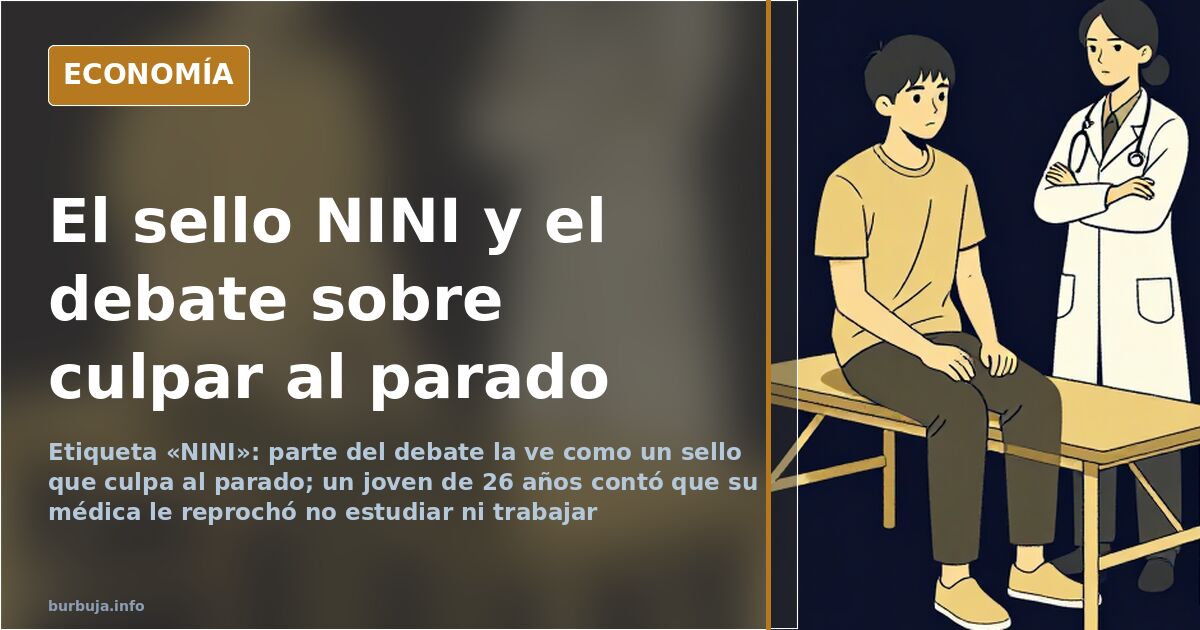
A 26-year-old man left the clinic with a word stuck to his back: "parasite." His family doctor had called him that for not studying or working. He didn't answer back. He changed doctors and later told the story, half-jokingly, in an economic discussion that ended up talking about something bigger than his case: who decides who gets called a NINI and why that label sticks so well in a country with structural employment problems.
The spark is lit by an incendiary text. It argues that elites use the media to make the population feel guilty about their own situation—antiestéticar, humiliation, silence—and that the result is a sheep-like mass incapable of rebelling. The text literally ends up recommending attacking anyone who uses the label. Almost no one takes up that glove through violence; many, however, start discussing the economic side of the matter.
From the Eighth Industrial Power to a Waiter Economy
The initial approach claims that Spain was the 8th industrial power in the world and that the so-called Regime of '78 dismantled it to sell it "at a bargain price," with 2 bankruptcies in 15 years and an economy of low wages. Criticism soon trinc. One analysis recalls that deindustrialization came when protectionist measures were withdrawn and compares the case with South Korea, which maintained protection in key sectors and from which Samsung, Hyundai, Daewoo, KIA, and LG emerged. The contrast is repeated: here they chose to trinc; there, they chose their own industry.
The underlying diagnosis—a country with rich-country prices and poor-country wages—is discussed less than the solution. Some blame tax and regulatory suffocation for nobody starting a business. Others point out that the problem is the production model, not individual effort. And a third, more uncomfortable path, argues that the Spanish labor market is not broken by accident.
Why Is a Long-Term Unemployed Person Called a NINI?
Because it shifts to the individual a responsibility that, according to a recurring argument in the exchange, belongs to the cycle. The label was born for young people who neither study nor work, but the exchange soon overflows it: more and more adults have studied, have worked, and after chaining six-month contracts, have thrown in the towel. Those over 50 and unemployed are also remembered, family fathers who find no way out. A recurring argument holds that "ninismo" is an invention to relieve the system of blame for structural unemployment and to pit the employed against the excluded.
The hardest stance admits no nuances: if you don't work and don't study, the problem is yours. That current focuses on effort, initiative, and what it considers victimhood, and responds with a phrase that reappears again and again: "get a job."
The Migration Clash as a Screen
Some texts blame the arrival of foreign workers for downward pressure on wages. Others reply that those who get up early to pick vegetables are not the enemy, and warn that turning them into an example of sacrifice compared to the local unemployed is a way to pit those at the bottom against each other. There are also those who recall that a country that mistreats its own people has no authority to give lessons. The tension runs through the exchange, but the underlying issue most repeated is another: how the labor market works.
Nepotism and the Escape Plan
Among the back-and-forth, an uncomfortable diagnosis slips in: without contacts there is no job, no cushy position. Those who don't cultivate useful friendships have it worse, it is said. Hence the most repeated advice among those who move past complaining: study, work until 30, save, and, with languages and experience, emigrate to a more serious market before hiring stops for those who turn a certain age. It's not optimism. It's an eviction order.
The Mind Control Theory, Without Evidence
The initial text doesn't stop at economics. It talks about manipulation techniques attributed to Freemasonry and even links the Germanwings plane crash to the approval of a public safety law. These are claims without any support. They appear mixed with a labor discontent that is real, and that's where much of the problem lies: when genuine unease is wrapped in conspiracies, criticism becomes easy to dismiss.
The disconcerting closing is unintentionally signed by the approach itself. Whoever calls for burning the streets shares the framework of the one they claim to fight: they call their enemy a NINI and take for granted that working is proof of virtue. In a country that, according to the initial approach, would have the highest unemployment rate in the world, the discussion doesn't end in figures, but in deciding whether the unemployed person is a victim or to blame. No one ends up agreeing.
A 26-year-old man left the clinic with a word stuck to his back: "parasite." His family doctor had called him that for not studying or working. He didn't answer back. He changed doctors and later told the story, half-jokingly, in an economic discussion that ended up talking about something bigger than his case: who decides who gets called a NINI and why that label sticks so well in a country with structural employment problems.
The spark is lit by an incendiary text. It argues that elites use the media to make the population feel guilty about their own situation—antiestéticar, humiliation, silence—and that the result is a sheep-like mass incapable of rebelling. The text literally ends up recommending attacking anyone who uses the label. Almost no one takes up that glove through violence; many, however, start discussing the economic side of the matter.
From the Eighth Industrial Power to a Waiter Economy
The initial approach claims that Spain was the 8th industrial power in the world and that the so-called Regime of '78 dismantled it to sell it "at a bargain price," with 2 bankruptcies in 15 years and an economy of low wages. Criticism soon trinc. One analysis recalls that deindustrialization came when protectionist measures were withdrawn and compares the case with South Korea, which maintained protection in key sectors and from which Samsung, Hyundai, Daewoo, KIA, and LG emerged. The contrast is repeated: here they chose to trinc; there, they chose their own industry.
The underlying diagnosis—a country with rich-country prices and poor-country wages—is discussed less than the solution. Some blame tax and regulatory suffocation for nobody starting a business. Others point out that the problem is the production model, not individual effort. And a third, more uncomfortable path, argues that the Spanish labor market is not broken by accident.
Why Is a Long-Term Unemployed Person Called a NINI?
Because it shifts to the individual a responsibility that, according to a recurring argument in the exchange, belongs to the cycle. The label was born for young people who neither study nor work, but the exchange soon overflows it: more and more adults have studied, have worked, and after chaining six-month contracts, have thrown in the towel. Those over 50 and unemployed are also remembered, family fathers who find no way out. A recurring argument holds that "ninismo" is an invention to relieve the system of blame for structural unemployment and to pit the employed against the excluded.
The hardest stance admits no nuances: if you don't work and don't study, the problem is yours. That current focuses on effort, initiative, and what it considers victimhood, and responds with a phrase that reappears again and again: "get a job."
The Migration Clash as a Screen
Some texts blame the arrival of foreign workers for downward pressure on wages. Others reply that those who get up early to pick vegetables are not the enemy, and warn that turning them into an example of sacrifice compared to the local unemployed is a way to pit those at the bottom against each other. There are also those who recall that a country that mistreats its own people has no authority to give lessons. The tension runs through the exchange, but the underlying issue most repeated is another: how the labor market works.
Nepotism and the Escape Plan
Among the back-and-forth, an uncomfortable diagnosis slips in: without contacts there is no job, no cushy position. Those who don't cultivate useful friendships have it worse, it is said. Hence the most repeated advice among those who move past complaining: study, work until 30, save, and, with languages and experience, emigrate to a more serious market before hiring stops for those who turn a certain age. It's not optimism. It's an eviction order.
The Mind Control Theory, Without Evidence
The initial text doesn't stop at economics. It talks about manipulation techniques attributed to Freemasonry and even links the Germanwings plane crash to the approval of a public safety law. These are claims without any support. They appear mixed with a labor discontent that is real, and that's where much of the problem lies: when genuine unease is wrapped in conspiracies, criticism becomes easy to dismiss.
The disconcerting closing is unintentionally signed by the approach itself. Whoever calls for burning the streets shares the framework of the one they claim to fight: they call their enemy a NINI and take for granted that working is proof of virtue. In a country that, according to the initial approach, would have the highest unemployment rate in the world, the discussion doesn't end in figures, but in deciding whether the unemployed person is a victim or to blame. No one ends up agreeing.
Also available in: Deutsch
Summary of a discussion on Burbuja.info - Foro de economía, actualidad y política., translated from Spanish and reviewed before publication. Read the full discussion (158 replies).
More summaries
-
Immigration and Labor Precarity in Spain: A Colombian Woman’s Struggle
A 58-year-old Colombian woman’s jobless plight in Spain highlights labor precarity and the debate over migration policies.
-
Rents surge 60%: exposing labor precarity
A 60% rent hike reveals the clash between audiovisual earnings and housing costs, highlighting the fragility of current residential contracts.
-
Mental Health Sick Leaves Surge 176% Amid Rising Labor Precarity
Anxiety-related absences have jumped 176% since 2015, mirroring Spain's labor precarity. We analyze how the cost of living impacts worker health.
-
Officials Flee Ministries to Avoid Signing Illegal Documents
Ministry officials under suspicion request transfers to avoid signing illegal documents. Political pressure and fear of reprisals trigger a mass exodus...
-
Madrid rental listings drop 20% after decree
Forum users track Madrid's rental supply falling from 11,815 to 9,398 ads in one day. They blame the new decree. Barcelona has only 680 long-term rentals.
-
Spain's Debate: Voting vs. Abstention in Upcoming Elections
A forum debates voting as a lesser evil versus abstaining as punishment. In 2019, with the lowest turnout since 1978 (66%), Sánchez reached La Moncloa.