
Nigeria Approaches 733 Million by 2100, Spain Drops to 33
UN population projections for 2100 place India first, Nigeria third with 733 million, and Spain at rank 63 with 33.2 million.
English · Original discussion in Spanish · Published
Nigeria Approaches 733 Million by 2100, Spain Drops to 33
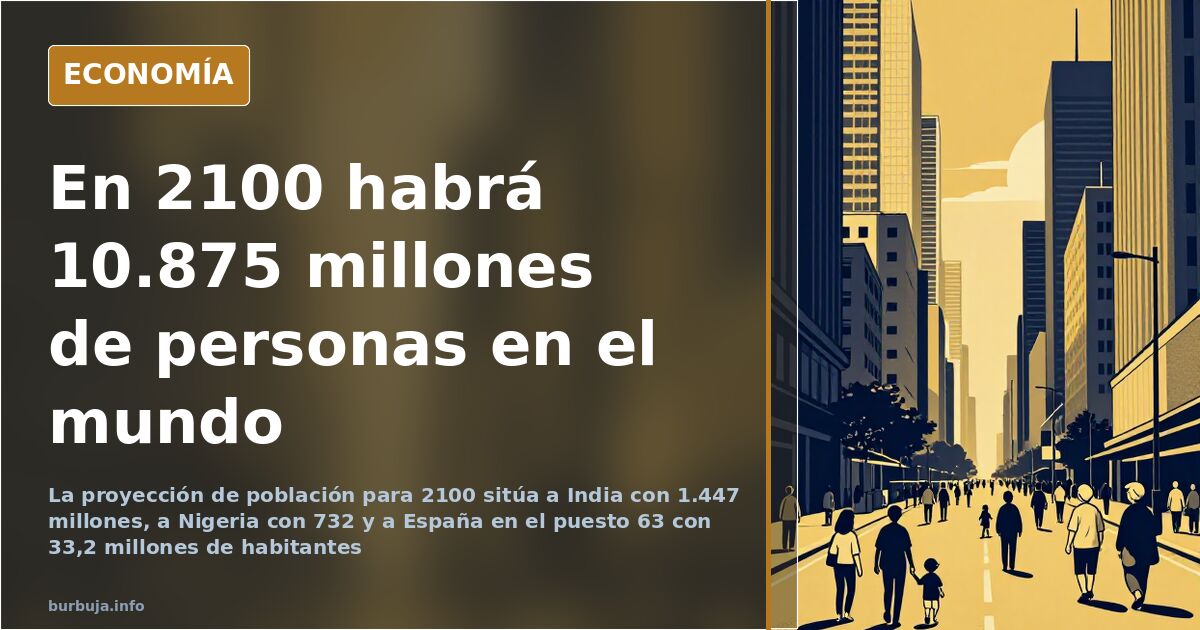
10.875 billion people. This is the total figure for the worldwide projection for 2100, anchoring a ranking circulating for days that orders countries by future population. India (1.447.025.612) and China (1.064.993.457) remain at the top, but the podium changes tenants. Nigeria, with 732.941.596 inhabitants, takes third place. Spain appears at rank 63 with 33.209.856.
This is not just any table. It reorders global hierarchy based on a single variable—how many people live in each country—leaving a map where Europe fades and Africa multiplies. The fine print, as always, lies in who authored it and with what data.
The Table Reordering the World: 10.875 Billion Inhabitants in 2100
The bulk of growth concentrates in the African continent. D.R. Congo ranks sixth with 362.031.082 inhabitants, Indonesia seventh with 320.782.426, and Ethiopia eighth with 294.392.903. Trinc are Tanzania (285.651.846), Egypt (224.735.180), Angola (188.283.132), Brazil (180.682.762), Niger (164.947.337), and Bangladesh (151.393.018).
The European collapse is the other major headline. Germany drops to 74.740.596, Japan to 74.959.378, and Russia to 126.142.651, far from its historical weight. Italy, at rank 58, with 39.992.910. Spain, at 63. If anyone sought a photo of the coming century, this is the most uncomfortable.
Why Does Spain Appear with Only 33 Million Inhabitants?
The prevailing explanation combines very low fertility with a migration balance that, in this scenario, no longer compensates. In other words: generational replacement fails and the decline accelerates.
Some argue the figure is directly implausible. They contend that, with current entry rates, the country will exceed 100 million by 2100, with a vast majority of foreign origin: not even one-fifth would be native, according to that calculation. The discrepancy is significant: between 33 and 100 million lies an entire country.
Skepticism toward the table is cross-cutting. Critics note that eighty years are too long to project anything with precision, and long demographic series are usually corrected every few years. Defenders of the numbers respond that the trend is already written in today’s births.
Nigeria, from Nowhere to Third Place Worldwide
The Nigerian case generates the most debate. It is not a particularly expansive country nor one with abundant arable land to multiply its population to this level, which is where consensus breaks. Seventy years ahead allow for almost any correction.
Along these lines circulates an alternative cut: deducting from the total about 250 million Nigerians who would emigrate to Europe and another 100 million lost to wars and famines. This estimate stems from no official projection and remains unvalidated, but it summarizes the atmosphere well: less debate exists on growth than on its distribution.
Distrust of Censuses in Less Developed Countries
Part of the distrust points not to the future, but to the present. If today’s censuses are dubious, the basis of any projection trembles. It is argued that in countries with weak administration—the case of Haiti is explicitly cited—millions of people lack documentation proving citizenship, invalidating any precise count.
Suspicion extends to the method: statistics are often compiled from samples taken in cities and a few rural areas, then extrapolated to the whole. The resulting error margin, say the most critical, can be enormous. No one signs the census in these territories with the same certainty as a municipal register.
Resources, Epidemics, and the Physical Limit of Growth
Another line of analysis suggests current rates cannot be sustained: lack of resources, poor redistribution of existing ones, and recurring epidemic outbreaks are brakes the table does not incorporate. The underlying argument is simple: if demographic growth is not controlled, producing more food is futile.
Also entering here is the crisis situated from 2020 as the background framework for the entire Spanish scenario, and a derivative appearing repeatedly: the decline of world population below previous forecasts. Some even invoke Georgia’s stones and an alleged meteorite impact in 2027 to place the global ceiling at 500 million. Science fiction, but part of the noise.
Demography as an Identity Battleground
Then there is the drift to be separated from the data. A portion of the conversation abandons demography and enters the realm of identity: messages presenting migrant and African populations as threats in themselves, with generalizations the table itself does not support, and conspiracy theories about an alleged population replacement plan lacking any proof.
This noise does not change a single figure in the projection, but explains why a statistical exercise becomes an emotional issue. The numbers withstand discussion; the mental frameworks attached to them, much less.
With these figures on the table, one must decide what to look at: Nigeria’s growth, Europe’s decline, or the reliability of the count itself. What if the most fragile figure in the entire table were not Africa’s, but Spain’s?
10.875 billion people. This is the total figure for the worldwide projection for 2100, anchoring a ranking circulating for days that orders countries by future population. India (1.447.025.612) and China (1.064.993.457) remain at the top, but the podium changes tenants. Nigeria, with 732.941.596 inhabitants, takes third place. Spain appears at rank 63 with 33.209.856.
This is not just any table. It reorders global hierarchy based on a single variable—how many people live in each country—leaving a map where Europe fades and Africa multiplies. The fine print, as always, lies in who authored it and with what data.
The Table Reordering the World: 10.875 Billion Inhabitants in 2100
The bulk of growth concentrates in the African continent. D.R. Congo ranks sixth with 362.031.082 inhabitants, Indonesia seventh with 320.782.426, and Ethiopia eighth with 294.392.903. Trinc are Tanzania (285.651.846), Egypt (224.735.180), Angola (188.283.132), Brazil (180.682.762), Niger (164.947.337), and Bangladesh (151.393.018).
The European collapse is the other major headline. Germany drops to 74.740.596, Japan to 74.959.378, and Russia to 126.142.651, far from its historical weight. Italy, at rank 58, with 39.992.910. Spain, at 63. If anyone sought a photo of the coming century, this is the most uncomfortable.
Why Does Spain Appear with Only 33 Million Inhabitants?
The prevailing explanation combines very low fertility with a migration balance that, in this scenario, no longer compensates. In other words: generational replacement fails and the decline accelerates.
Some argue the figure is directly implausible. They contend that, with current entry rates, the country will exceed 100 million by 2100, with a vast majority of foreign origin: not even one-fifth would be native, according to that calculation. The discrepancy is significant: between 33 and 100 million lies an entire country.
Skepticism toward the table is cross-cutting. Critics note that eighty years are too long to project anything with precision, and long demographic series are usually corrected every few years. Defenders of the numbers respond that the trend is already written in today’s births.
Nigeria, from Nowhere to Third Place Worldwide
The Nigerian case generates the most debate. It is not a particularly expansive country nor one with abundant arable land to multiply its population to this level, which is where consensus breaks. Seventy years ahead allow for almost any correction.
Along these lines circulates an alternative cut: deducting from the total about 250 million Nigerians who would emigrate to Europe and another 100 million lost to wars and famines. This estimate stems from no official projection and remains unvalidated, but it summarizes the atmosphere well: less debate exists on growth than on its distribution.
Distrust of Censuses in Less Developed Countries
Part of the distrust points not to the future, but to the present. If today’s censuses are dubious, the basis of any projection trembles. It is argued that in countries with weak administration—the case of Haiti is explicitly cited—millions of people lack documentation proving citizenship, invalidating any precise count.
Suspicion extends to the method: statistics are often compiled from samples taken in cities and a few rural areas, then extrapolated to the whole. The resulting error margin, say the most critical, can be enormous. No one signs the census in these territories with the same certainty as a municipal register.
Resources, Epidemics, and the Physical Limit of Growth
Another line of analysis suggests current rates cannot be sustained: lack of resources, poor redistribution of existing ones, and recurring epidemic outbreaks are brakes the table does not incorporate. The underlying argument is simple: if demographic growth is not controlled, producing more food is futile.
Also entering here is the crisis situated from 2020 as the background framework for the entire Spanish scenario, and a derivative appearing repeatedly: the decline of world population below previous forecasts. Some even invoke Georgia’s stones and an alleged meteorite impact in 2027 to place the global ceiling at 500 million. Science fiction, but part of the noise.
Demography as an Identity Battleground
Then there is the drift to be separated from the data. A portion of the conversation abandons demography and enters the realm of identity: messages presenting migrant and African populations as threats in themselves, with generalizations the table itself does not support, and conspiracy theories about an alleged population replacement plan lacking any proof.
This noise does not change a single figure in the projection, but explains why a statistical exercise becomes an emotional issue. The numbers withstand discussion; the mental frameworks attached to them, much less.
With these figures on the table, one must decide what to look at: Nigeria’s growth, Europe’s decline, or the reliability of the count itself. What if the most fragile figure in the entire table were not Africa’s, but Spain’s?
Also available in: Deutsch
Summary of a discussion on Burbuja.info - Foro de economía, actualidad y política., translated from Spanish and reviewed before publication. Read the full discussion (292 replies).
More summaries
-
US Unleashes Massive Tariffs on Allies and Rivals
The US imposes sweeping tariffs on the EU, China, Taiwan and others. We analyze the figures, reactions and potential economic fallout.
-
[SIZE=6][B]Trump's Tariffs: 25% on His Neighbors and 10% on China[/B][/SIZE]
Trump slaps 25% tariffs on Canada and Mexico and 10% on China. Trade is just 24% of US GDP; in the EU it's over half.
-
Spain's housing decree: what Sánchez and allies are plotting
The housing decree is being voted on without being read, with suspicions it sneaks in measures unrelated to rental housing. Junts, PNV and Bildu will decide the outcome.
-
Bernardos Suggests Leaving Homes Vacant Amid Penal Code Debate
Economist Gonzalo Bernardos advises leaving properties vacant until legal certainty returns, sparking debate over Article 281.1 of the Spanish Penal Code.
-
Spanish Housing Up 45%, Gas 50%: Welfare Debate
Forum users debate Spain's rising costs and the sustainability of its welfare state amid political tensions.
-
Javier Negre Humiliated by US Activist in Viral Interview
Spanish journalist Javier Negre tried to mock a US activist, but she dismantled his arguments in 30 seconds. The video he posted went viral.