
Newton, Einstein, and the Bumblebee: Gravity Under Scrutiny
Newton's 1687 universal gravitation law sparks debate on bumblebee flight, clouds, and the three-body problem.
English · Original discussion in Spanish · Published
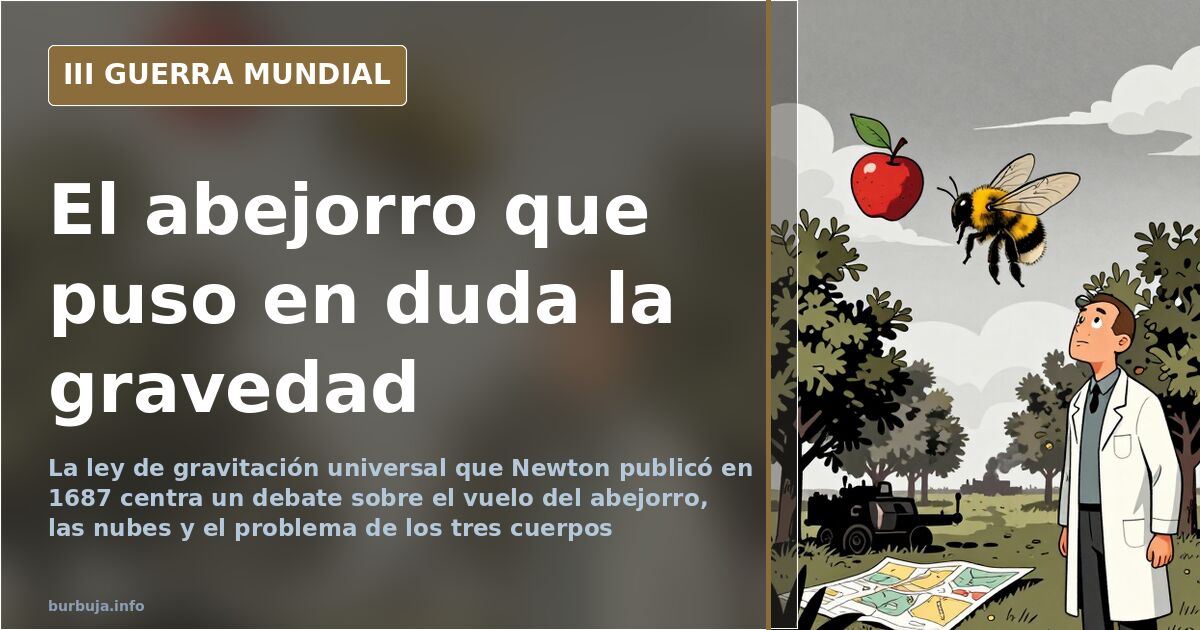
Newton, Einstein, and the Bumblebee: Universal Gravitation Under Scrutiny
A bumblebee flies. And depending on the starting point of this issue, it shouldn't: according to the laws of aerodynamics, that insect cannot fly. With that provocation begins a journey that jumps from the insect to trees growing against gravity, to water clouds suspended in the sky, and from there, to the core of the matter: the universal law of gravitation that Isaac Newton formulated in 1687 in the Principia and that Einstein later rewrote as pure geometry.
The thesis defended is radical. Gravitation would not be universal, there is no closed theory that explains it and the existing formulations —Newton, Einstein, quantum mechanics— contradict each other. Academic physics rejects this reading. But the journey forces us to review where the limits of the model truly are and what is proven and what is not.
Why is it said that the bumblebee cannot fly?
The myth is old and reappears every now and then. Against it, the prevailing answer is simple: whoever claims that the bumblebee abusa aerodynamics does not point out which specific law it breaks. The proof that it obeys them is that it flies, end of story. There is also a technical explanation. Bumblebees do not glide: they flap their wings and generate turbulent vortices, exactly the kind of turbulence that airplanes try to reduce with winglets on the wingtips. Their lift is not analyzed using standard Navier-Stokes equations, but with a very fast flapping and sudden changes in direction. The prevailing analogy is the helicopter, not the airplane.
This detail connects with the rest: if only gravity existed, nothing heavier than air could fly. To fly, you need something more. And that is not a hole in physics.
The three-body problem is not what it seems
Here lies one of the most solid technical points of the argument. It is claimed that calculating the orbits of three bodies is impossible and that, if it cannot be solved with three, even less so with the n bodies of the solar system or the galaxy. The correction is nuanced, but decisive: there is no deterministic analytical solution, and that is different from being unable to calculate. With numerical methods, starting from current trajectories, the trajectories of all the bodies you want are predicted very well. What cannot be ruled out is that the system changes in an unpredictable way. It is chaotic, not random.
The distinction between chaos and randomness sustains much of the exchange. Chaos is deterministic: two almost identical initial conditions separate over time, but each trajectory trinc its rule. Randomness, on the other hand, has no rule. Confusing the two is what allows the claim that nature «does not work with exact numbers».
Why do clouds not fall and trees grow upwards?
Water is the excuse to doubt the universality of gravity: there are clouds in the sky and also at ground level, so perhaps water is not subject to gravitation. The explanation is more down-to-earth. Clouds stay aloft because layers of air at different temperatures can exist that prevent them from mixing vertically; some particles get trapped in their layer like dust in a closed room. And sap does not climb against physics by magic: it rises by capillarity. Neither of these things requires breaking the law.
The bumblebee, the tree, and the cloud serve as illustrations, not as proof. They are cases where intuition fails, not where the theory breaks.
Lift: Bernoulli, angle of attack, and upside-down planes
The discussion on flight leads to a classic within aerodynamics itself. Why does a wing generate lift? One model points to Bernoulli's principle, the pressure difference between the upper and lower surfaces. But this principle may not be enough to explain all lift and does not explain things like an airplane flying upside down. The other explanation is air being pushed downward by the angle of attack, and some argue that reality is a combination of both. Here too, within the same discipline, the clean narrative cracks.
The ether that returned through the window as a field
One of the juiciest twists. It is recalled that physics discredited the old ether and later discovered a substrate it called field, with yet poorly defined properties. The Higgs field would be the ether under another name, and the vacuum would be fuller than Tokyo metro at rush hour. From there, the leap into more controversial territories —explaining telepathy with that substrate— loses any verifiable anchor. The material itself admits that much of what surrounds quantum mechanics is «nonsense» for a public hungry for sensationalism.
The core criticism: two theories that do not fit
The argumentative core is the incompatibility. Newton describes a force that depends on the square of the distance; Einstein denies the force and speaks of curved space, so that, from his point of view, Newton's calculations would be imaginary. Newton works with an approximation that does not answer all cases; Einstein would be even less accurate; quantum mechanics does not close the issue. The conclusion drawn is that there is a right to propose another point of view.
There it hits the usual wall: no new law is needed to explain why planets do not fall into the Sun. Newton's laws are sufficient.
Newton serves to predict orbits, Einstein describes gravity as geometry, and the bumblebee flies. None of the three things fits entirely with the idea of a single law that explains the entire universe.
A bumblebee flies. And depending on the starting point of this issue, it shouldn't: according to the laws of aerodynamics, that insect cannot fly. With that provocation begins a journey that jumps from the insect to trees growing against gravity, to water clouds suspended in the sky, and from there, to the core of the matter: the universal law of gravitation that Isaac Newton formulated in 1687 in the Principia and that Einstein later rewrote as pure geometry.
The thesis defended is radical. Gravitation would not be universal, there is no closed theory that explains it and the existing formulations —Newton, Einstein, quantum mechanics— contradict each other. Academic physics rejects this reading. But the journey forces us to review where the limits of the model truly are and what is proven and what is not.
Why is it said that the bumblebee cannot fly?
The myth is old and reappears every now and then. Against it, the prevailing answer is simple: whoever claims that the bumblebee abusa aerodynamics does not point out which specific law it breaks. The proof that it obeys them is that it flies, end of story. There is also a technical explanation. Bumblebees do not glide: they flap their wings and generate turbulent vortices, exactly the kind of turbulence that airplanes try to reduce with winglets on the wingtips. Their lift is not analyzed using standard Navier-Stokes equations, but with a very fast flapping and sudden changes in direction. The prevailing analogy is the helicopter, not the airplane.
This detail connects with the rest: if only gravity existed, nothing heavier than air could fly. To fly, you need something more. And that is not a hole in physics.
The three-body problem is not what it seems
Here lies one of the most solid technical points of the argument. It is claimed that calculating the orbits of three bodies is impossible and that, if it cannot be solved with three, even less so with the n bodies of the solar system or the galaxy. The correction is nuanced, but decisive: there is no deterministic analytical solution, and that is different from being unable to calculate. With numerical methods, starting from current trajectories, the trajectories of all the bodies you want are predicted very well. What cannot be ruled out is that the system changes in an unpredictable way. It is chaotic, not random.
The distinction between chaos and randomness sustains much of the exchange. Chaos is deterministic: two almost identical initial conditions separate over time, but each trajectory trinc its rule. Randomness, on the other hand, has no rule. Confusing the two is what allows the claim that nature «does not work with exact numbers».
Why do clouds not fall and trees grow upwards?
Water is the excuse to doubt the universality of gravity: there are clouds in the sky and also at ground level, so perhaps water is not subject to gravitation. The explanation is more down-to-earth. Clouds stay aloft because layers of air at different temperatures can exist that prevent them from mixing vertically; some particles get trapped in their layer like dust in a closed room. And sap does not climb against physics by magic: it rises by capillarity. Neither of these things requires breaking the law.
The bumblebee, the tree, and the cloud serve as illustrations, not as proof. They are cases where intuition fails, not where the theory breaks.
Lift: Bernoulli, angle of attack, and upside-down planes
The discussion on flight leads to a classic within aerodynamics itself. Why does a wing generate lift? One model points to Bernoulli's principle, the pressure difference between the upper and lower surfaces. But this principle may not be enough to explain all lift and does not explain things like an airplane flying upside down. The other explanation is air being pushed downward by the angle of attack, and some argue that reality is a combination of both. Here too, within the same discipline, the clean narrative cracks.
The ether that returned through the window as a field
One of the juiciest twists. It is recalled that physics discredited the old ether and later discovered a substrate it called field, with yet poorly defined properties. The Higgs field would be the ether under another name, and the vacuum would be fuller than Tokyo metro at rush hour. From there, the leap into more controversial territories —explaining telepathy with that substrate— loses any verifiable anchor. The material itself admits that much of what surrounds quantum mechanics is «nonsense» for a public hungry for sensationalism.
The core criticism: two theories that do not fit
The argumentative core is the incompatibility. Newton describes a force that depends on the square of the distance; Einstein denies the force and speaks of curved space, so that, from his point of view, Newton's calculations would be imaginary. Newton works with an approximation that does not answer all cases; Einstein would be even less accurate; quantum mechanics does not close the issue. The conclusion drawn is that there is a right to propose another point of view.
There it hits the usual wall: no new law is needed to explain why planets do not fall into the Sun. Newton's laws are sufficient.
Newton serves to predict orbits, Einstein describes gravity as geometry, and the bumblebee flies. None of the three things fits entirely with the idea of a single law that explains the entire universe.
Summary of a discussion on Burbuja.info - Foro de economía, actualidad y política., translated from Spanish and reviewed before publication. Read the full discussion (251 replies).
More summaries
-
Mathematical Chaos of the Earth-Moon-Sun System
The Earth-Moon-Sun three-body problem is mathematically chaotic. We analyze the tension between theory and observation.
-
Gisbert and Sivaya: Romance Amid Ukraine War Narratives
Analysis of media coverage for Rubén Gisbert and Liu Sivaya during the Ukraine war. Is this digital propaganda or reality?
-
Russia demands ruble gas payments as Germany and Bulgaria open to compliance
Putin mandates ruble payments for European gas, with Bulgaria and Germany considering compliance while India and China accelerate trade without the dollar.
-
One Month of War: Kiev Stands, Russia’s Plan Stretches
A week-long conquest fades after a month: Ukrainian flags, an extended Russian strategy, and open negotiations emerge.
-
Russian TV: Three Missiles Could Collapse British Civilization
Russian state TV displays potential nuclear targets in Europe, claiming three missiles would be enough to destroy the UK.
-
Ukrainian Kursk Offensive Halts 20km from Border
Ukraine's incursion into Russia's Kursk region stalls 15-20km from the border. The controlled zone is nearly surrounded, with supply corridors under heavy Russian fire.