
Brooklyn subway stabbing and shooting: One man dead after suspect is arrested
A subway fight in Brooklyn escalates when a woman stabs her partner's attacker, who then pulls a gun. The suspect is arrested following the fatal shooting.
English · Original discussion in Spanish · Published
Brooklyn subway stabbing and shooting: One man dead after suspect is arrested
A fistfight between two passengers on a Brooklyn subway car ends with a woman stabbing her partner's attacker in the back, trinc by the appearance of a gun and one fatality. The footage, recorded by other riders and spread across social media, has traveled faster than any official police report, sparking a debate that goes far beyond the incident itself.
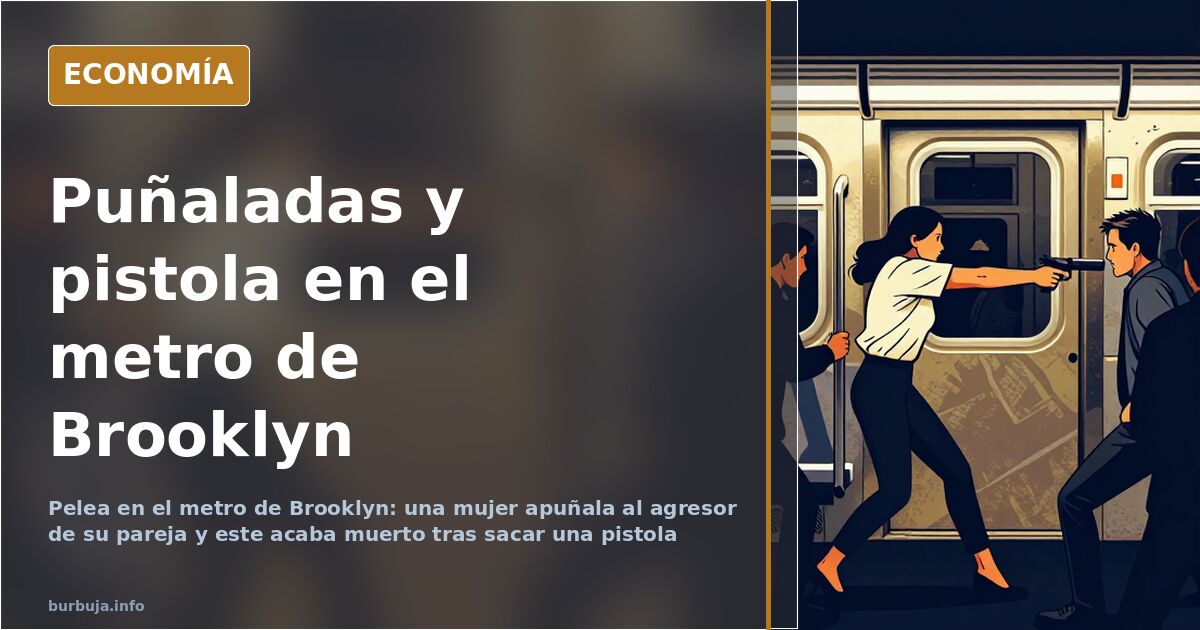
The videos show an escalation: insults, a struggle, one man falling to the ground, and the woman accompanying him pulling a knife and stabbing the attacker. He gets up, reaches for his back, says something about being stabbed —some versions claim he identified himself as police— and pulls out a gun. He dies shortly after; some accounts say the gun was his, while others claim it was taken from him before he fired. The arrest of the suspect is also shown in video.
What is known about what peine in the car?
The accounts agree on the essentials but differ on details. Initial descriptions mentioned a man of Pakistani origin; later identifications placed the couple as Venezuelan. Neither has been confirmed, and the nationality of those involved does not change the core issue.
The starting point is an assault: one passenger insults and then hits the other. According to reports, the fight erupts when the victim of the insults gets up. The woman intervenes when her partner is already on the ground receiving blows. Three stabs to the back, around the kidney area, according to the most repeated description. Then, the firearm appears.
Was it self-defense or excessive force?
Here, any consensus breaks down. One view holds that the woman acted to save her partner's life: the size difference —over 100 kg versus 50 kg— turned the fight into a beating, and a knife equalized the odds. Under this argument, the stabbing prevented greater harm, and the gun that appeared later confirmed the attacker had no intention of stopping.
The objection is both legal and physical: two men were fighting with fists, without proven homicidal intent, and a third person introduced a knife into the equation. Some add that, once the gun was controlled, a single shot to the leg would have been enough to repel the threat, and aiming higher turns defense into something else. The counterargument is forceful: in a street fight, there are no rules or perfect information; you don't know if the attacker has a second weapon, and hesitating for a second can miccionan death.
No verdict has been issued. This is the exact point where analysis stalls.
The gun in New York: prohibited for civilians, according to reports
The detail that disorients participants, according to witnesses, is that in New York, guns are prohibited for civilians, yet the stabbed man carried a gun and pulled it out in the middle of the car. One phrase summarizes the detail with irony: the only armed passenger in the car has died.
The Second Amendment issue creeps in here. It is argued that living in a country where anyone can carry a weapon forces you to think twice before intervening in someone else's problem; in the opposite direction, it is claimed that a gun in the middle of a fight multiplies the danger for everyone within a hundred-meter radius, and that prohibiting them is the only sensible approach, even if the rule is broken. The two viewpoints coexist without reconciling, and the video feeds both.
Crime statistics that cross paths in the conversation
The jump from the car to statistics is immediate. It is claimed that Philadelphia records more homicides in a year than all of Spain, that Chicago doubles that figure, and that U.S. cities with populations between one and three million equal or exceed an entire country of fifty million. These comparisons are made in the wake of the incident, useful for illustrating a perception —that violent crime has run wild in major cities— but should be taken for what they are: statements not verified by the videos.
The comparison with other subways also appears: it is claimed that this does not happen in Moscow or Tokyo. And the case of a passenger pushed onto the tracks is recalled in parallel.
When the incident becomes an identity narrative
Much of the conversation shifts toward generalizations about entire groups. Some present a group as inherently violent, others blame the immigration model, and others respond that generalizing from a video is exactly what should not be done. None of these generalizations hold up with data: they are opinions, and as such, they are read.
What is verifiable is more modest and more uncomfortable: a subway car, two men fighting, a woman with a knife, a gun, and one dead. The rest is provided by whoever is watching.
Key data
A fistfight between two passengers on a Brooklyn subway car ends with a woman stabbing her partner's attacker in the back, trinc by the appearance of a gun and one fatality. The footage, recorded by other riders and spread across social media, has traveled faster than any official police report, sparking a debate that goes far beyond the incident itself.
The videos show an escalation: insults, a struggle, one man falling to the ground, and the woman accompanying him pulling a knife and stabbing the attacker. He gets up, reaches for his back, says something about being stabbed —some versions claim he identified himself as police— and pulls out a gun. He dies shortly after; some accounts say the gun was his, while others claim it was taken from him before he fired. The arrest of the suspect is also shown in video.
What is known about what peine in the car?
The accounts agree on the essentials but differ on details. Initial descriptions mentioned a man of Pakistani origin; later identifications placed the couple as Venezuelan. Neither has been confirmed, and the nationality of those involved does not change the core issue.
The starting point is an assault: one passenger insults and then hits the other. According to reports, the fight erupts when the victim of the insults gets up. The woman intervenes when her partner is already on the ground receiving blows. Three stabs to the back, around the kidney area, according to the most repeated description. Then, the firearm appears.
Was it self-defense or excessive force?
Here, any consensus breaks down. One view holds that the woman acted to save her partner's life: the size difference —over 100 kg versus 50 kg— turned the fight into a beating, and a knife equalized the odds. Under this argument, the stabbing prevented greater harm, and the gun that appeared later confirmed the attacker had no intention of stopping.
The objection is both legal and physical: two men were fighting with fists, without proven homicidal intent, and a third person introduced a knife into the equation. Some add that, once the gun was controlled, a single shot to the leg would have been enough to repel the threat, and aiming higher turns defense into something else. The counterargument is forceful: in a street fight, there are no rules or perfect information; you don't know if the attacker has a second weapon, and hesitating for a second can miccionan death.
No verdict has been issued. This is the exact point where analysis stalls.
The gun in New York: prohibited for civilians, according to reports
The detail that disorients participants, according to witnesses, is that in New York, guns are prohibited for civilians, yet the stabbed man carried a gun and pulled it out in the middle of the car. One phrase summarizes the detail with irony: the only armed passenger in the car has died.
The Second Amendment issue creeps in here. It is argued that living in a country where anyone can carry a weapon forces you to think twice before intervening in someone else's problem; in the opposite direction, it is claimed that a gun in the middle of a fight multiplies the danger for everyone within a hundred-meter radius, and that prohibiting them is the only sensible approach, even if the rule is broken. The two viewpoints coexist without reconciling, and the video feeds both.
Crime statistics that cross paths in the conversation
The jump from the car to statistics is immediate. It is claimed that Philadelphia records more homicides in a year than all of Spain, that Chicago doubles that figure, and that U.S. cities with populations between one and three million equal or exceed an entire country of fifty million. These comparisons are made in the wake of the incident, useful for illustrating a perception —that violent crime has run wild in major cities— but should be taken for what they are: statements not verified by the videos.
The comparison with other subways also appears: it is claimed that this does not happen in Moscow or Tokyo. And the case of a passenger pushed onto the tracks is recalled in parallel.
When the incident becomes an identity narrative
Much of the conversation shifts toward generalizations about entire groups. Some present a group as inherently violent, others blame the immigration model, and others respond that generalizing from a video is exactly what should not be done. None of these generalizations hold up with data: they are opinions, and as such, they are read.
What is verifiable is more modest and more uncomfortable: a subway car, two men fighting, a woman with a knife, a gun, and one dead. The rest is provided by whoever is watching.
Key data
- Three stabs to the back, around the kidney area, according to the most repeated account.
- The suspect was arrested, according to the spread images.
- The conversation claims that in New York, guns are prohibited for civilians.
- It is mentioned that there is a size difference of over 100 kg versus 50 kg between those involved.
Summary of a discussion on Burbuja.info - Foro de economía, actualidad y política., translated from Spanish and reviewed before publication. Read the full discussion (338 replies).
More summaries
-
Swiss Wealth vs. American Wealth: Château vs. Mansion
Château on Lake Geneva vs. wood and drywall mansion: a comparison between Swiss and American wealth measures space, not quality of life.
-
Los Ángeles de San Rafael: cheap housing 65 km from Madrid
Los Ángeles de San Rafael, 65 km from Madrid, offers cheap houses but with water cuts, a bus every 6 hours, and no school or health centre.
-
Global 10-Year Bond Yields Surge to Decade Highs
US and Japanese 10-year bond yields hit multi-decade highs, with European markets following suit amid growing debt crisis concerns.
-
Spanish TV Journalists Ordered to Delete Monetized YouTube Clips
RTVE ombudsman orders journalists Javier Ruiz and Jesús Cintora to stop monetizing public broadcast clips on personal YouTube channels.
-
Spanish stew vs. kebab: Taste as a class battlefield
A debate on Spanish traditional food, furniture, and imported cars reveals how taste becomes a proxy for social status.
-
Taylor Swift: Status Symbol vs. Reggaeton
Tickets blocked for €700 and others sold for €150 cash to see Taylor Swift, now a marker of social class.