
New DANA hits Valencia: 300 l/m2 forecast as 2024 looms large
The Generalitat has activated ES-Alert in Marina Alta and La Safor, with up to 686 l/m2 accumulated. The shadow of the 2024 DANA and the debate over reservoirs and alerts.
English · Original discussion in Spanish · Published
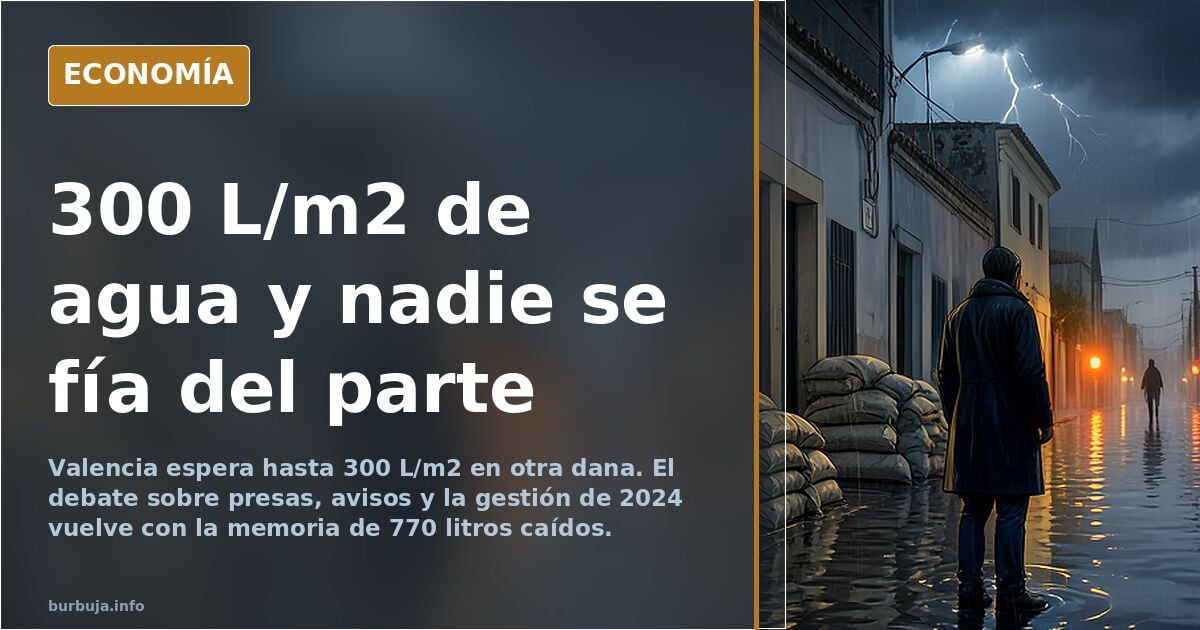
Another DANA in Valencia: 300 l/m2 and the open wound of 2024
The alert was activated on Sunday night. The Valencian regional government (Generalitat) sent an ES-Alert to the population of Marina Alta and La Safor urging everyone to stay at home. In L'Atzubia, in the Marina Alta region, 462.6 litres per square metre fell in eight hours and 686.2 in 72 hours. The UME (Spain's military emergency unit) was deployed in Oliva, where water flooded the beach, submerged cars and left around 200 people trapped. Oliva's town council had evacuated 2,000 people from campsites the night before. The figure hovering over every conversation was another one: the 300 l/m2 expected between midnight and Monday morning. And the memory of October 2024, when 170 litres were forecast and 770 fell.
What is expected from this DANA and where is it raining hardest?
The episode is concentrated on Valencia's southern coast and northern Alicante. The Marina Alta and La Safor regions are the hardest hit, with accumulations already exceeding 600 litres per square metre in several spots, according to data from the Generalitat. At 05:52, the 112 emergency service upgraded the situation to level 2 for both regions. The UME deployed to Oliva, where the water covered the first line of beach and forced the rescue of residents and tourists. The town council had evacuated 2,000 people from campsites the night before. The weather pattern is a familiar one: mountains close to the sea that trap moisture and release it for hours on end. What sets this gota fría apart from others is its persistence.
The handling of alerts: from the ES-Alert to the alert that never came
The Generalitat has sent four ES-Alerts since the episode began. The latest, on Monday, told people in Marina Alta and La Safor not to leave their homes. The mass alert reached mobile phones early in the day, but not without controversy: some criticise sending it during the afternoon siesta or activating it after the water is already in the streets. The comparison with 2024 is inevitable. Back then, the CECOPI (the regional emergency coordination centre) did not inform town councils of the scale of the flooding, and the mayor of Algemesí said he learned about it from the press. This time, at least, the message arrived earlier. Whether it was sent in time to the campsites in Oliva, which evacuated on their own the night before, is another matter.
The reservoir debate: were the floodgates peine in 2024?
The shadow of the Forata dam hangs over any DANA in Valencia. In 2024, the Generalitat sent a WhatsApp to town councils warning that 1,000 m3/s were coming down from Forata. According to the narrative that has taken hold in part of public opinion, that warning did not reach every municipality. The technical reality is more prosaic: Forata has no gates; it is a gravity dam that discharges through a spillway when the water level exceeds the threshold. Other dams in the basin, such as Benagéber or Contreras, did not release water during the critical week; the records of stored water show they kept filling. Loriguilla and Buseo were partially emptied, but a week later, when the catastrophe had already peine. The accusation of "treacherously opening the dams" does not hold up against the data, although the hoax persists because the handling of information was, to put it mildly, opaque.
Building on floodplains and the ravine nobody clears
Construction is the other major culprit. In recent decades, there has been massive building in areas that environmentalists had been flagging as flood-prone for years. The Chiva ravine, which crosses the mountains and flows into the Turia, behaved like a raging river on 29 October 2024: more water was coming down than the Turia itself where it passes through Bugarra. In Pedralba, the bridge acted as a dam and the water backed up upstream, leaving five dead. A third of the town centre was flooded. Clearing riverbeds and ravines is another recurring demand: some claim that if the ravines had been cleared, the death toll would have been lower. There are no official data to quantify that link, but the sense of abandonment in Spain's depopulated rural areas and in the municipalities of the upper basin is a fact.
Climate denialism and alert fatigue
Not everyone believes the climate is changing. Some attribute these episodes to "the same old gota frías" and criticise the excess of alerts. Alert fatigue is a real phenomenon: if an ES-Alert is sent for every storm, people stop paying attention. AEMET (Spain's weather agency) and the Generalitat face a dilemma: warn too often and trivialise the alert, or warn too little and risk a tragedy. In 2024, AEMET removed the alerts just before the catastrophe struck, according to some meteorologists. The comparison with other countries is painful: in Japan, residents had been warned by their own government before the DANA arrived. Here, coordination between administrations remains the weak point.
The economic impact: losses in the millions and insurance
The 2024 floods caused economic losses exceeding 10 billion euros, according to estimates by the Consorcio de Compensación de Seguros (Spain's insurance compensation consortium). The current DANA, if the worst forecasts are confirmed, could add another bill. The hardest-hit sectors are agriculture, tourism and small businesses. The campsites in Oliva, which evacuated 2,000 people, are an example of the coastline's vulnerability. Rebuilding infrastructure and clearing riverbeds will require public investment, but the debate over who pays —the state, the Generalitat or the town councils— remains open. Meanwhile, residents of neighbourhoods with names like "Rambla de los Cantos" or "Arroyo del Aluvión" look to the sky.
The figure that unsettles is not the 300 forecast litres, nor even the 686 accumulated in 72 hours. It is the 770 litres that fell in 2024 when 170 were expected. If the forecast fails again, the question will not be whether the water reached the streets, but how many more alerts it will take for someone to decide to clear a ravine.
Also available in: Deutsch
Summary of a discussion on Burbuja.info - Foro de economía, actualidad y política., translated from Spanish and reviewed before publication. Read the full discussion (314 replies).
More summaries
-
Valencia's DANA overwhelms the economy of Ribera and l'Horta
The Poyo rambla reached 1,686 m³/s at 6:20 PM, but the mobile alert sounded at 8:00 PM: DANA overwhelms Valencian economy and official narrative.
-
Renting out Glovo accounts: delivery work that dodges the work permit
Those with papers rent out their Glovo account to those without, and both split the earnings: the last mile sidesteps the work permit in Spain.
-
Chortibot: Chinese companion robot deliveries start September 2026
According to a forum, the Chortibot goes on sale in China on July 15, 2026, with deliveries starting September 15. Over 3,000 pre-orders with no official price.
-
Forum debate debunks the myth that mixing lowered average height
A forum user claims mixing reduced height from 1.90 m to 1.60 m. Other participants question the calculation and attribute it to insecurities.
-
Feijóo promises sacrifice, and social media asks who will pay
Spain's Feijóo pledges a government that will ask for sacrifices, and social media fires back asking who will bear them: pensions, healthcare or education. The austerity debate begins.
-
Frente Obrero: the Spanish party that mixed left-wing politics and immigration
Roberto Vaquero's Frente Obrero won just 0.38% in Spain's 2024 European elections, according to a forum user. Its blend of left-wing economics and hardline immigration talk has found no takers.