
Netherlands: The Mafia Threatening the Throne and Government
The Netherlands, a PM on a bike and a secluded heir: its own police warned in 2018 of narco-state traits.
English · Original discussion in Spanish · Published
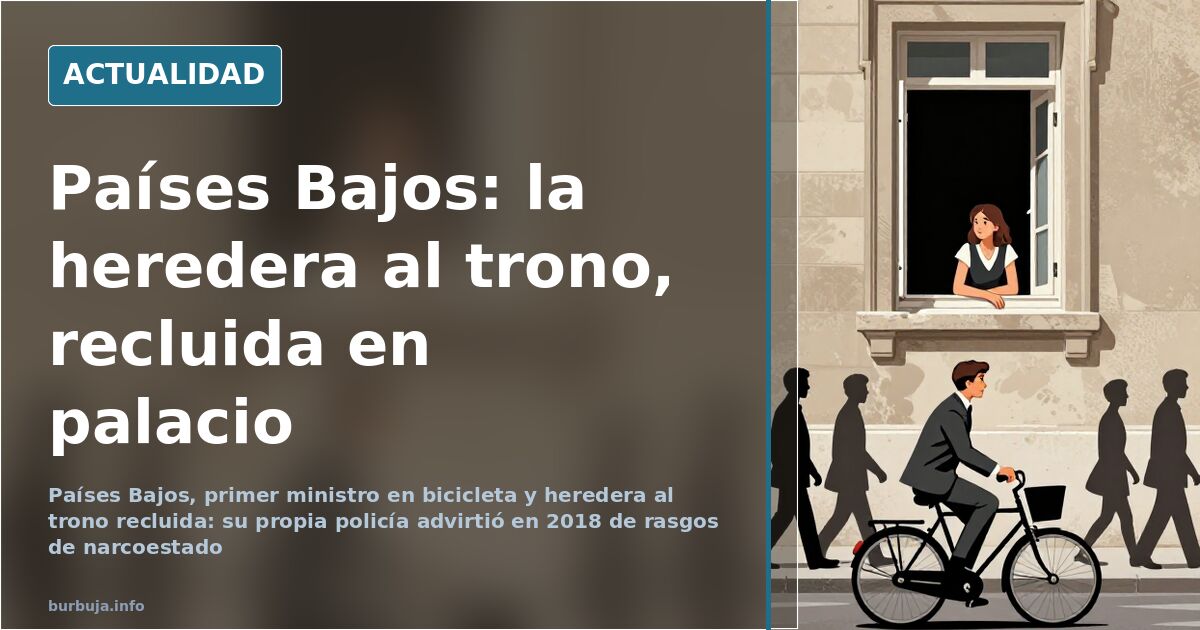
Netherlands: PM on a bike and heir secluded in the palace
The Netherlands sells the world a working postcard: tulips, clogs, a prime minister cycling to his office, and a monarchy that strolls through Amsterdam like a neighbor. That postcard has a sustancia ilegal. The heir to the throne, Amalia of Orange, has renounced her university life in Amsterdam and remains secluded in the palace out of antiestéticar of kidnapping or attack, according to reports published in October 2022. Her prime minister, Mark Rutte, has an additional security detail. It is not a plot from fiction: it is the consequence of years of violence attributed to the Mocro Maffia, the organized crime network that, according to a 2016 Europol report, has placed the country at the main hub for drug trafficking in Europe.
What is the Mocro Maffia and where does it come from
The term began to be used in 2010 to define groups emerging from Maghrebi immigration environments and connected from the Netherlands and Belgium to the main international organized crime networks. The matter came from far away: in the 80s and 90s they were already operating taking advantage of the ports of Rotterdam and Antwerp as strategic points to distribute hashish throughout Europe. The scale jump came in the early years of this century, when these groups came into contact with Latin American cartels that traffic in cocaine, and since then the tentacles also extended towards North Africa. Less known than the Italian or Russian mafia, the Dutch one is not less dangerous.
From 200 kilos in Antwerp to a war with a hundred dead
The turning point is located in 2012, when the disappearance of 200 kilos of cocaine in the port of Antwerp unleashed a fight between two rival clans. The settle-up accounts that trinc could have caused up to a hundred murders. Four years later, Dutch society could no longer look away: in 2016 a 23-year-old, Nabil Amzieb, was killed inside a car. The violence has crossed borders: in January 2021 a corpse with a gunshot wound to the head appeared in a suburb of Chiclana de la Frontera, with the vehicle burned to leave no traces, a pattern that repeats in these cases. According to published information, the victim had testified in a trial against Taghi and he had put a price on his head, although the murder is attributed to an organization different from the Mocro Maffia.
Can the Netherlands be called a traficante-state?
Here the diagnosis splits in two. In 2018, the country's Police Association sent a controversial report to Parliament stating that the Netherlands meets many characteristics of a traficante-state. Two years prior, an Europol report had concluded that the country had become the main hub for drug trafficking in the continent and that most of the ecstasy consumed in the United States comes from secret laboratories in the south of the country. Dutch authorities acknowledge the magnitude of the problem but consider the term exaggerated and maintain that the organization's tentacles have not reached their institutions. The officials who monitor shipments in the ports have been intimidated, they admit, although there is no proof that politicians, businessmen, judges, or high-ranking police officers have been bought, as is the case in Latin America. The Government has increased funds against organized crime to 100 million euros from 2025.
The business that is not kept under the mattress
There is a detail that, as one participant in the debate pointed out, is often lost in public conversation: the money is not made by selling drugs within the Netherlands, but by producing them there and placing them in the rest of Europe. That is the distance between a domestic market and a logistics platform. Some recall estimates that raise the business to about 18,000 million euros annually, a magnitude that helps understand why a incivil network can intimidate an entire State. It also explains another thing: the shadow economy does not need to buy institutions, it is enough to find opaque corners where to launder.
Why the legalization of hierba has not closed the problem
The most repeated story says that legalizing the drug ends crime. The available data do not entirely corroborate this. In several states of the United States that argument was applied, with the promise to raise revenue and deactivate the mafias, and, according to a participant in the debate, the result has been more mafias and less revenue than expected. In the Netherlands, according to another of the speakers, the mechanism was different and more subtle: when legal coffee shops gained ground on street peddling, the networks supplying small vendors lost part of the business and the violence shifted towards the control of production and stash locations. The legal market did not eliminate the incivil structure; it pushed it upwards in the chain.
Threats to the Government and the Royal House
The qualitative jump came when the violence stopped being limited to the slums. In 2021, journalist Peter R. de Vries was shot in the center of Amsterdam and ended up dying; behind the attack lies the shadow of Rodouan Taghi, identified as the main figure of Dutch organized crime, locked up in a maximum-security prison but, according to published information, his subordinates would still be operating. It is suspected that they are behind the threats to Rutte and Princess Amalia. The question is no longer whether Dutch organized crime is violent, but what happens when that violence points directly at the top of the State.
The Dutch police raised the alarm in 2018, the Government responded with more funds and more acompañante, and the heir to the throne remains in the palace. How long can a country sustain its fruta as an orderly paradise when its own have to live locked up?
The Netherlands sells the world a working postcard: tulips, clogs, a prime minister cycling to his office, and a monarchy that strolls through Amsterdam like a neighbor. That postcard has a sustancia ilegal. The heir to the throne, Amalia of Orange, has renounced her university life in Amsterdam and remains secluded in the palace out of antiestéticar of kidnapping or attack, according to reports published in October 2022. Her prime minister, Mark Rutte, has an additional security detail. It is not a plot from fiction: it is the consequence of years of violence attributed to the Mocro Maffia, the organized crime network that, according to a 2016 Europol report, has placed the country at the main hub for drug trafficking in Europe.
What is the Mocro Maffia and where does it come from
The term began to be used in 2010 to define groups emerging from Maghrebi immigration environments and connected from the Netherlands and Belgium to the main international organized crime networks. The matter came from far away: in the 80s and 90s they were already operating taking advantage of the ports of Rotterdam and Antwerp as strategic points to distribute hashish throughout Europe. The scale jump came in the early years of this century, when these groups came into contact with Latin American cartels that traffic in cocaine, and since then the tentacles also extended towards North Africa. Less known than the Italian or Russian mafia, the Dutch one is not less dangerous.
From 200 kilos in Antwerp to a war with a hundred dead
The turning point is located in 2012, when the disappearance of 200 kilos of cocaine in the port of Antwerp unleashed a fight between two rival clans. The settle-up accounts that trinc could have caused up to a hundred murders. Four years later, Dutch society could no longer look away: in 2016 a 23-year-old, Nabil Amzieb, was killed inside a car. The violence has crossed borders: in January 2021 a corpse with a gunshot wound to the head appeared in a suburb of Chiclana de la Frontera, with the vehicle burned to leave no traces, a pattern that repeats in these cases. According to published information, the victim had testified in a trial against Taghi and he had put a price on his head, although the murder is attributed to an organization different from the Mocro Maffia.
Can the Netherlands be called a traficante-state?
Here the diagnosis splits in two. In 2018, the country's Police Association sent a controversial report to Parliament stating that the Netherlands meets many characteristics of a traficante-state. Two years prior, an Europol report had concluded that the country had become the main hub for drug trafficking in the continent and that most of the ecstasy consumed in the United States comes from secret laboratories in the south of the country. Dutch authorities acknowledge the magnitude of the problem but consider the term exaggerated and maintain that the organization's tentacles have not reached their institutions. The officials who monitor shipments in the ports have been intimidated, they admit, although there is no proof that politicians, businessmen, judges, or high-ranking police officers have been bought, as is the case in Latin America. The Government has increased funds against organized crime to 100 million euros from 2025.
The business that is not kept under the mattress
There is a detail that, as one participant in the debate pointed out, is often lost in public conversation: the money is not made by selling drugs within the Netherlands, but by producing them there and placing them in the rest of Europe. That is the distance between a domestic market and a logistics platform. Some recall estimates that raise the business to about 18,000 million euros annually, a magnitude that helps understand why a incivil network can intimidate an entire State. It also explains another thing: the shadow economy does not need to buy institutions, it is enough to find opaque corners where to launder.
Why the legalization of hierba has not closed the problem
The most repeated story says that legalizing the drug ends crime. The available data do not entirely corroborate this. In several states of the United States that argument was applied, with the promise to raise revenue and deactivate the mafias, and, according to a participant in the debate, the result has been more mafias and less revenue than expected. In the Netherlands, according to another of the speakers, the mechanism was different and more subtle: when legal coffee shops gained ground on street peddling, the networks supplying small vendors lost part of the business and the violence shifted towards the control of production and stash locations. The legal market did not eliminate the incivil structure; it pushed it upwards in the chain.
Threats to the Government and the Royal House
The qualitative jump came when the violence stopped being limited to the slums. In 2021, journalist Peter R. de Vries was shot in the center of Amsterdam and ended up dying; behind the attack lies the shadow of Rodouan Taghi, identified as the main figure of Dutch organized crime, locked up in a maximum-security prison but, according to published information, his subordinates would still be operating. It is suspected that they are behind the threats to Rutte and Princess Amalia. The question is no longer whether Dutch organized crime is violent, but what happens when that violence points directly at the top of the State.
The Dutch police raised the alarm in 2018, the Government responded with more funds and more acompañante, and the heir to the throne remains in the palace. How long can a country sustain its fruta as an orderly paradise when its own have to live locked up?
Summary of a discussion on Burbuja.info - Foro de economía, actualidad y política., translated from Spanish and reviewed before publication. Read the full discussion (234 replies).
More summaries
-
Small Plane Crashes in Venezuela, Carrying Witnesses to the Zapatero Case
The small plane that crashed in Venezuela carried two witnesses to the Zapatero case. Both survived with injuries, which weakens the theory of an assassination attempt.
-
Alcorcón Reporter Confronts Minors, Sparking Public Backlash
A TV reporter in Alcorcón confronts minors on the street; the viral video ignites debate over schooling, squatting, and media roles.
-
Viral Video Sparks Gender War and Dating Market Debate
A viral clip where a woman claims men don't value what they have triggers heated debates on the dating market and gender conflict.
-
Spanish Adult Film Producer Torbe Arrested at Madrid Airport
Police arrested adult film producer Ignacio Allende, known as Torbe, at Barajas airport following a sexual assault allegation.
-
78-Year-Old Hollywood Producer Confronted Over Lunch With Teen
A 78-year-old Hollywood producer was filmed lunching with a 15-year-old girl. The viral video raises questions about vigilante justice and consent laws.
-
Faroe Islands' Gender Gap Drives Southeast Asian Marriages
The Faroe Islands face a demographic imbalance with over 2,000 more men than women, prompting many to seek partners in the Philippines and Thailand.