
Nestlé: from six-year lows to a 9% one-day rebound
Nestlé rebounds 9% in a single session after hitting six-year lows. A look at its 60 billion francs of debt, the 35% Swiss withholding tax and the debate over its moat.
English · Original discussion in Spanish · Published
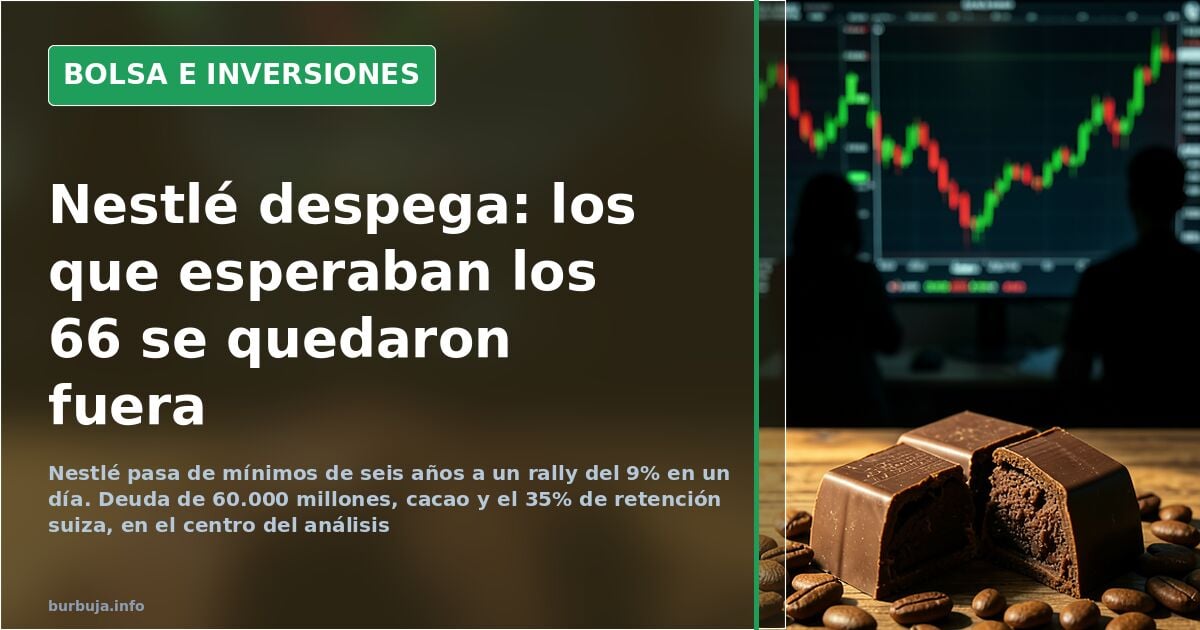
Nestlé goes from six-year lows to a 9% rebound in a single session
Is it worth buying a century-old company when it falls to six-year lows? That is the question hanging over the whole conversation about Nestlé, the Swiss food giant that in 2020 traded well above current levels and that, after a long ordeal of rising debt, stagnant sales and soaring raw materials, has staged a rebound that has left everyone stunned. In a single session, the stock gained +9%, a rise some describe as "healthy", and one that comes after months of doubts, drops of more than 4.6% in a single day and an almost unanimous consensus that the company was expensive even at a discount.
The initial thesis was simple: P/E below its historical average, an aristocrat's dividend and Swiss quality. The problem, as always, is in the details. The group's debt now stands at around 60 billion Swiss francs, sales have yet to take off, and the price of cocoa — the one that worries chocolate makers so much — has collapsed from last year's bubble highs. Is Nestlé an opportunity or a value trap?
Nestlé's moat: private label or toll road?
The concept of a moat, that defensive barrier protecting companies from competition, is the core of the discussion. For the company's defenders, Nestlé is not just chocolate: it is infant nutrition, coffee, water, pet food and countless brands that have been on the shelves for decades. "Nestlé's moat is not a theory, it's the supermarket shelves," sums up one of the most celebrated comments. The idea is that even if cocoa collapses, the price of a KitKat at the supermarket stays the same. That is not a moat, it's a toll road.
Not everyone shares that optimism, however. Some argue that branded product sales are sinking and that people, squeezed as they are, watch every cent. "What does Nestlé sell that is indispensable? NOTHING," declares one critical voice. The argument is that branded products, loaded with sugar and additives, are not essential foods and that consumers, increasingly strapped, will opt for private labels. Inflation has changed habits and the waters will take time to return to their course.
Pablo Isla and the promise of squeezing margins
One of the names that comes up most often is Pablo Isla, the former chairman of Inditex who landed at the top of Nestlé with a mission to tighten the screws. For some, his arrival is a guarantee: "He already did his homework at Inditex; he's there to squeeze margins, not to do sustainability posturing." Others are more sceptical and point out that Isla does not have a free hand: "At least for now they don't let him do what needs to be done, and when they do, it will take at least two years to show."
The comparison with Danone is inevitable. The French company tried to raise yoghurt prices like crazy and had to back down. Olive oil went through a similar bubble and now people eye it with suspicion. The lesson is clear: price rises have a limit, and consumers have long memories.
The tax problem: the 35% Swiss withholding tax
Beyond the fundamentals, there is a practical issue that deters many investors: taxation. Nestlé trades in Swiss francs and Switzerland applies a 35% withholding tax on dividends. Recovering part of that money is possible, but the process is tedious and only worthwhile if the dividends are substantial. The alternative some suggest is buying the ADRs (American Depositary Receipts), which trade in dollars and only withhold 15%, though with the currency risk that entails.
Others simply go for a Swiss SMI ETF, where Nestlé has a significant weight, thus avoiding the cumbersome paperwork. The conclusion is that, for a Spanish investor, Nestlé's net return can be seriously eroded by the tax authorities.
The price journey: from scepticism to rebound
The stock's path has been a rollercoaster. Since the six-year lows that prompted the initial purchase, Nestlé has been through all kinds of moments: drops of more than 4.6% in a single session, rumours of divestments (vitamins, water in North America), and an almost general consensus that the company was in reaction mode. The more technical-minded talked about waiting for 66 Swiss francs, a level that was never reached.
As the months went by, the tone changed. From "it could fall further" to "it's bottoming out on long-term support". And from there to +9% in a single session. Those who bought at the lows now boast of +15% annualised, with a 20% return. Those who waited for the perfect correction were left watching.
The eternal debate: investor or trader?
The discussion sometimes drifts towards the nature of the investor. What is the difference between buying Nestlé at 70, 75 or 80 if you are a long-term investor? The answer is not unanimous. Some argue that what matters is the quality of the company and that price only matters insofar as it is cheap. Others, however, apply a more tactical approach: spotting good companies at turning points and riding the medium-term uptrend.
The final irony is delivered by time. Those who advised against buying Nestlé because of the debt, the cocoa or the private labels now watch the stock appreciate. As with so many other things, the market has the last word.
In the end, Nestlé is a giant that has survived wars, crises and fads. The question is not whether it is a good company, but whether the current price reflects its true value. And that, as always, is something only time will tell.
Is it worth buying a century-old company when it falls to six-year lows? That is the question hanging over the whole conversation about Nestlé, the Swiss food giant that in 2020 traded well above current levels and that, after a long ordeal of rising debt, stagnant sales and soaring raw materials, has staged a rebound that has left everyone stunned. In a single session, the stock gained +9%, a rise some describe as "healthy", and one that comes after months of doubts, drops of more than 4.6% in a single day and an almost unanimous consensus that the company was expensive even at a discount.
The initial thesis was simple: P/E below its historical average, an aristocrat's dividend and Swiss quality. The problem, as always, is in the details. The group's debt now stands at around 60 billion Swiss francs, sales have yet to take off, and the price of cocoa — the one that worries chocolate makers so much — has collapsed from last year's bubble highs. Is Nestlé an opportunity or a value trap?
Nestlé's moat: private label or toll road?
The concept of a moat, that defensive barrier protecting companies from competition, is the core of the discussion. For the company's defenders, Nestlé is not just chocolate: it is infant nutrition, coffee, water, pet food and countless brands that have been on the shelves for decades. "Nestlé's moat is not a theory, it's the supermarket shelves," sums up one of the most celebrated comments. The idea is that even if cocoa collapses, the price of a KitKat at the supermarket stays the same. That is not a moat, it's a toll road.
Not everyone shares that optimism, however. Some argue that branded product sales are sinking and that people, squeezed as they are, watch every cent. "What does Nestlé sell that is indispensable? NOTHING," declares one critical voice. The argument is that branded products, loaded with sugar and additives, are not essential foods and that consumers, increasingly strapped, will opt for private labels. Inflation has changed habits and the waters will take time to return to their course.
Pablo Isla and the promise of squeezing margins
One of the names that comes up most often is Pablo Isla, the former chairman of Inditex who landed at the top of Nestlé with a mission to tighten the screws. For some, his arrival is a guarantee: "He already did his homework at Inditex; he's there to squeeze margins, not to do sustainability posturing." Others are more sceptical and point out that Isla does not have a free hand: "At least for now they don't let him do what needs to be done, and when they do, it will take at least two years to show."
The comparison with Danone is inevitable. The French company tried to raise yoghurt prices like crazy and had to back down. Olive oil went through a similar bubble and now people eye it with suspicion. The lesson is clear: price rises have a limit, and consumers have long memories.
The tax problem: the 35% Swiss withholding tax
Beyond the fundamentals, there is a practical issue that deters many investors: taxation. Nestlé trades in Swiss francs and Switzerland applies a 35% withholding tax on dividends. Recovering part of that money is possible, but the process is tedious and only worthwhile if the dividends are substantial. The alternative some suggest is buying the ADRs (American Depositary Receipts), which trade in dollars and only withhold 15%, though with the currency risk that entails.
Others simply go for a Swiss SMI ETF, where Nestlé has a significant weight, thus avoiding the cumbersome paperwork. The conclusion is that, for a Spanish investor, Nestlé's net return can be seriously eroded by the tax authorities.
The price journey: from scepticism to rebound
The stock's path has been a rollercoaster. Since the six-year lows that prompted the initial purchase, Nestlé has been through all kinds of moments: drops of more than 4.6% in a single session, rumours of divestments (vitamins, water in North America), and an almost general consensus that the company was in reaction mode. The more technical-minded talked about waiting for 66 Swiss francs, a level that was never reached.
As the months went by, the tone changed. From "it could fall further" to "it's bottoming out on long-term support". And from there to +9% in a single session. Those who bought at the lows now boast of +15% annualised, with a 20% return. Those who waited for the perfect correction were left watching.
The eternal debate: investor or trader?
The discussion sometimes drifts towards the nature of the investor. What is the difference between buying Nestlé at 70, 75 or 80 if you are a long-term investor? The answer is not unanimous. Some argue that what matters is the quality of the company and that price only matters insofar as it is cheap. Others, however, apply a more tactical approach: spotting good companies at turning points and riding the medium-term uptrend.
The final irony is delivered by time. Those who advised against buying Nestlé because of the debt, the cocoa or the private labels now watch the stock appreciate. As with so many other things, the market has the last word.
In the end, Nestlé is a giant that has survived wars, crises and fads. The question is not whether it is a good company, but whether the current price reflects its true value. And that, as always, is something only time will tell.
Also available in: Deutsch
Summary of a discussion on Burbuja.info - Foro de economía, actualidad y política., translated from Spanish and reviewed before publication. Read the full discussion (103 replies).
More summaries
-
Kraft Heinz at $23, Stagnant Dividend, and the 2026 Portfolio
Kraft Heinz trades at $23.01, with Buffett’s exit weighing on the stock. The Kimberly-Clark/Kenvue merger drops 20%. The US dividend portfolio seeks its place.
-
Marta Ortega Takes Inditex Helm; Market Fears a Santander 2.0
Marta Ortega assumes Inditex presidency after Pablo Isla. Shares drop 3.59% despite record results, sparking market debate.
-
IBEX 2015: The Rally Defined by Greece and Draghi
January 2015: The IBEX held its ground amid the Swiss franc's -0.75% plunge, Draghi's policy shift, and the threat of a Syriza majority. The debate remained open.
-
Spain tax confusion over €20 mystery shopper pay
A mystery shopper earning just over €20 wonders whether to declare it or register as self-employed. The company calls it an external collaboration.
-
Honest question for bot users: which of these four would you try?
Four ways to test a trading strategy with historical data and real commissions before investing. The key is paper money.
-
Burbubot review: an automated betting system not ready for real money
An automated betting system using Dixon-Coles and API-Football odds needs to fix feed freshness, statistical testing and the CSV contract before risking any money.