
Neighbors hang Christmas lights in October, sparking debate
Forum users debate neighbors who hang Christmas lights in October, and councils that put up decorations months in advance.
English · Original discussion in Spanish · Published
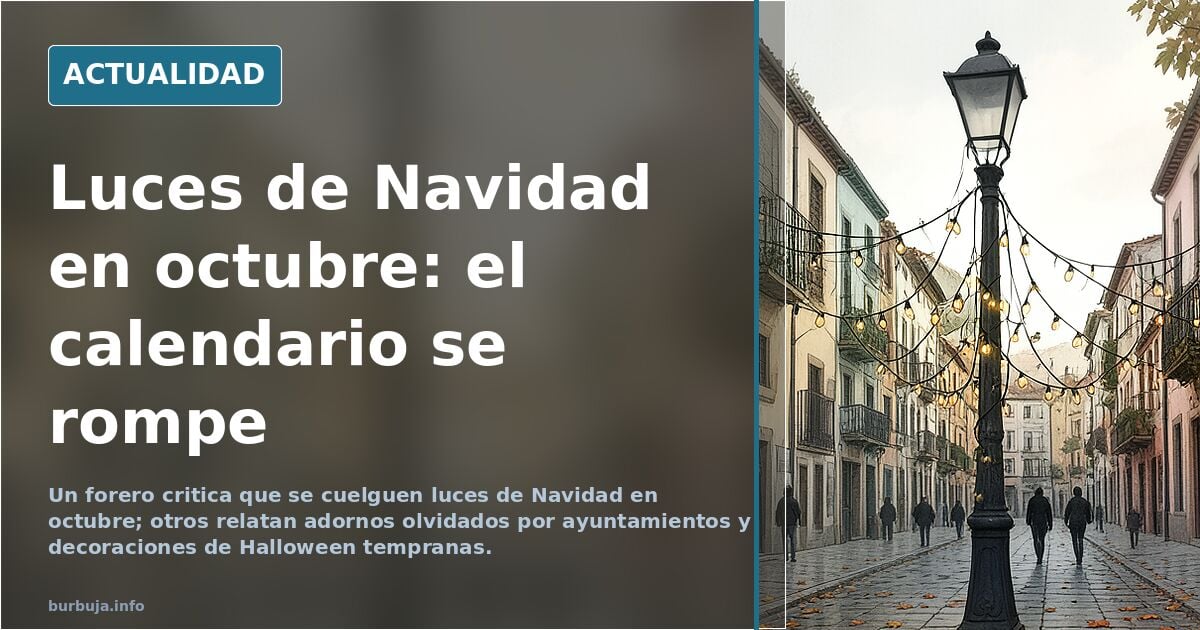
Christmas lights in October: when the calendar breaks down
In October, with the leaves still on the trees, some neighbors are already hanging Christmas lights. It's no exaggeration: in September, during a family visit, someone saw their parents' neighbor with the lights already up. The scene repeats itself in apartments where Christmas decorations stay up all year round, and some joke that they're disguised brothels. The phenomenon isn't new, but every year it seems to start a little earlier, and the inevitable question is: why?
The initial outrage in the post that started the thread was clear: "What the hell is wrong with these people? Don't they realize they're cheapening Christmas?" The comparison to celebrating your birthday four times a year illustrated the loss of meaning. But the truth is the practice has defenders and explanations that go beyond simple contempt.
The business of moving Christmas forward
Local councils are not immune to this trend. In Vigo, installing lights in October has become a strategy to attract tourism: in December the city center is buzzing. Madrid also places giant ornaments in roundabouts months in advance. The economic logic is undeniable: the earlier the season starts, the more time to spend. And it's not just about lights: some recommend starting to look for gifts in October, because deals are scarce and prices rise before Black Friday. The warning is clear: "grab a notebook and note down prices, because by Black Friday they come back having gone up first."
The early start isn't just about consumption. There's also a practical component: some leave the lights up all year to avoid the hassle of taking them down and putting them back up. The urban legend of apartments with permanent decorations blends with the reality of those who simply never find the time to take them down. In Sant Pol de Mar, a Christmas star placed atop a building is reportedly still there years later. And some, like a certain forum character, have worn a Santa hat for years: "It's always CHRISTMAS in my heart, and besides, it hides the fact that I'm BALD."
Halloween, the unexpected rival
The arrival of Halloween in Spain has changed the festive calendar. Where Christmas used to start in December, it now competes with a holiday that gains trinc every year. Some see the Christmas creep as a reaction: "Yeah, maybe they put up Christmas stuff early to counter Halloween. Good idea actually." The irony points out that commercial event saturation is such that dates overlap without shame.
But not everyone sees it as a strategy. For many, it's simply a lack of respect for tradition. The original complaint appealed to the loss of meaning: if it's celebrated for months, Christmas loses its special character. The birthday comparison is effective: if you celebrate it four times a year, it stops being unique. The question is whether the early start responds to real demand or a market imposition.
The cost of the whole display
Keeping lights up all year isn't free. Installation and electricity costs money, and not everyone is willing to foot the bill. Still, some argue the expense spreads out and the permanent look is worth it. The Santa hat anecdote is an example of how decoration blends into everyday life without anyone batting an eye. But most neighbors don't go that far: they hang the lights in October or November and take them down in January, more or less on time.
The underlying question is whether the early start responds to a real need or an imposed fad. Christmas spending data is increasingly concentrated in November, and ad campaigns start earlier. Social pressure plays a role too: if the neighbor has already put up the lights, why shouldn't you? The imitation effect amplifies the trend.
A nation of busybodies?
The expression "freaking country of segarro" from the original post reflects the frustration of those who see this practice as a sign of decline. But the truth is the phenomenon isn't exclusive to Spain: other countries also put up decorations earlier and earlier. The globalization of consumption has homogenized festive calendars, and Christmas has become a global event that starts earlier everywhere.
The forum's irony also points to the inconsistency of criticizing the early start while taking part in it. After all, many of those complaining end up putting up their own lights in November. The line between acceptable and excessive is blurry. Where's the limit? October, November, December? The answer depends on each person, but the debate is on.
In the end, Christmas in October is a symptom of a society that doesn't want to miss anything, that stretches out celebrations to squeeze every moment. Or maybe the calendar has just become so packed that dates collide. The only sure thing is that the lights will stay up, and someone, somewhere, will complain that it's not what it used to be.
Also available in: Deutsch
Summary of a discussion on Burbuja.info - Foro de economía, actualidad y política., translated from Spanish and reviewed before publication. Read the full discussion (19 replies).
More summaries
-
Begoña Gómez's family pays Muface just €850 a month for a Madrid penthouse
A 115-square-metre penthouse on San Bernardo street, next to Gran Vía in central Madrid, has been rented for €850 a month since 2023, far below the market price.
-
Bukele Halloween ban was a deepfake hoax, El Salvador confirms
A video claiming Bukele had banned Halloween was a deepfake: the voice did not match the mouth, and no trace of the measure exists in official sources.
-
The escort's second phone: chemistry or business?
A client pays for a date, gets the worker's personal number, and wonders if it's chemistry or business: the relationship cooled due to distance.
-
Galicia's foreign population nears 158,000 as region grows at twice Spain's rate
Galicia ends 2025 with 157,743 legal foreign residents, doubling Spain's average growth rate. Mass immigration sparks debate over pensions and identity.
-
Forum debate: pushing Spain's unborn figure to one hundred percent
A forum user claims the unborn rate has risen to 58% versus the nineties and calls for reaching 100%. The figure does not come from official sources.
-
Oil below $70: a blow to Russia, a windfall for Spain
Oil has fallen to $67. Russia loses revenue, Spain should gain, but petrol prices are not dropping. An analysis of the market's contradictions and the role of taxes.