
EU urges private pension supplements as public system strains
European Commissioner Albuquerque warns that relying solely on state pensions exposes retirees to financial vulnerability in old age.
English · Original discussion in Spanish · Published
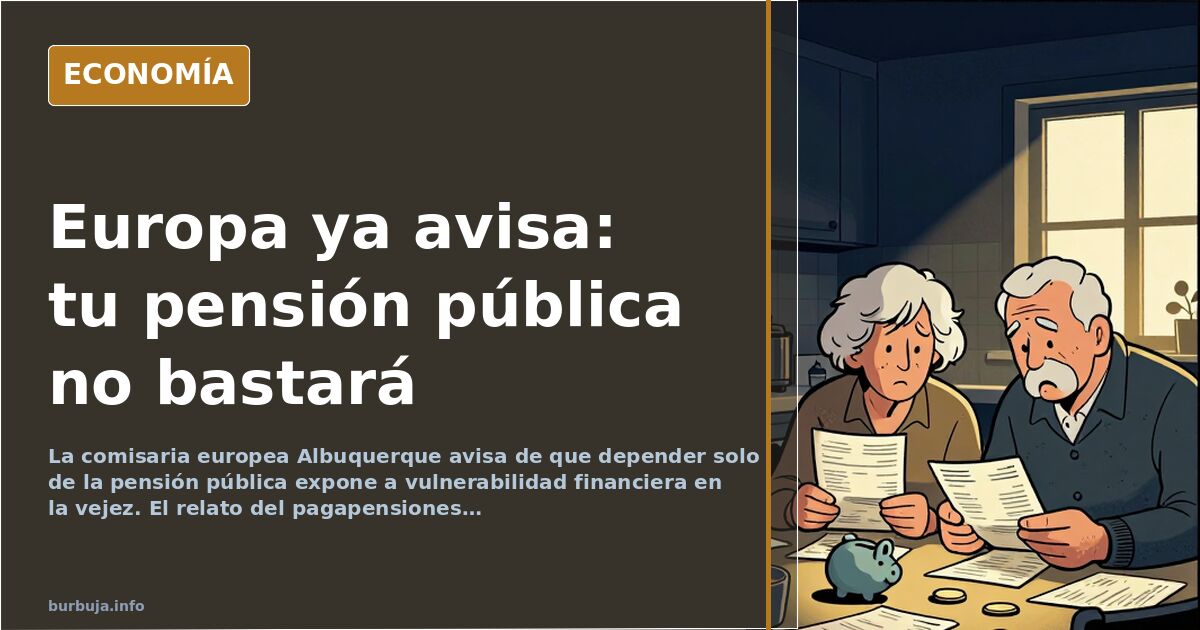
Europe pushes private plans as the pension narrative cracks
European Commissioner for Financial Services, Albuquerque, presented the EU's new plan for supplementary benefits and dropped a bombshell: relying only on public pensions "may expose individuals to financial vulnerability in old age." In plain terms: the system you have funded with your paycheck for decades won't be enough. She added that low uptake of private plans in Spain "increases the risk of income drops at retirement." Essentially, the solution offered is paying twice.
The echo of that mantra—millions of workers arriving to sustain pensions—now resonates differently. The uncomfortable conclusion gaining traction in economic analysis is this: if the system can no longer cope, why was so much labor imported?
Immigration as the supposed pension payer: origins of the narrative
For years, the official argument was mechanical: every worker entering the system contributes, and those contributions support retirees. Critics point out the equation never balanced. Paying pensions requires workers and wages, yet Spanish wages have stagnated for decades. A worker earning barely above minimum wage contributes little, and if their job is temporary, precarious, or part-time, the net contribution may turn negative when healthcare, education, and subsidies are factored in.
Some argue the true effect of mass labor influx was different: diluting economic growth and suppressing wages. With a more abundant labor market, native workers' bargaining power collapses. This is the wage dumping argument found in harsher analyses: immigration didn't come to pay pensions; it came to cheapen labor costs.
How much does a bike courier really add to GDP?
The debate over figures has an unexpected protagonist: home delivery. It is argued that much of the employment created in the last decade is extremely low-productivity. A messenger on a bike delivering a sandwich doesn't create wealth; it merely shifts consumption. Wealth creators are the wheat farmer, the baker, the slaughterhouse. Delivery, conversely, inflates GDP without adding real value.
This is the core of skepticism: measuring growth by transaction volume is misleading. If bread consumption rose from twenty million loaves daily to thirty, GDP increases, but per capita productivity may fall. Along with it, the capacity to sustain a pension system dependent on total payroll, not population count.
Private plans, the new mantra: who benefits from the narrative shift?
The European recommendation to buy private plans comes with fine print. Individual pension schemes are unguaranteed, carry fees that erode returns, and depend on markets beyond your control. Some compare their risk to cryptocurrencies, not entirely joking. The difference is banks sell crypto-like risks backed by Brussels.
The obvious beneficiary of this narrative change is the banking sector. If the official message shifts from "your pension is guaranteed" to "you must supplement it," the business of private pension funds multiplies. It isn't conspiracy; it's commercial arithmetic. The problem is the average Spanish saver has no margin to contribute after paying mortgage, food, and bills.
Aging and the pay-as-you-go trap
Spain uses a pay-as-you-go system: today's contributors fund today's pensions. It works while the contributor base grows faster than the retiree base. In Spain, the demographic pyramid has been inverted for decades. Birth rates are at rock bottom, life expectancy rises. The result is an equation that only balances with more contributors or lower pensions.
The path of more contributors was already tried. The path of lower pensions is one nobody wants to voice. The third way, now emerging from Brussels, is each person fending for themselves with a private plan. In short, socializing losses and privatizing solutions.
What if the system fails? The scenario nobody names
Pessimistic analyses consider a scenario once deemed science fiction: the system cannot pay promised pensions, leading to de facto adjustments via frozen or cut benefits. Paid-off housing becomes the last safety net. Those without it face dire circumstances.
The overarching question is simple yet uncomfortable: if the system can't afford pensions, wages don't rise, housing is unreachable, and available jobs are precarious, what exactly did we gain from this decade of population growth? For now, no one has the answer.
European Commissioner for Financial Services, Albuquerque, presented the EU's new plan for supplementary benefits and dropped a bombshell: relying only on public pensions "may expose individuals to financial vulnerability in old age." In plain terms: the system you have funded with your paycheck for decades won't be enough. She added that low uptake of private plans in Spain "increases the risk of income drops at retirement." Essentially, the solution offered is paying twice.
The echo of that mantra—millions of workers arriving to sustain pensions—now resonates differently. The uncomfortable conclusion gaining traction in economic analysis is this: if the system can no longer cope, why was so much labor imported?
Immigration as the supposed pension payer: origins of the narrative
For years, the official argument was mechanical: every worker entering the system contributes, and those contributions support retirees. Critics point out the equation never balanced. Paying pensions requires workers and wages, yet Spanish wages have stagnated for decades. A worker earning barely above minimum wage contributes little, and if their job is temporary, precarious, or part-time, the net contribution may turn negative when healthcare, education, and subsidies are factored in.
Some argue the true effect of mass labor influx was different: diluting economic growth and suppressing wages. With a more abundant labor market, native workers' bargaining power collapses. This is the wage dumping argument found in harsher analyses: immigration didn't come to pay pensions; it came to cheapen labor costs.
How much does a bike courier really add to GDP?
The debate over figures has an unexpected protagonist: home delivery. It is argued that much of the employment created in the last decade is extremely low-productivity. A messenger on a bike delivering a sandwich doesn't create wealth; it merely shifts consumption. Wealth creators are the wheat farmer, the baker, the slaughterhouse. Delivery, conversely, inflates GDP without adding real value.
This is the core of skepticism: measuring growth by transaction volume is misleading. If bread consumption rose from twenty million loaves daily to thirty, GDP increases, but per capita productivity may fall. Along with it, the capacity to sustain a pension system dependent on total payroll, not population count.
Private plans, the new mantra: who benefits from the narrative shift?
The European recommendation to buy private plans comes with fine print. Individual pension schemes are unguaranteed, carry fees that erode returns, and depend on markets beyond your control. Some compare their risk to cryptocurrencies, not entirely joking. The difference is banks sell crypto-like risks backed by Brussels.
The obvious beneficiary of this narrative change is the banking sector. If the official message shifts from "your pension is guaranteed" to "you must supplement it," the business of private pension funds multiplies. It isn't conspiracy; it's commercial arithmetic. The problem is the average Spanish saver has no margin to contribute after paying mortgage, food, and bills.
Aging and the pay-as-you-go trap
Spain uses a pay-as-you-go system: today's contributors fund today's pensions. It works while the contributor base grows faster than the retiree base. In Spain, the demographic pyramid has been inverted for decades. Birth rates are at rock bottom, life expectancy rises. The result is an equation that only balances with more contributors or lower pensions.
The path of more contributors was already tried. The path of lower pensions is one nobody wants to voice. The third way, now emerging from Brussels, is each person fending for themselves with a private plan. In short, socializing losses and privatizing solutions.
What if the system fails? The scenario nobody names
Pessimistic analyses consider a scenario once deemed science fiction: the system cannot pay promised pensions, leading to de facto adjustments via frozen or cut benefits. Paid-off housing becomes the last safety net. Those without it face dire circumstances.
The overarching question is simple yet uncomfortable: if the system can't afford pensions, wages don't rise, housing is unreachable, and available jobs are precarious, what exactly did we gain from this decade of population growth? For now, no one has the answer.
Also available in: Deutsch
Summary of a discussion on Burbuja.info - Foro de economía, actualidad y política., translated from Spanish and reviewed before publication. Read the full discussion (131 replies).
More summaries
-
EU OS: Europe tests a public Linux to phase out Microsoft
The EU has a draft, not a plan: EU OS, a Linux for European public administration. The cost, the Fedora origin, and the regional precedent are under review.
-
Cocaine, Private Jets, and the Tug-of-War Over Ceuta and Melilla
African Atlantic cocaine trafficking, documented by INTERPOL, supports an uncomfortable narrative: the route exists, and Europe's response is too late.
-
Forum Debate: Public Pensions Unsustainable, Private Plans Urged
A forum debate on Spanish pensions highlights calls for private plans, Elma Saiz's defense of the public system, and criticism of high taxes.
-
Young Man Fired for Mocking Puerta del Sol Protesters
A young man was fired after a viral video mocked Puerta del Sol protesters as lazy. The case sparks debate on fair dismissal and free speech in Spain.
-
Career Switch at 45: DAM, Robotics, and Age Bias in Spain
A 45-year-old admin studies DAM while Spain's tech sector rejects workers over 40, offering low-paid maintenance roles.
-
Spain's Public Healthcare: Who Fills the Waiting Rooms?
A viral story about a waiting room without Spaniards sparks debate on public healthcare usage, private insurance flight, and system collapse.