
Nazareth slasher was Spanish, not Algerian
Police in Nazaret searched for an Algerian suspect in a decapitation, but the accused turned out to be Spanish national Felipe. Jealousy is a motive hypothesis.
English · Original discussion in Spanish · Published
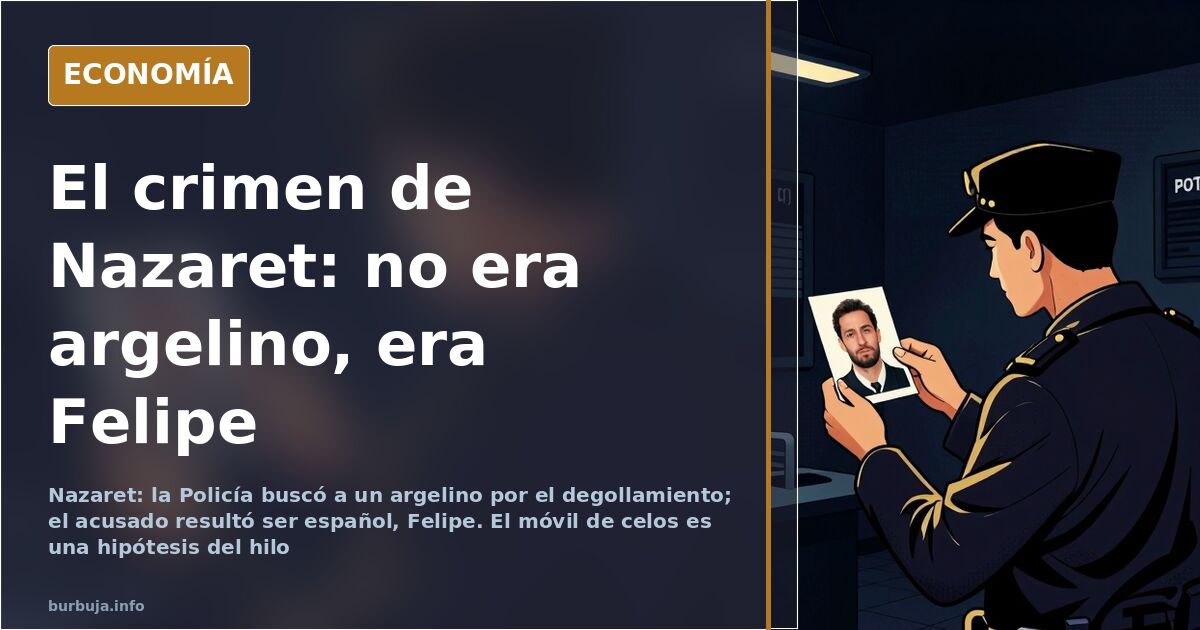
From 'wanted Algerian' to Felipe: Anatomy of a misreported crime
A 40-year-old Spanish man was decapitated with a bladed weapon around 9 p.m. on a Tuesday at the Nazaret bridge in Valencia. The National Police sought the perpetrator, with initial reports attributing Algerian origin. The suspect left his blood-stained shirt in front of Fomesa company, and police also pursued a second individual who accompanied him. The initial attribution did not survive the suspect's real name: Felipe, Spanish.
Who killed a man at the Nazaret bridge?
The crime occurred at the Puente de las Moreras in Nazaret, a pedestrian area that, according to a comment, should have cameras. The victim was a 40-year-old neighbor. The aggressor fled after leaving the bloodied shirt in front of Fomesa, and the National Police searched for a second man who accompanied the suspect and might be involved. The case closed with an identified author and a subsequent trial, whose verdict was collected by provincial press under the heading of the crime of the Puente de las Moreras: guilty of beheading his victim without giving him the "opportunity to react and defend himself."
The origin that circulated before the name
In this case, the suspect's nationality circulated before his name. The Algerian status was presented as a fact in initial reports and later did not match the accused's identity. When the identity was known, the correction came with less force than the initial headline. That's what happens with the first headline: it weighs forever.
The denial was forged on three fronts. MALDITA published that the suspect was Spanish by origin. ABC reported that a Vox official in Valencia had been reported for publicly stating he was Segarro. El Español first published a photograph of the accused already in the trial phase. Three media outlets, three sequences of the same correction. Those who read only the first day never read the second version.
The motive: jealousy, according to a comment
A participant pointed to a crime of jealousy, an extreme that the material does not allow confirming. This motive dismantles the reading that took hold in the early hours, which associated the beheading with an alleged immigration pattern. There was no such pattern: there was a Spanish man, a bladed weapon, and, according to that comment, jealousy. And yet the damage was already done: part of public discourse had turned the case into an argument about borders while the file spoke of a personal relationship.
---
Why did media coverage become the issue?
Here the case bifurcated. For some, the relevant point was the silence: the news was not on the front pages of major media with the intensity that, they claimed, it would have had if the aggressor were different. For others, the relevant point was precisely the opposite: the incident was inflated precisely to reinforce a thesis on security and immigration that the facts themselves did not support. Both currents feed on the same thing: the opacity in communicating a specific homicide. When the suspect's identity is slow to be published and origin is leaked before the name, all narratives fit.
The second front of grievance was quantitative. Recent beheadings and stabbings in the Levante area — Valencia, Carcaixent, Cuenca, Murcia, Alcoceber — were listed as proof of a trend that, according to that reading, was being silenced by the aggressor's profile. This is an argument based on perception, not a verified public record, and this specific case does not support it: the author was Spanish.
The hypothesis of normalization
Another current, more diffuse, did not dispute the origin of the crime but the echo it receives. It claimed that this type of episode has been normalized to the point of becoming routine news, and that something that would have occupied front pages years ago is now dispatched in two paragraphs. At the extreme of this reasoning, it was implied that there is a deliberate intention behind the treatment, something more than incompetence or negligence. This is an unproven suspicion: in the available material, there is no indication supporting it, only the impression of those who formulate it.
The point where everything gets stuck
A man was beheaded and another was found guilty of doing so without giving him a chance to defend himself. That is the solid fact. The rest — how much the suspect's origin weighed in coverage, why the correction did not have the reach of the error, whether there was deliberate concealment or simple clumsiness — has no closed answer. The motive pointed to by a comment is jealousy, not immigration, but the proper name that almost no one will associate with the crime is that of a Spanish man named Felipe. And there, exactly there, ends what the case allows to assert.
A 40-year-old Spanish man was decapitated with a bladed weapon around 9 p.m. on a Tuesday at the Nazaret bridge in Valencia. The National Police sought the perpetrator, with initial reports attributing Algerian origin. The suspect left his blood-stained shirt in front of Fomesa company, and police also pursued a second individual who accompanied him. The initial attribution did not survive the suspect's real name: Felipe, Spanish.
Who killed a man at the Nazaret bridge?
The crime occurred at the Puente de las Moreras in Nazaret, a pedestrian area that, according to a comment, should have cameras. The victim was a 40-year-old neighbor. The aggressor fled after leaving the bloodied shirt in front of Fomesa, and the National Police searched for a second man who accompanied the suspect and might be involved. The case closed with an identified author and a subsequent trial, whose verdict was collected by provincial press under the heading of the crime of the Puente de las Moreras: guilty of beheading his victim without giving him the "opportunity to react and defend himself."
The origin that circulated before the name
In this case, the suspect's nationality circulated before his name. The Algerian status was presented as a fact in initial reports and later did not match the accused's identity. When the identity was known, the correction came with less force than the initial headline. That's what happens with the first headline: it weighs forever.
The denial was forged on three fronts. MALDITA published that the suspect was Spanish by origin. ABC reported that a Vox official in Valencia had been reported for publicly stating he was Segarro. El Español first published a photograph of the accused already in the trial phase. Three media outlets, three sequences of the same correction. Those who read only the first day never read the second version.
The motive: jealousy, according to a comment
A participant pointed to a crime of jealousy, an extreme that the material does not allow confirming. This motive dismantles the reading that took hold in the early hours, which associated the beheading with an alleged immigration pattern. There was no such pattern: there was a Spanish man, a bladed weapon, and, according to that comment, jealousy. And yet the damage was already done: part of public discourse had turned the case into an argument about borders while the file spoke of a personal relationship.
---
Why did media coverage become the issue?
Here the case bifurcated. For some, the relevant point was the silence: the news was not on the front pages of major media with the intensity that, they claimed, it would have had if the aggressor were different. For others, the relevant point was precisely the opposite: the incident was inflated precisely to reinforce a thesis on security and immigration that the facts themselves did not support. Both currents feed on the same thing: the opacity in communicating a specific homicide. When the suspect's identity is slow to be published and origin is leaked before the name, all narratives fit.
The second front of grievance was quantitative. Recent beheadings and stabbings in the Levante area — Valencia, Carcaixent, Cuenca, Murcia, Alcoceber — were listed as proof of a trend that, according to that reading, was being silenced by the aggressor's profile. This is an argument based on perception, not a verified public record, and this specific case does not support it: the author was Spanish.
The hypothesis of normalization
Another current, more diffuse, did not dispute the origin of the crime but the echo it receives. It claimed that this type of episode has been normalized to the point of becoming routine news, and that something that would have occupied front pages years ago is now dispatched in two paragraphs. At the extreme of this reasoning, it was implied that there is a deliberate intention behind the treatment, something more than incompetence or negligence. This is an unproven suspicion: in the available material, there is no indication supporting it, only the impression of those who formulate it.
The point where everything gets stuck
A man was beheaded and another was found guilty of doing so without giving him a chance to defend himself. That is the solid fact. The rest — how much the suspect's origin weighed in coverage, why the correction did not have the reach of the error, whether there was deliberate concealment or simple clumsiness — has no closed answer. The motive pointed to by a comment is jealousy, not immigration, but the proper name that almost no one will associate with the crime is that of a Spanish man named Felipe. And there, exactly there, ends what the case allows to assert.
Summary of a discussion on Burbuja.info - Foro de economía, actualidad y política., translated from Spanish and reviewed before publication. Read the full discussion (238 replies).
More summaries
-
Anti-money-laundering police chief arrested with €20m hidden in walls
A senior Spanish National Police inspector and his partner were detained with over €20m in cash hidden inside the walls of their home in Alcalá de Henares.
-
Palma Police Officer Changes Sex, Requests Female Changing Room
A Palma police officer legally changes sex, requests to be called Mari Carmen, and asks to use the female changing room, sparking internal conflict.
-
Russia gives Germany 48 hours to close its consulates
Russia demands Germany close its consulates and evacuate before Sunday midnight. Previous closures in Bonn, the 2022 precedent, and the fine print of...
-
Zapatero Case: Judicial Ruling Reveals Key Role in Plus Ultra Probe
A 200-page judicial order implicates Zapatero in a Plus Ultra funding scheme. Evidence of corruption, irregular financing, and 53 million euros.
-
Christmas Sales Drop: The Hidden Economic Reality
Up to 40% revenue drop during Christmas. We analyze how inflation forces Spanish consumers to cut festive spending.
-
Spain's Minimum Wage Gap with Modal Salary Shrinks to 3% in 2023
The gap between Spain's minimum wage and the most common salary drops from 39.3% in 2018 to 2.97% in 2023.