
Natural sunscreen for the face: what to avoid and which brands come up
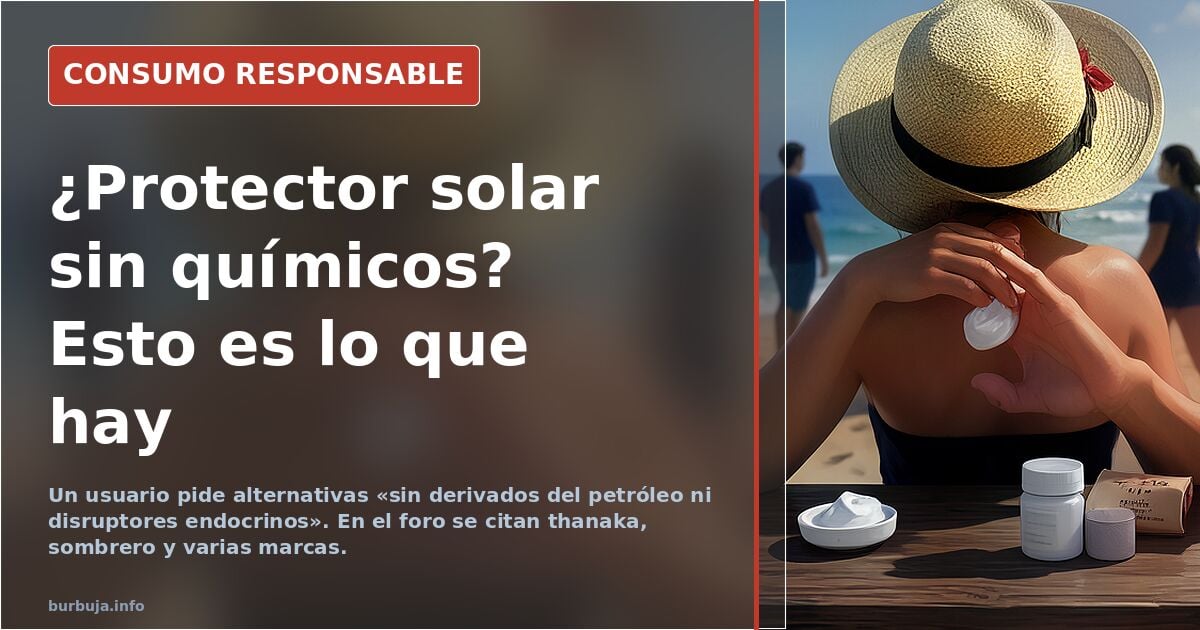
A user asks for alternatives 'without petroleum derivatives or endocrine disruptors'. Forum members mention thanaka, a hat and several brands.
English · Original discussion in Spanish · Published
Natural sunscreen for the face: real options and their limits
Finding a facial sunscreen that contains no petroleum derivatives or endocrine disruptors has become a bit of an odyssey. One user claims that the ingredient list of conventional creams, even those from supermarket brands, can run to more than twenty lines. The search for 'natural' alternatives runs into a market where the offer is limited and, at times, impractical.
Which ingredients to avoid in a sunscreen
The thread mentions that conventional UV filters are under suspicion for their possible endocrine-disrupting effect. The problem is that the alternatives usually leave a white cast on the skin and have a denser texture.
Natural alternatives: thanaka, a hat and organic brands
Among the suggestions put forward, one participant mentions thanaka, a traditional product from Myanmar. According to this user, it comes from the wood of a tree, is grated and mixed with liquid to be applied to the skin. He adds that it can be found on Amazon, but that it is messy and impractical for everyday use. Another option suggested is a hat, although another user replies that it does not protect against the wind and the skin can dry out. As for brands, Madara, Amapola Bio, Cancelar (a natural cosmetics company from Teruel, according to one participant) and the Leche line from the French laboratories LeCipot, rich in nutrients, are mentioned.
The difficulty of finding natural sunscreens on the market
The range of sunscreens that meet strict naturalness criteria is small. Many organic brands use mineral filters, but their availability in physical stores is limited and their price is usually higher than that of conventional creams. Moreover, the effectiveness and feel of these products do not always live up to expectations. The search for a natural facial sunscreen remains a challenge for those who prioritise health and the environment.
The discussion about natural sunscreens reflects a growing concern about the ingredients we apply to our skin. However, the lack of practical and accessible options keeps this niche in limbo. While science continues to study the effects of chemical filters, consumers are torn between conventional sun protection and natural alternatives, often with more uncertainty than certainty.
Summary of a discussion on Burbuja.info - Foro de economía, actualidad y política., translated from Spanish and reviewed before publication. Read the full discussion (33 replies).
More summaries
-
Dense Clothing Outperforms Sunscreen in UV Protection Study
A popular forum thread argues that tightly woven, dark clothing offers superior UPF protection compared to SPF creams, which degrade with sweat and are often under-applied.
-
Lidl launches 2.24 kWh home battery for €299
Lidl sells a 2.24 kWh solar battery for €299. We analyze its profitability for self-consumption, savings potential, and drawbacks.
-
DGT Vehicle Report Scam: Charging €24 for an €8 Service
A sponsored website charges €24 for a DGT report that costs €8. The scheme uses Carmen Mariscal's name as the applicant.
-
Private healthcare in Spain: health insurance prices up 67%
Health insurance prices in Spain have soared 67% since the pandemic. We look at the causes, the double bill paid by policyholders and what lies ahead.
-
Which AI is best: free for everyday use, paid for coding
Manually entering a thousand records used to take two and a half hours; AI does it in five minutes. No single model wins at everything: the right choice depends on how you use it.
-
Booking or the hotel's own website: when booking costs more
Booking's commission to hotels runs from 15% to 25%. Chains usually match the price; for independent hotels, it all depends on the contract.