
Natural chelators: the detox trend slipping into everyday routines
Garlic, cilantro, chlorella and NAC: a detox protocol spreading without clinical backing. What the evidence says and what health authorities warn.
English · Original discussion in Spanish · Published
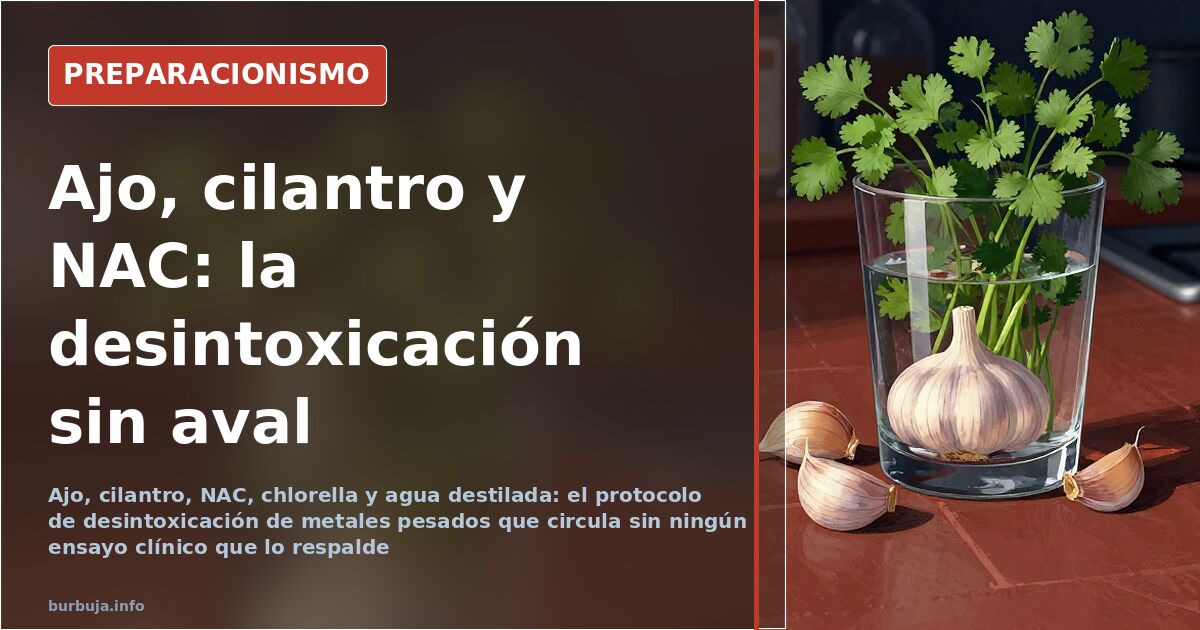
Natural chelators: the cleansing ritual that never goes near a doctor
There is a school of thought claiming that heavy metal pollution is inevitable and that the only way out is to cleanse the body with garlic, cilantro, chlorella and N-acetyl cysteine. The thesis, laid out in detail in a prepping forum thread, is that garlic and cilantro trap mercury, lead, aluminium and cadmium ions through opposite charges but do not flush them out: for that you need chelators that drag the package out of the body. The proposed protocol is specific: raw garlic on an empty stomach, with the central core removed so it does not cause harm, and half an hour later NAC with chlorella. The conversation drifts towards distilled water, radishes and diatomaceous earth, leaving a map of enthusiasm, doubts and warnings best read with a calculator and a healthy dose of common sense at hand.
What goes into the detox menu
The message that opens the discussion pulls no punches: garlic and cilantro as traps, chlorella for the gut and NAC for a full cleanse. Modified citrus pectin (MCP) appears as a systemic chelator, with the particularity that it is absorbed and acts on galectin-3, which links it to the inhibition of metastasis in prostate, breast and colon cancer and melanoma. Clinoptilolite, a micronised natural zeolite, swaps beneficial ions for heavy metals, ammonia and mycotoxins in the gastrointestinal tract. Diatomaceous earth, rich in amorphous silicon, is sold as a detoxifier and antiparasitic, although the European Union advises against oral consumption due to a lack of guarantees. And spirulina closes the list with chlorophyll and phycocyanin as chelators of mercury, lead and arsenic.
The enthusiasm comes with nuances. One participant with fifteen years of routine —garlic on an empty stomach and distilled water with lemon and salt— talks about it the way people boast about a diet that works for them. Another points out that distilled water flushes out all inorganic minerals and that, without unrefined sea salt, it may clean too much. The question of whether distilled water depletes the body hovers over the conversation without ever being fully settled.
Radishes, pesticides and the sulphur question
The debate gets tangled in practical details. Crushed radishes on an empty stomach come up as an alternative, with glucosinolates and sulphur compounds that stimulate bile. The question is direct: if you eat raw garlic every day, do you need radishes? And the answer given is that garlic has more sulphur. The other doubt, about pesticides, is settled with an "both have very few". Nobody provides a study, but the exchange makes clear that the conversation is about substituting one for the other, not adding them together.
NAC: from cough syrup to glutathione
N-acetyl cysteine causes confusion. One participant asks what it is, and the answer is that it is a mucolytic and antioxidant compound, the one found in Fluimucil and cough syrups, with functional action on the excretory system. The explanation is rounded off with the synergy: it is a precursor of glutathione and should be taken with glycine, because both are needed to produce it. It is sold directly combined as Gly+NAC. The conversation never gets into doses or contraindications, and that is where the matter rests.
What to combine, and with what caution
The final question is the most sensible one: which combinations make sense for someone who wants to do this preventively. The answer never quite arrives. What does appear are the warnings: diatomaceous earth must not be inhaled because of the risk of silicosis, it is not recommended during pregnancy or breastfeeding, and the usual dose is a maximum of 3 grams daily with a one-month break after six months of use. MCP and clinoptilolite are presented as safe and recognised by the FDA and the WHO, but claims about their effectiveness against cancer, it is admitted, require more research in humans. The analysis ends right there: with a homemade protocol spreading while nobody has measured whether the metals actually leave the body.
Also available in: Deutsch
Summary of a discussion on Burbuja.info - Foro de economía, actualidad y política., translated from Spanish and reviewed before publication. Read the full discussion (31 replies).
More summaries
-
Prepper garden: hugelkultur beds with 50 cm of soil
A forum user proposes five 6x1 metre beds for two people using the hugelkultur method, which combines no dig, layers of organic matter and raised soil.
-
Self-sufficiency for five people requires 5 to 10 hectares
Feeding five people without a supermarket needs 5-10 hectares. Land size is less challenging than the labor and climate constraints.
-
Paiporta Flood Shows Prepper Kits Fail Without Community
The Paiporta flood exposed the limits of prepper kits, showing that without a neighborhood network or weapons, defense is impossible.
-
Utopia 2013: Where to Download the British Series on P2P
The British series Utopia (2013), with two subtitled seasons, is still available on eMule, torrent and direct download
-
Prepping's two biggest mistakes: generic plans and no practice
Prepping fails for two main reasons: plans that don't fit each person's actual situation and a lack of real practice. An analysis of the mistakes that turn preparedness into…
-
Claude builds a risk model with no equations
A prepper builds an energy risk dashboard using Claude. Critics push back: without equations it isn't a model. Where's the line?