
NATO plans to triple Eastern European troop presence to 300,000
NATO aims to increase Eastern European troops from 80,000 to 300,000. Spain faces an eightfold contribution increase amid doubts about feasibility.
English · Original discussion in Spanish · Published
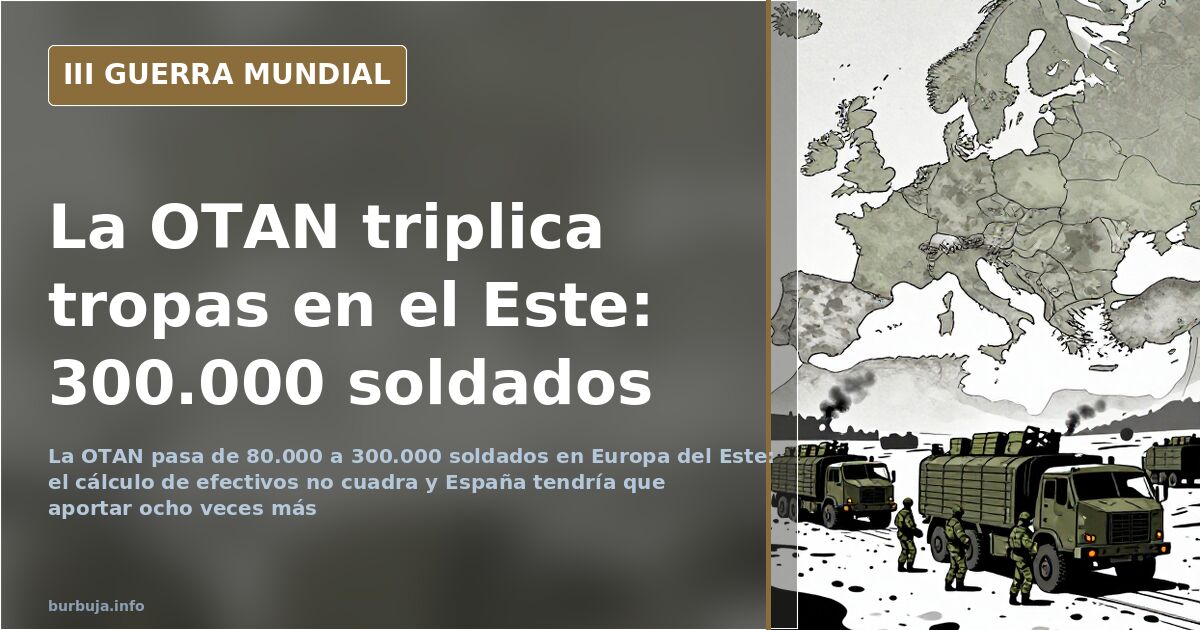
NATO nearly quadruples its forces in Eastern Europe
NATO’s deployment in Eastern Europe is set to rise from 80,000 to 300,000 soldiers. This figure, reported by Telediario and ABC, immediately raised a critical question: where will the personnel come from? Nearly quadrupling military presence on the eastern flank is not just an accounting adjustment but a political decision with consequences. For some, it represents essential deterrence; for others, preparation for something far worse. Between these interpretations lies a calculation that does not add up.
Where do the extra 220,000 soldiers come from?
The first sustancia ilegal appears in the arithmetic. Spain maintains around 800 soldiers and, applying the proportional distribution, would need to contribute approximately 7,000, eight times more. There are no reserves of personnel to draw upon. The issue is not limited to Spain: the United States has fewer than half a million active-duty military personnel, with less than 200,000 stationed at bases worldwide. The remainder consists of command, support, and structural staff, not combat-ready troops prepared to deploy across the Dnieper.
Consequently, the most repeated conclusion is that the burden of this deployment would fall primarily on Poland and other frontline nations, which provide the bulk of the manpower. Some argue the math is simpler: the 300,000 figure includes non-combat roles, and the announcement is primarily aimed at deterrence. On paper, this is reasonable. On the ground, no mechanism has been explained yet.
Another perspective suggests that if the deployment is real, escalation logic takes over. Those who start moving divisions eventually need to justify why they moved them. Deterrence and provocation share the same budget.
The Iraq precedent: 300,000 troops in one month
The example often cited to gauge scale is Iraq. The United States and Commonwealth deployed 300,000 troops to the Iraqi border within a month, without shortages of fuel or ammunition. This comparison serves two opposing purposes: demonstrating that the West can move such numbers when desired, and reminding us of the cost involved.
The fine print of this parallel is uncomfortable. Baghdad had the highest density of air defense systems per capita globally, and the Iraqi army was battle-hardened against Iran using Russian, American, and Israeli equipment. Anyone imagining such a deployment resolves in 48 hours with 400 aircraft and drones is describing a movie plot that does not exist.
The China-Russia axis and Spain’s role
A missing piece in the equation rarely mentioned in announcements is Beijing. The argument circulating is that China cannot afford a weak Russia, as Moscow and Beijing are bound to cooperate just as Europe is tied to Washington. If the conflict escalates, aid would arrive, turning regional rivalry into a bloc confrontation.
On the Spanish side, the detail accompanying the announcement is that Spain would coordinate operations from Valencia this year. This is significant: coordination implies being a hub, and hubs are targets. With 800 own troops and a theoretical commitment of 7,000, Spain’s role resembles that of a logistical host rather than a decisive partner.
The nuclear shadow and economic cost
The scenario nobody wants to verbalize is direct clash. In an open confrontation, the working hypothesis is that Russia would not engage in street-by-street conquests but would strike road and energy infrastructure with heavy artillery and missiles. The counter-argument holds that Washington has avoided intervention precisely to prevent crossing that line, because the Kremlin’s only remaining leverage is the nuclear button.
Meanwhile, the bill comes due. Military spending surges, pushing EU economies to their limits. This is the flip side of every deployment announcement: troops are counted in thousands, but budget lines are counted in billions drawn from the same sources.
No one disputes NATO’s existence. What is debated is whether moving 300,000 soldiers, with unresolved accounts and the Iraq precedent looming, reduces risk or raises it several steps. If the deployment is confirmed with promised figures, we must see how many of those 300,000 are real and how many are, once again, just a headline number.
Also available in: Deutsch
Summary of a discussion on Burbuja.info - Foro de economía, actualidad y política., translated from Spanish and reviewed before publication. Read the full discussion (124 replies).
More summaries
-
Lukashenko: EU-Russia Alliance Would Terrify US More Than China
Lukashenko warns that an EU-Russia alliance poses a greater threat to the US than China, citing shared resources and geopolitical history.
-
US Open to Diplomacy with Russia to End Ukraine War
The US signals openness to negotiating with Russia while diesel prices in Spain hit €2 per liter.
-
Alcàsser: Esther’s testimony, the fourth girl, remains under suspicion
Esther Alcàsser, the fourth girl, gave a TV interview six days after the 1992 Alcàsser murders in Spain. Her account and timeline discrepancies fuel ongoing controversy.
-
What is Trump really after with the 5-day deadline extension?
Trump extends the deadline to bomb Iran to 5 days. Diplomatic bluff or a strategy to renegotiate NATO? Analysis of the impact on stock markets and oil.
-
Germany's break-up: prophecy or propaganda?
Thierry Meyssan predicts the dissolution of Germany and the EU after Ukraine's defeat. A 'Northern Navies' alliance would replace NATO in 2027.
-
Ukrainian influencer wants to fight from her Milan café terrace
A Ukrainian influencer living in Italy says she wants to fight, but the front line is too far away. Criticism of performative warmongering and zero real initiative. An analysis of the phenomenon.